Lower back injuries are a common reason for emergency room visits, urgent care evaluations, and outpatient assessments. Whether caused by falls, sports incidents, workplace strain, or motor vehicle accidents, lower back trauma often requires clinical documentation even when the exact injury type is not immediately confirmed. In these situations, ICD-10 coding provides a standardized way to record the encounter.
One code that appears frequently in medical records is S39.92XA. Healthsure Hub helps you understand the correct meaning and documentation use of ICD-10 code S39.92XA and why it is important for clean claims submission, accurate injury reporting, and consistent clinical recordkeeping.
What Is ICD-10 Code S39.92XA?
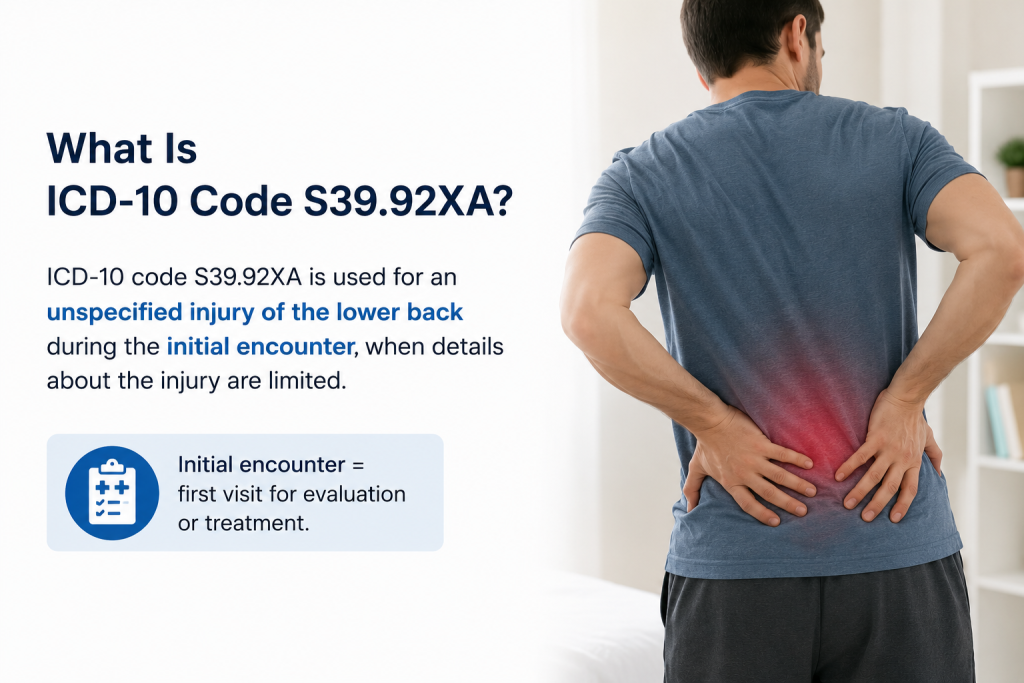
ICD-10 code S39.92XA is defined as unspecified injury of lower back, initial encounter. This code is used when a provider documents an injury affecting the lower back, but the specific nature of the injury (such as strain, sprain, contusion, or fracture) is not clearly identified in the medical record.
The code also includes the encounter extension “A,” which indicates the visit is the initial encounter where active evaluation or treatment is being provided. In short, this ICD represents an initial medical visit for a lower back injury when details are limited or unspecified.
Breaking Down the Code Structure
The ICD-10 system is built to include location, injury type, and encounter phase. The code S39.92XA includes multiple elements that provide this structure:
- S indicates injury, poisoning, and certain other consequences of external causes
- 39 refers to injuries of the abdomen, lower back, pelvis, and external genitals
- .92 specifies an unspecified injury of the lower back
- X is a placeholder character to maintain correct formatting
- A indicates initial encounter
Because the 7th character is required for injury codes, the “X” placeholder must remain in place. This is why documentation often shows ICD S39.92XA exactly in this format.
What “Unspecified Injury of Lower Back” Means
The term “unspecified injury” does not mean the injury is unimportant. Instead, it reflects that the documentation does not clearly identify the type of injury. The provider may note lower back trauma, pain after an accident, or tenderness on examination, but without confirming a more specific diagnosis.
This ICD code may be used when the record includes descriptions such as:
- “Lower back injury”
- “Back trauma after fall”
- “Injury to lumbar region”
- “Back pain after accident” without further detail
In many real-world clinical settings, this level of documentation occurs during early evaluation before imaging or follow-up assessment is complete.
When the “Initial Encounter” Extension Applies
The final character “A” in ICD-10 S39.92XA indicates the initial encounter. In ICD-10, injury codes require encounter extensions that describe the stage of treatment. The “initial encounter” extension is used when the patient is receiving active treatment, which may include:
- Emergency department evaluation
- Urgent care assessment
- Diagnostic imaging
- Initial stabilization and treatment planning
- First orthopedic or primary care evaluation after injury
Later visits related to the same injury would require different extensions, such as “D” for subsequent encounters or “S” for sequela.
Common Scenarios Where ICD-10 Code S39.92XA Is Used
This ICD-10 code is commonly applied in cases where a patient presents with lower back trauma but no specific diagnosis is established immediately. Common situations include:
- A fall causing back impact or pain
- Motor vehicle accidents with lumbar discomfort
- Car collisions involving a driver or passenger
- Workplace incidents involving lifting injuries
- Sports collisions affecting the lower back
- Minor blunt trauma with localized tenderness
These encounters often involve documentation of pain, limited mobility, and possible injury, even if imaging results are pending or no clear injury classification is identified.
Relationship to Other Lower Back Injury Codes
Lower back injuries can fall under several ICD-10 categories depending on how clearly the clinical findings are documented. ICD-10 code S39.92XA is often used when an injury is confirmed in the lower back region, but the record does not specify whether the condition is a strain, contusion, or fracture. If later documentation provides more detail, the coding may shift toward a more specific diagnosis.
In lower back trauma documentation, this code is frequently seen alongside related entries such as S30.0XXA for contusion of the lower back and pelvis, as well as broader symptom-based codes like M54.50 for lower back pain, depending on what the provider documents during the encounter.
Why Accurate Coding Matters
Correctly applying ICD S39.92XA supports accurate documentation and helps ensure consistency in medical billing and reduce denials rates. Because this is an unspecified injury code, it may be more closely reviewed in certain billing contexts if an insurance payer expects more detail.
Accurate use of ICD code S39.92XA is important for several reasons. It improves medical record clarity, strengthens claim accuracy, and ensures that injury encounters are tracked consistently across healthcare systems. It also supports public health reporting and injury surveillance data, especially in settings where workplace injuries and trauma-related visits are analyzed.
Documentation Requirements for ICD Code S39.92XA
To support the appropriate use of S39.92XA ICD, documentation should clearly show that an injury occurred and that the lower back region was involved. The record should ideally include the injury mechanism and clinical findings observed during the initial evaluation. Common documentation elements that support this ICD-10 code include:
- Patient history describing trauma or injury event
- Provider assessment noting lower back injury or lumbar region involvement
- Physical exam findings such as tenderness, swelling, bruising, or reduced range of motion
- Confirmation that the encounter is the initial evaluation
Even though the code is unspecified, the record should still clearly justify why an injury-related ICD code is being used.
Common Documentation Gaps and Coding Errors
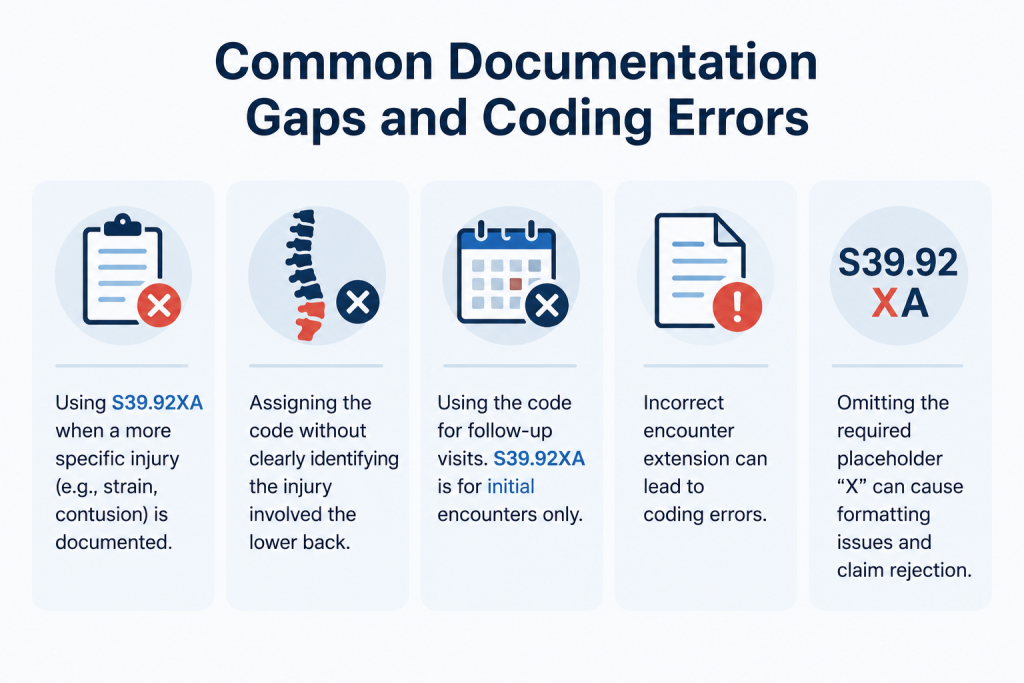
Coding issues with ICD-10 S39.92XA often occur when documentation is vague or incomplete. One common medical billing error is using this code when a more specific injury has actually been documented, such as a strain or contusion. Another issue is assigning the code without clearly identifying that the injury involved the lower back rather than a different spinal region.
Errors may also occur when the encounter extension is incorrect. Since ICD-10 code S39.92XA is an initial encounter code, it should not be used for follow-up visits unless the patient is still receiving active treatment under ICD-10 guidelines.
Because placeholder characters are required, leaving out the “X” can also lead to formatting problems and claim rejection.
Conclusion
ICD-10 code S39.92XA is used to document an unspecified injury of the lower back during the initial encounter. It plays an important role in situations where a patient presents with trauma-related lower back symptoms but the clinical documentation does not identify a more specific injury type.
Understanding how S39.92XA ICD-10 is structured and applied helps coders, billers, and healthcare organizations maintain accurate records, improve claim management, and support standardized injury reporting. With thorough documentation and correct encounter selection, this code can be used appropriately in a wide range of real-world clinical scenarios.
About the Author