Knee injuries are among the most frequently documented musculoskeletal conditions in clinical practice, making accurate diagnosis coding essential for both patient care and reimbursement. ICD-10 S83.90XA is used when a patient presents with a knee sprain that has not yet been fully characterized during the initial phase of treatment. Understanding when and how to apply this code correctly is critical for clinicians, medical coders, and billing professionals.
Our team provides a detailed, code-specific explanation of S83.90XA, including its clinical meaning, documentation requirements, and billing implications.
What Does ICD-10-CM Code S83.90XA Represent?
S83.90XA falls under the ICD-10-CM category S83- Dislocation and sprain of joints and ligaments of the knee. This code specifically describes an unspecified sprain of an unspecified knee during the initial encounter.
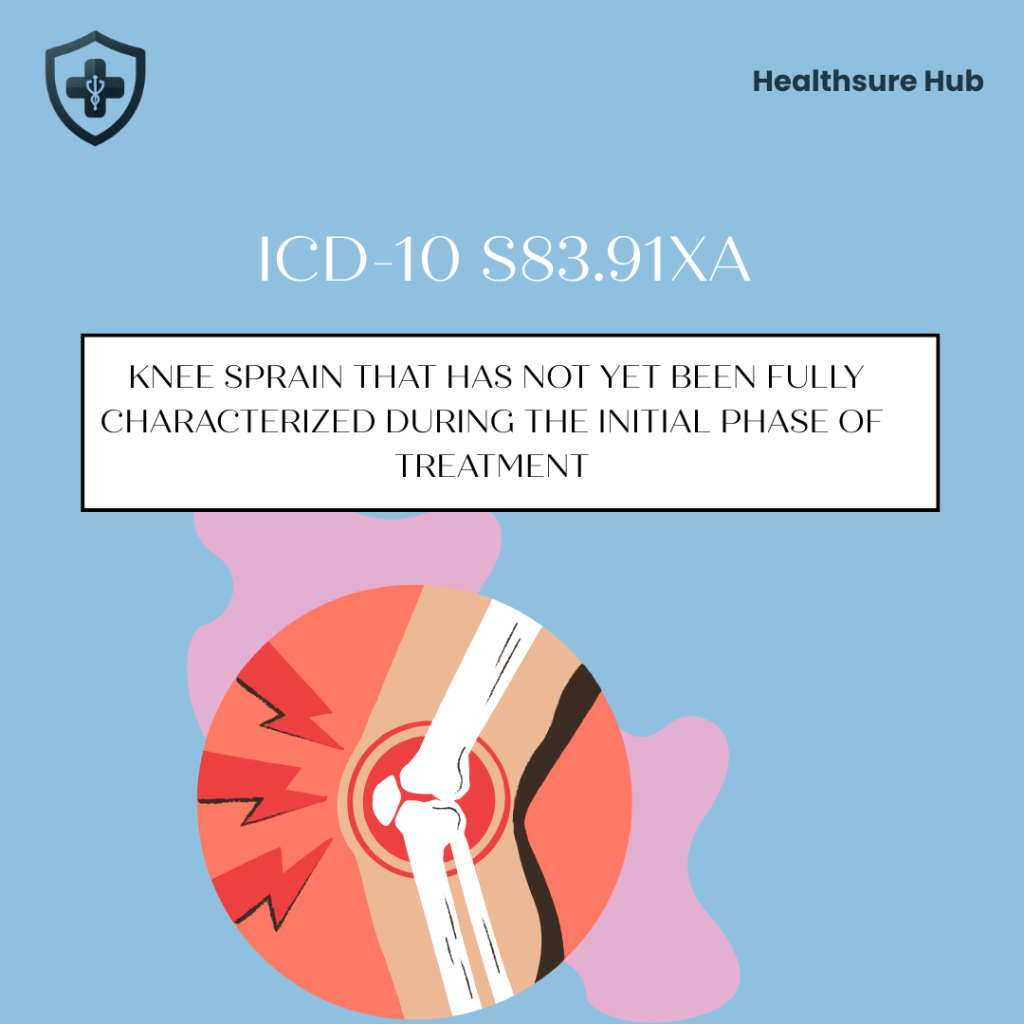
Each component of the code carries meaning:
- S83 identifies injuries involving the knee joint and its supporting ligaments
- .90 indicates that the specific ligament involved is not identified
- X functions as a placeholder to maintain the correct code structure
- A designates the initial encounter, meaning the patient is receiving active treatment
This code is commonly used when clinical findings support a knee sprain, but additional detail, such as the exact ligament or laterality, is not yet documented.
Clinical Definition of an Unspecified Knee Sprain
A knee sprain occurs when one or more ligaments supporting the knee joint are stretched or torn due to trauma or sudden stress. In the case of S83.90XA, the sprain is classified as “unspecified,” meaning the treating provider has not identified the precise ligament involved at the time of diagnosis.
This often occurs early in the evaluation process, particularly when swelling, pain, or limited mobility prevents a complete physical assessment. Imaging studies may not yet be performed or may be pending. As a result, the diagnosis remains nonspecific during the initial encounter.
When more information becomes available, S83.90XA can be updated to a more specific code: S83.91XA for an unspecified sprain of the right knee, or S83.92XA for an unspecified sprain of the left knee. These codes provide precise laterality, which improves coding accuracy and supports proper documentation for subsequent encounters.
Knee Sprain Statistics
Knee injuries are a common reason for emergency department visits in the United States. Between 1999 and 2008, an estimated 6.66 million knee injuries were reported, equating to a rate of 2.29 injuries per 1,000 people.
The highest incidence occurred among individuals aged 15 to 24 years, with a rate of 3.83, while children under five experienced the lowest rate at 0.55 per 1,000. Strains and sprains were the most frequently diagnosed injuries, accounting for 42.1% of cases, followed by contusions and abrasions (27.1%) and lacerations or punctures (10.5%).
Notably, males were more likely to sustain basketball-related injuries than females, while adults 65 years and older experienced a higher proportion of falls from stairs or ramps compared to younger populations. These trends highlight the need for targeted prevention and careful clinical documentation. When patients present with a knee sprain that has not yet been fully evaluated or specified, clinicians and coders use S83.90XA to document the injury.
Common Causes of Knee Sprains Coded as S83.90XA
Knee sprains associated with S83.90XA typically result from acute injury mechanisms. Common causes include:
- Sports-related injuries involving twisting or pivoting motions
- Falls that place sudden stress on the knee joint
- Workplace accidents involving uneven surfaces or heavy lifting
- Motor vehicle collisions causing blunt trauma to the knee
While sport-related injuries remain the leading cause of knee sprains, many knee injuries also occur at home, often from being struck by objects or bumping into furniture (13.6%). These incidents can happen with or without direct contact and usually present suddenly, prompting immediate medical evaluation. In ICD-10 coding, the knee sprain itself would be classified as an unspecified sprain of knee, initial encounter, while the cause of the injury, such as being struck by a household object, can be captured with an external cause code such as W22.8XXA. Using both codes together provides a more complete picture of the injury and its mechanism.
Understanding the Initial Encounter Designation
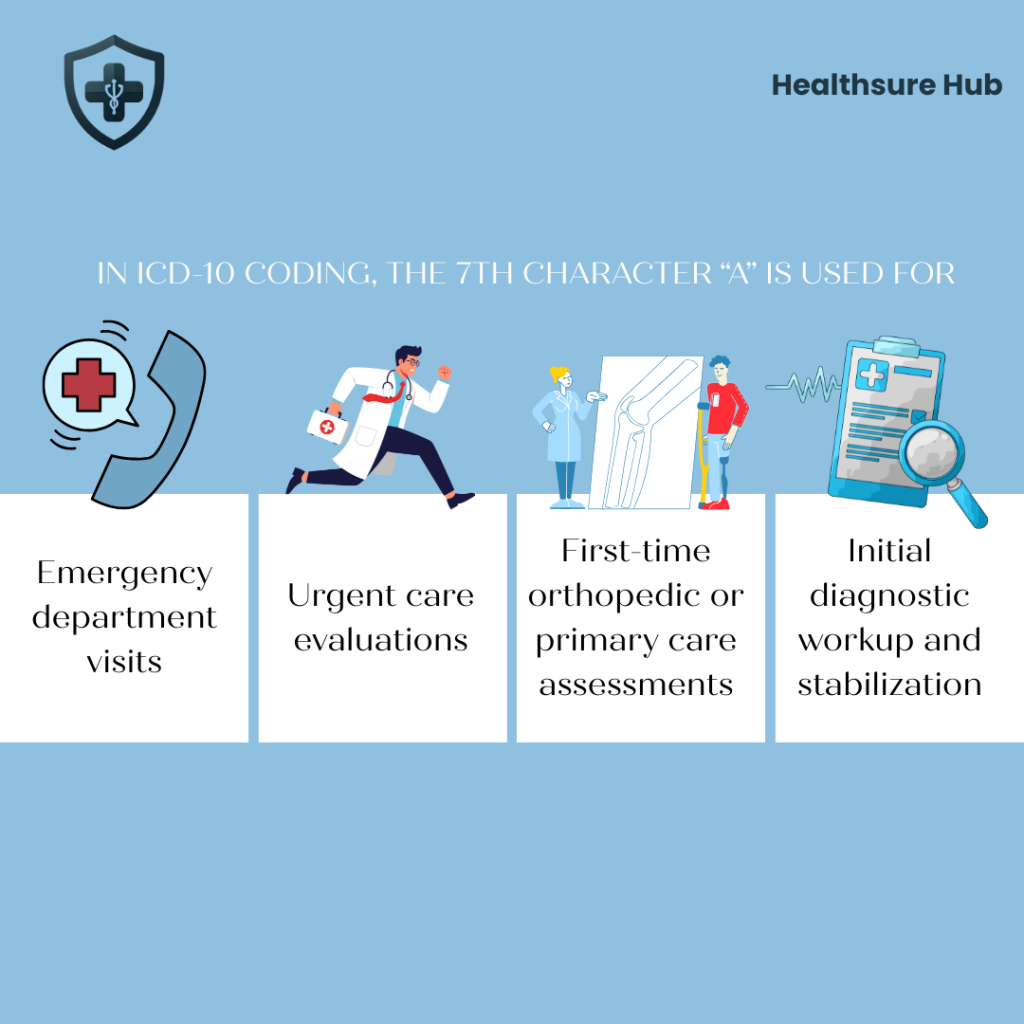
In ICD-10-CM coding, the 7th character “A” is used to indicate an initial encounter, which refers to the period when the patient is receiving active treatment for the injury. This includes:
- Emergency department visits
- Urgent care evaluations
- First-time orthopedic or primary care assessments
- Initial diagnostic workup and stabilization
The initial encounter designation does not refer to the first visit only, but rather to the entire phase of active treatment. Once active treatment concludes, subsequent encounters must be coded differently.
Signs and Symptoms Supporting This Diagnosis
Patients diagnosed with an unspecified knee sprain commonly report:
- Localized knee pain or tenderness
- Swelling or joint effusion
- Stiffness and reduced range of motion
- Difficulty bearing weight
- A sensation of instability or weakness
Because these symptoms overlap among various ligament injuries, they may not immediately point to a specific ligament, supporting the use of an unspecified code during the initial encounter.
Diagnostic Evaluation and Clinical Assessment
The evaluation of a suspected knee sprain typically begins with a physical examination, including inspection, palpation, and range-of-motion testing. However, pain and swelling may limit the accuracy of ligament stress tests early on.
Imaging studies may be ordered to support the diagnosis:
- X-rays are often used to rule out fractures
- MRI may be considered if symptoms persist or worsen
Until diagnostic findings confirm the specific ligament involved, the diagnosis may appropriately remain unspecified.
Coding and Documentation Considerations
Accurate use of S83.90XA depends heavily on clinical documentation. This code should be used only when the medical record does not identify:
- The specific ligament involved
- The side of the body (left or right knee)
If later documentation provides more detail, coders should update the diagnosis to a more specific ICD-10-CM code in subsequent encounters. In an analysis among high school athletes we noticed that MCL injuries are the most common knee injuries (36.1%) followed by ACL injuries (25.4%). These are more specific knee injuries affecting the ligament and require a different ICD-10 code for sprain of the medial collateral ligament, or anterior cruciate ligament, respectively. Overuse of using the unspecified diagnosis code when specificity is available may increase payer scrutiny and audit risk.
Common Billing Errors and Compliance Risks
Frequent errors associated with S83.90XA include:
- Omission of the required 7th character
- Incorrect encounter designation
- Continued use of unspecified codes despite updated clinical findings
Payers often monitor unspecified injury codes closely, making proper documentation and timely code updates essential for claim accuracy and compliance.
Conclusion
Correct application of ICD-10-CM code S83.90XA supports accurate clinical communication, appropriate reimbursement, and reliable healthcare data. While unspecified codes are sometimes necessary during early evaluation, they should be used thoughtfully and updated as the patient’s diagnosis becomes clearer.
For healthcare organizations, precise coding improves compliance, reduces denials, and strengthens documentation integrity. For patients, it ensures continuity of care and accurate medical records throughout the treatment process.
About the Author