Injuries to the lower back and pelvis are frequently seen in emergency departments, urgent care clinics, and medical records. One ICD-10 code that commonly appears in documentation and billing is S30.0XXA. The ICD-10 code S30.0XXA represents a contusion of the lower back and pelvis during the initial encounter.
This code is applied when a patient presents with a bruise or soft tissue injury in this region, but detailed anatomical structures are not fully documented at the first visit. Our team at Healthsure Hub helps you understand why this code is essential for accurate coding, claims processing, and interpreting patient records.
Overview of ICD-10 Code S30.0XXA
S30.0XXA is part of the “S” chapter in ICD-10-CM, which covers injuries, poisoning, and certain other consequences of external causes. It specifically refers to contusions of the lower back and pelvis during the initial encounter, when the patient is actively being evaluated and treated for the injury.
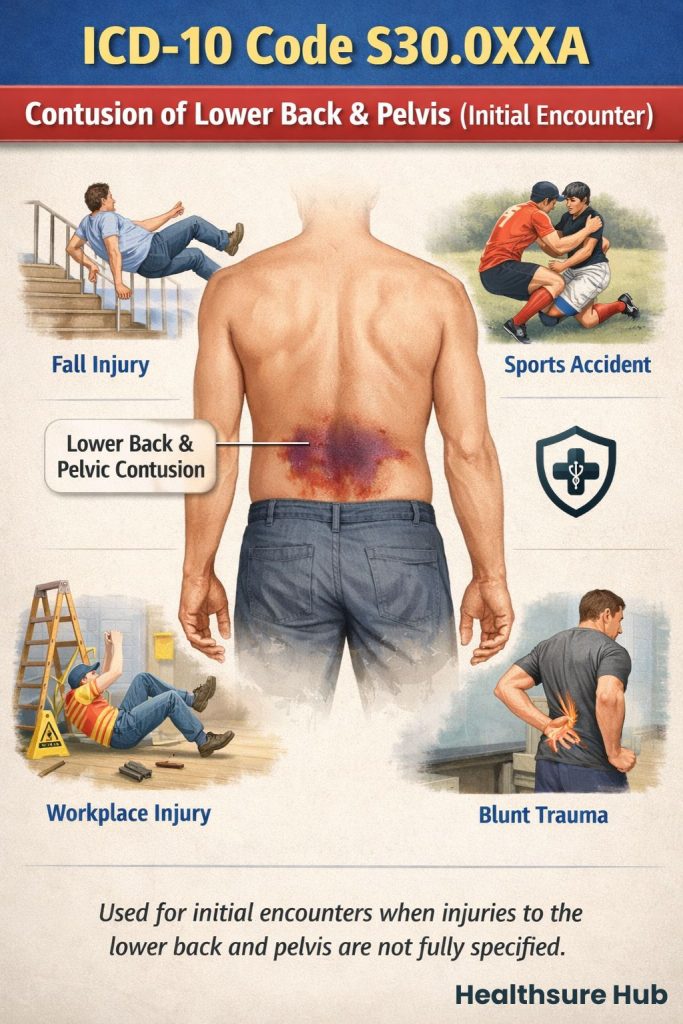
This code is commonly used in cases such as minor falls, blunt trauma, sports incidents, or workplace injuries, where the exact muscles or tissues involved are not documented in detail.
Breaking Down the Code
Each component of S30.0XXA has a distinct meaning:
- S – Injury, poisoning, and certain other consequences of external causes
- 30 – Superficial injury of the abdomen, lower back, and pelvis
- .0 – Contusion (bruise)
- XX – Placeholder characters for future specificity
- A – Initial encounter, indicating active treatment
This structured approach ensures consistent documentation across clinical settings and accurate claims reporting.
What “Contusion” Means in This Context
A contusion is a bruise caused by blunt trauma that does not break the skin. In the context of S30.0XXA, it refers to a soft tissue injury in the lower back or pelvic region where the exact muscle or structure is not specified.
Using this code does not indicate the injury is minor; rather, it reflects that detailed anatomical documentation was not captured during the initial evaluation.
When the Initial Encounter Extension Applies
The “A” in S30.0XXA denotes the initial encounter. ICD-10 coding differentiates between phases of care:
- A – Initial encounter: Active evaluation, imaging, or treatment at the first visit
- D – Subsequent encounter: Follow-up care, monitoring, or ongoing treatment
- S – Sequela: Late effects or complications resulting from the injury
Using the correct extension ensures compliance with coding guidelines and accurate tracking of patient care.
Common Scenarios for S30.0XXA
- This code is frequently applied in situations such as:
- Emergency visits after falls or blunt trauma
- Sports-related impacts to the lower back or pelvic region
- Workplace accidents causing soft tissue bruising
Initial urgent care assessments where detailed imaging or anatomical specification is not yet available
In these cases, the focus is on documenting the presence of injury rather than naming the exact structures involved.
Relationship to Other Lower Back and Pelvic Injury Codes
ICD-10 includes numerous codes for injuries in the lower back and pelvic region. When documentation specifies muscles, ligaments, or internal organs, a more specific code may replace S30.0XXA.
Readers comparing how injuries are classified across different body regions may also find it helpful to review how lower back pain is documented in lower back pain ICD-10 coding, which highlights similar challenges in anatomical specificity.
Importance of Accurate Coding
Correctly using S30.0XXA is critical for:
- Billing compliance: Accurate coding reduces claim denials
- Healthcare data analysis: Ensures trends in lower back and pelvic injuries are reported correctly
- Clinical documentation: Supports continuity of care for follow-up visits
Even though the code is for unspecified contusions, proper use maintains clarity in medical records and contributes to reliable health data reporting.
Common Documentation Gaps Leading to S30.0XXA
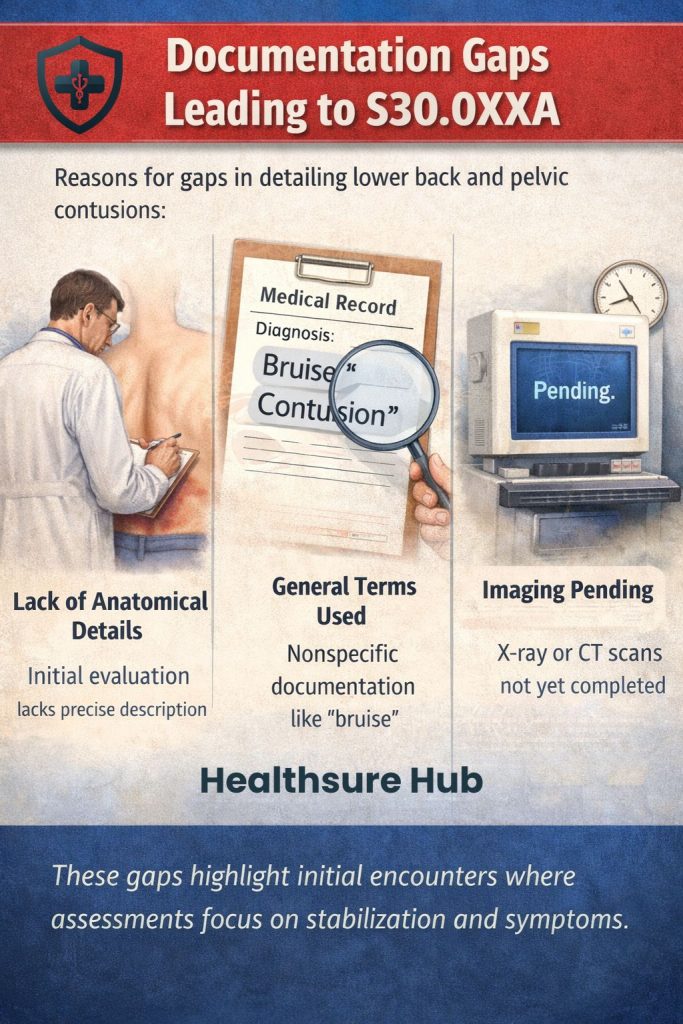
This code is often selected due to documentation gaps during the initial encounter, such as:
- Lack of precise anatomical details in the first evaluation
- General terms like “bruise” or “contusion” without specifying muscles or soft tissues
- Imaging results pending or not yet performed
These gaps reflect real-world clinical workflows where assessment prioritizes stabilization and symptom management.
Conclusion
ICD-10 code S30.0XXA provides a standardized way to document contusions of the lower back and pelvis during the initial encounter. By capturing the injury type, anatomical region, and treatment phase, it ensures accurate medical records, proper billing, and reliable health data.
Understanding this code is valuable for coders, administrators, and patients reviewing records, helping clarify why some injuries are coded as unspecified and how documentation practices affect ICD-10 code selection.
About the Author