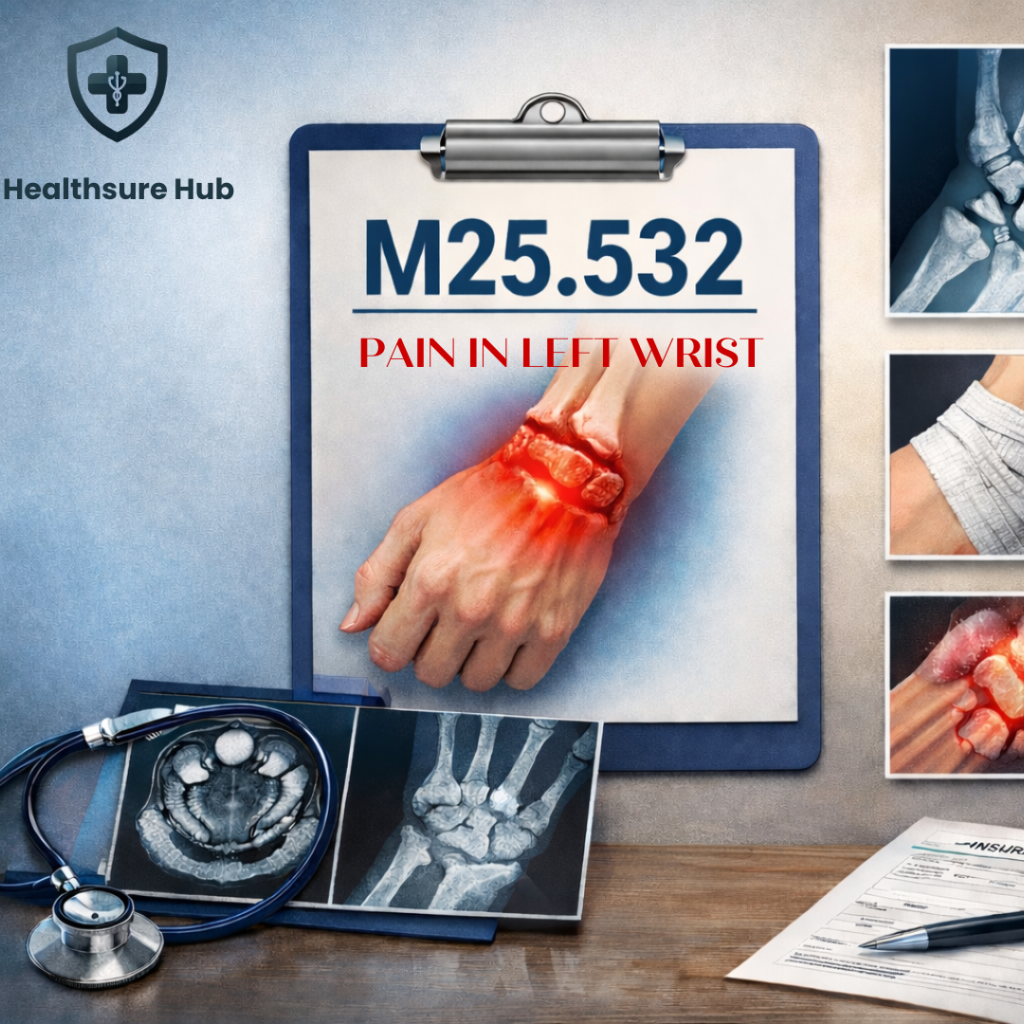
Pain in the wrist is a common musculoskeletal complaint that affects people of all ages and activity levels. Whether caused by injury, repetitive use, or underlying joint disorders, wrist pain can significantly impact daily activities, work, and quality of life. In medical coding, ICD-10 code M25.532 is used to document pain in the left wrist, allowing healthcare providers to accurately record symptoms for treatment, billing, and insurance purposes.
Accurate use of this code is essential. Not only does it help clinicians communicate effectively, but it also ensures proper reimbursement from insurers and helps avoid claim denials. Healthsure Hub explores the causes, symptoms, diagnosis, documentation requirements, and common reasons why claims for M25.532 may be denied.
Understanding ICD-10 Code M25.532
The ICD-10 coding system provides a standardized way to document medical diagnoses. The code M25.532 breaks down as follows:
- M25: Other joint disorders, not elsewhere classified.
- .532: Pain specifically in the left wrist.
Specifying laterality, the left wrist in this case, is crucial for accuracy. Using the correct code ensures that the patient record reflects the exact location of pain and that insurance claims are processed correctly.
It is important to differentiate M25.532 from other wrist-related diagnoses. For example, fractures, sprains, and infections each have their own ICD-10 codes and should be coded separately if confirmed. The ICD-10 code for pain in left wrist is primarily used for symptom-level documentation when no definitive diagnosis has been established.
Statistics Related to Wrist Pain
In occupational settings, wrist injuries represent approximately 5.5% of work-related injuries. Hand injuries are slightly less frequent, accounting for 2.76% of work-related injuries, with an incidence of 1.18 per 10,000 workers and an average of 16.08 days away from work per case.
A significant proportion of both occupational and sports-related hand and wrist conditions arise from repetitive stress rather than acute trauma. Overuse injuries are estimated to comprise 25–50% of all hand and wrist injuries, while the remainder are typically acute traumatic injuries, most commonly associated with high-impact or full-contact sports. Among younger athletes, the burden of upper extremity injury is notable. Individuals under the age of 16 experience upper limb injury rates of approximately 14.8%, with 16% affecting the hand and 9% involving the wrist.
Relationship to Other Wrist Codes
ICD-10 code M25.532 is used specifically for pain in the left wrist and serves primarily as a symptom-level code when a more precise diagnosis has not been confirmed. It is closely related to other wrist pain codes, such as M25.531 for pain in the left wrist and M25.52 for unspecified wrist pain.
When a specific condition is identified, such as a fracture, sprain, arthritis, or nerve compression, the appropriate diagnosis code should be used alongside or instead of the said code. For example, fractures of the wrist fall under the S62 series, and sprains are coded in the S63 series, while carpal tunnel syndrome may be documented with G56.0.
Similarly, inflammatory or arthritic conditions affecting the wrist are coded under the M65, M67, or M19 series depending on the specific diagnosis. Using the code for left pain wrist in conjunction with these codes is acceptable when the primary complaint is wrist pain, ensuring that both the symptom and underlying condition are accurately represented.
Causes of Pain in the left Wrist
Left wrist pain can result from a variety of causes, ranging from acute injuries to chronic medical conditions.
Acute Injuries
Acute wrist injuries typically result from sudden force or impact, most commonly due to falls, sports-related trauma, or abrupt twisting motions.
- Sprains and strains caused by falls, sports accidents, or sudden twisting movements.
- Fractures or dislocations, though fractures typically have separate codes, may initially present as wrist pain and be documented as M25.532.
Chronic Conditions
Chronic disorders usually cause persistent or progressive pain and are often associated with stiffness or functional limitation.
- Arthritis- Osteoarthritis, rheumatoid arthritis, and post-traumatic arthritis can lead to chronic wrist pain.
- Tendinitis/Tenosynovitis- Conditions such as De Quervain’s tendinitis or flexor/extensor tendon inflammation can cause localized pain and swelling.
Overuse and Repetitive Stress
Repeated wrist motion without adequate recovery can result in microtrauma and soft tissue inflammation.
- Repetitive tasks like typing, manual labor, or certain sports can lead to repetitive strain injuries (RSI).
- Carpal tunnel syndrome (CTS) is a common cause of wrist discomfort due to nerve compression.
Other Causes
Several less common conditions may also contribute to left wrist pain and should be considered during evaluation.
- Gout or pseudogout may affect the wrist joint.
- Nerve compression involving the median or ulnar nerves can lead to pain, numbness, or tingling.
- Systemic conditions like lupus or fibromyalgia may contribute to wrist pain as part of generalized joint discomfort.
Symptoms Associated with Left Wrist Pain
Patients with left wrist pain may experience:
- Localized tenderness or aching.
- Swelling, stiffness, or warmth in the joint.
- Reduced range of motion or difficulty gripping objects.
- Numbness or tingling if nerve compression is present.
- Symptoms may vary from intermittent discomfort to constant pain, depending on the underlying cause.
Diagnosis and Clinical Evaluation
Accurate diagnosis is essential to determine the cause of wrist pain and to support proper documentation for ICD-10 code for pain in left wrist.
Patient History
- Clinicians assess the onset, duration, and severity of pain.
- A history of trauma, repetitive activity, or previous wrist conditions is important.
- Associated symptoms, such as numbness, tingling, or weakness, help guide diagnosis.
Physical Examination
- Inspection for swelling, bruising, or deformity.
- Palpation to identify tender points or inflamed tendons.
- Range of motion tests and grip strength assessment.
- Special tests like Phalen’s, Finkelstein’s, or Tinel’s may help identify CTS or tendinitis.
Imaging and Lab Tests
- X-rays rule out fractures, arthritis, or bone abnormalities.
- MRI or CT scans assess soft tissue injuries, ligaments, and tendon damage.
- Ultrasound can evaluate tendon inflammation or synovitis.
- Lab tests may be performed if systemic or inflammatory conditions are suspected.
Importance of Accurate Documentation and Claim Denials
Proper documentation is critical when coding M25.532, both for patient care and insurance purposes. Accurate coding prevents denials and ensures continuity of care.
Common Reasons Claims Are Denied
- Lack of laterality- Failing to document that the pain is in the left wrist.
- Incomplete symptom description- Vague documentation of pain without severity, onset, or functional impact.
- Insufficient clinical evidence- No supporting exam findings, imaging, or lab results.
Conflicting codes- Using M25.532 alongside a more specific diagnosis (like a fracture or sprain) without justification. - Chronic condition ambiguity- Using the code for conditions that require a more precise arthritis or tendinitis diagnosis.

When to Use ICD-10 Code M25.532
This code is appropriate for primary symptom documentation when no other definitive wrist diagnosis has been established. It should not be used for:
- Fractures (S62 codes)
- Sprains (S63 codes)
- Infections or specific inflammatory conditions (other M or L codes)
It is often used alongside other codes for comprehensive documentation. For example, a patient with carpal tunnel syndrome may be coded with the ICD-code for left wrist pain in addition to G56.0 (CTS) if the pain is the primary complaint.
Conclusion
M25.532, pain in the left wrist is a common symptom frequently documented in medical practice. Accurate coding is essential to ensure proper billing, facilitate treatment planning, and support continuity of care.
Healthcare providers should document laterality, pain characteristics, and any supporting clinical evidence to avoid insurance claim denials. By understanding the causes, symptoms, and diagnostic requirements, clinicians can improve patient care and ensure accurate reporting of left wrist pain.
About the Author