Did you know that injuries to the wrist, hand, and fingers are so common that they account for a significant portion of emergency room and urgent care visits each year? From slips and falls to sports mishaps and workplace accidents, these injuries can range from minor bruises to serious trauma. Yet, in many cases, the exact nature of the injury isn’t immediately clear.
This is where the ICD-10-CM code S69.91XA comes in. Our team at Healthsure Hub explains the important role of the said code, the importance of accurate documentation, timely treatment, and proper claims submission when clinical details are still evolving.
Understanding ICD-10 Code S69.91XA
What Does S69.91XA Mean?
The ICD-10 code S69.91XA represents an unspecified injury of the right wrist, hand, and finger(s), initial encounter. This may occur when imaging is pending, swelling obscures physical findings, or symptoms overlap between multiple potential diagnoses such as sprains, contusions, or minor soft tissue injuries.
Importantly, this code does not specify the type of injury. It does not confirm a fracture, tendon tear, nerve injury, or open wound. Instead, it reflects a clinically valid situation where trauma is evident, but further evaluation is needed.
Breaking Down the Code Structure
Understanding the structure of ICD-10 for unspecified injury of the right wrist, hand, and finger at initial encounter helps ensure correct application:
- S – Injury, poisoning, and certain other consequences of external causes
- 69 – Injuries to the wrist, hand, and fingers
- .91 – Unspecified injury of the right side
- X – Placeholder character required for code completeness
- A – Initial encounter, meaning the patient is receiving active treatment
The seventh character “A” is critical. This code should only be used during the initial phase of care, such as the first evaluation, diagnostic workup, or acute treatment.
Statistics and Trends Related to Wrist, Hand, and Finger Injuries
According to healthcare utilization data, upper extremity injuries account for approximately 20–30% of complaints that present to emergency department injury-related visits each year.
In the United States alone, millions of patients seek medical care annually for hand and wrist trauma caused by falls, sports activities, workplace accidents, and motor vehicle incidents. Falls onto an outstretched hand remain one of the leading mechanisms of injury, especially among older adults and physically active individuals.
From a medical coding and billing perspective, in a national ambulatory care dataset, unspecified ICD-10-CM codes were used in approximately 33% of all coded encounters, reflecting the common reliance on unspecified codes when clinical details are not fully documented. While clinically appropriate in early evaluations, unspecified codes are also associated with higher claim scrutiny by payers if they are not updated promptly.
As healthcare systems increasingly focus on data accuracy, reimbursement integrity, and quality reporting, proper use of initial encounter injury codes plays a critical role in both patient care and revenue cycle management.
Common Clinical Scenarios
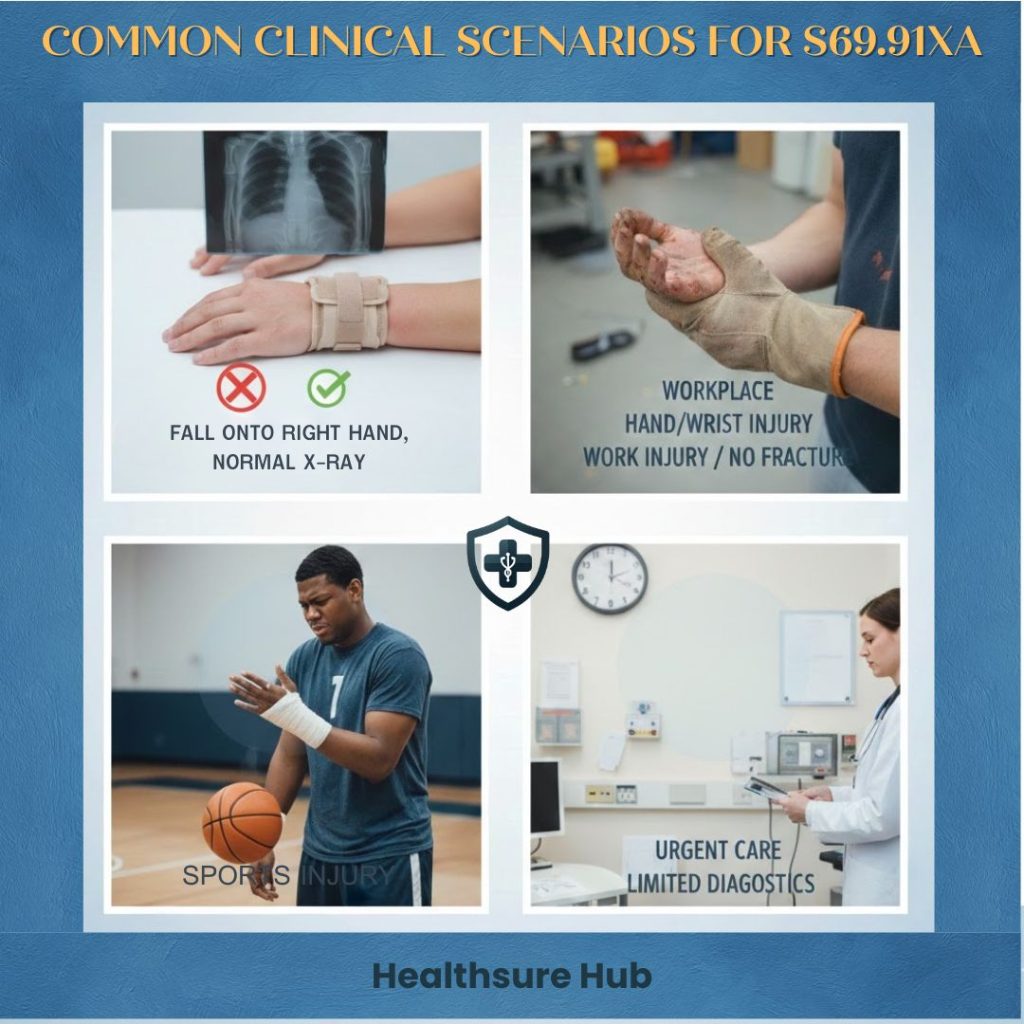
This code is frequently used in real-world clinical settings, particularly when a patient presents shortly after an injury. Typical scenarios include:
- A fall onto an outstretched right hand with pain and swelling but normal initial X-rays
- A workplace injury involving the hand or wrist without clear structural damage
- Sports-related trauma causing pain and limited motion pending further imaging
- Emergency or urgent care visits where time constraints limit diagnostic specificity
In these cases, ICD-10 for unspecified injury of the right wrist, hand, and finger at initial encounter allows providers to document the injury accurately without prematurely assigning an incorrect diagnosis.
Signs and Symptoms Associated With Right Hand and Wrist Injuries
Patients coded with ICD-10 for unspecified injury of the right wrist, hand, and finger at initial encounter often present with a combination of symptoms, including:
- Localized pain or tenderness
- Swelling or soft tissue inflammation
- Bruising or discoloration
- Reduced range of motion
- Decreased grip strength or functional impairment
These symptoms may affect daily activities, work performance, or athletic participation, reinforcing the need for proper follow-up and reassessment.
When to Use and When Not To Use S69.91XA
Appropriate Use
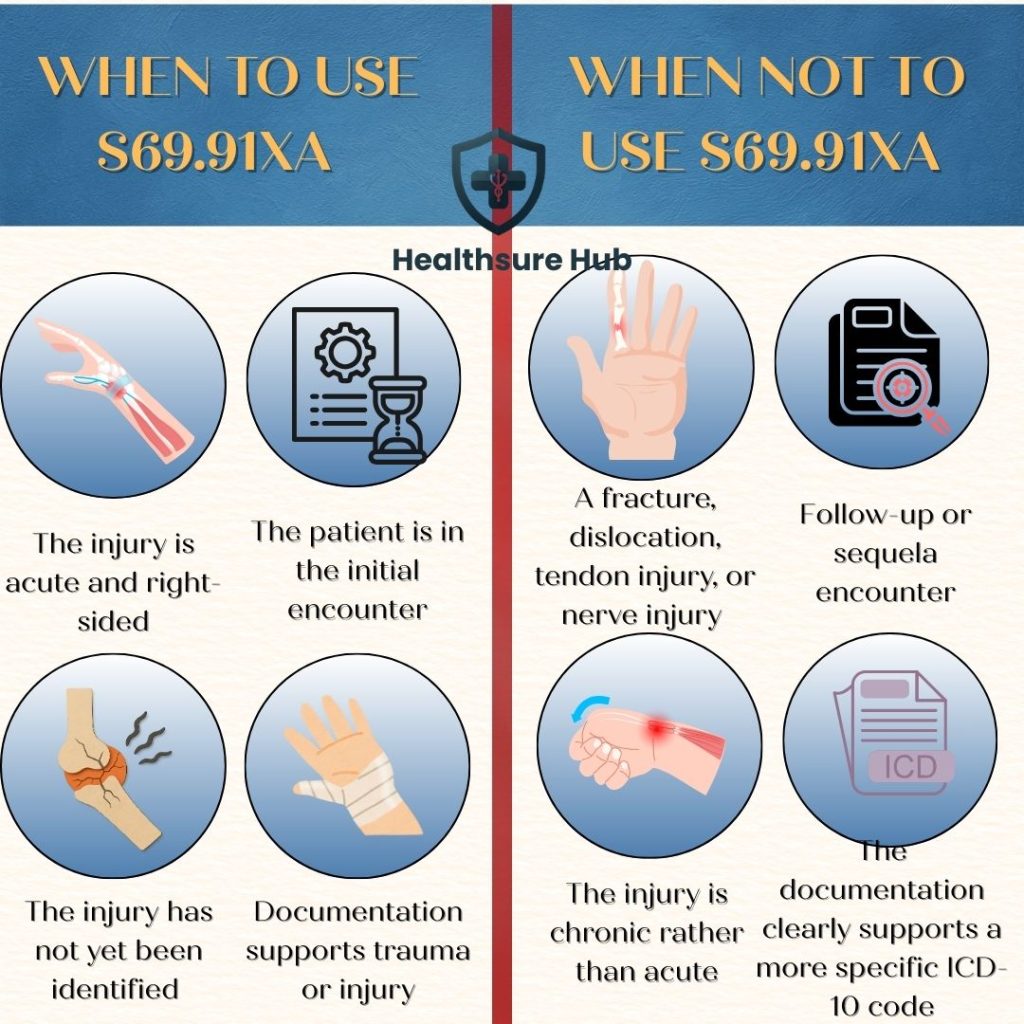
Usage of this code is appropriate when:
- The injury is acute and right-sided
- The patient is in the initial encounter
- The provider has not yet identified a specific injury type
- Documentation supports trauma or injury
When This Code Should Be Avoided
This code should not be used when:
- A fracture, dislocation, tendon injury, or nerve injury is confirmed
- The encounter is a follow-up or sequela visit
- The injury is chronic rather than acute
- The documentation clearly supports a more specific ICD-10 code
Overuse of unspecified codes when specificity is available is a common compliance risk.
Diagnostic Evaluation and Clinical Workup
Evaluation typically begins with a thorough physical examination assessing pain location, swelling, deformity, neurovascular status, and range of motion. Diagnostic imaging such as X-rays is often ordered to rule out fractures. In more complex cases, ultrasound or MRI may be used to evaluate soft tissue structures.
Let’s say that a 35-year-old patient fell on her outstretched right hand. X-rays were normal, so S69.91XA was used. One week later, MRI revealed a minor ligament tear. The code was updated to a specific ICD-10 code. This demonstrates the importance of revising unspecified codes once more information is available.
Once a definitive diagnosis is established, the ICD-10 code should be updated to reflect the specific condition, improving both clinical accuracy and billing integrity. For instance, M25.532 refers to unspecified pain in the left wrist, while M25.531 refers to pain in right wrist.
Documentation Best Practices
Strong documentation is essential when using the specific ICD-10 code. Providers should clearly record:
- Laterality (right wrist, hand, or fingers)
- Mechanism of injury (fall, impact, crush, overuse)
- Symptom onset and severity
- Functional limitations
- Confirmation that this is the initial encounter
- Rationale for using an unspecified diagnosis
This level of detail supports medical necessity and reduces claim denial risk.
Common Claim Denials
Claims involving S69.91XA may be denied due to:
- Missing laterality documentation
- Incorrect seventh character usage
- Continued use of the code after diagnostic clarification
- Conflicting documentation suggesting a more specific injury
Payers increasingly scrutinize unspecified codes, making timely updates essential.
Impact of Accurate Coding on Patient Care and Revenue Cycle Management
Accurate use of ICD-10-CM code S69.91XA affects more than just claim submission, it directly influences patient care coordination and revenue cycle performance. When initial injury encounters are coded correctly, care teams can track outcomes, monitor follow-up needs, and ensure timely reassessment. From a financial standpoint, proper initial coding reduces rework, minimizes payer inquiries, and supports faster reimbursement.
Conversely, vague or unsupported use of unspecified codes can lead to delayed payments, increased audits, and compliance risks. By aligning clinical documentation with correct ICD-10 coding from the outset, healthcare organizations improve data reliability, enhance operational efficiency, and maintain payer confidence.
Conclusion
The ICD-10 code S69.91XA plays a legitimate and necessary role in early injury evaluation. When used correctly, it supports timely treatment, accurate documentation, and appropriate reimbursement. Providers and coders should view this code as a short-term solution, transitioning to greater specificity as soon as clinical information allows.
By applying this diagnosis code thoughtfully and documenting thoroughly, healthcare teams strengthen compliance, improve data quality, and ensure continuity of care—key components of trustworthy and authoritative medical practice.
About the Author