Falls on stairs and steps are among the most common causes of accidental injury treated in emergency departments and urgent care settings. Whether occurring at home, in public buildings, or at work, stair-related falls can result in a wide range of injuries, from minor contusions to serious fractures and head trauma. Within medical documentation and billing systems, these events are captured using ICD-10 external cause codes, one of the most frequently used being W10.9XXA.
HealthSure Hub helps you understand how and when to use W10.9XXA correctly is essential for accurate clinical documentation, reliable injury reporting, and clean insurance claims.
What Is ICD-10 Code W10.9XXA?
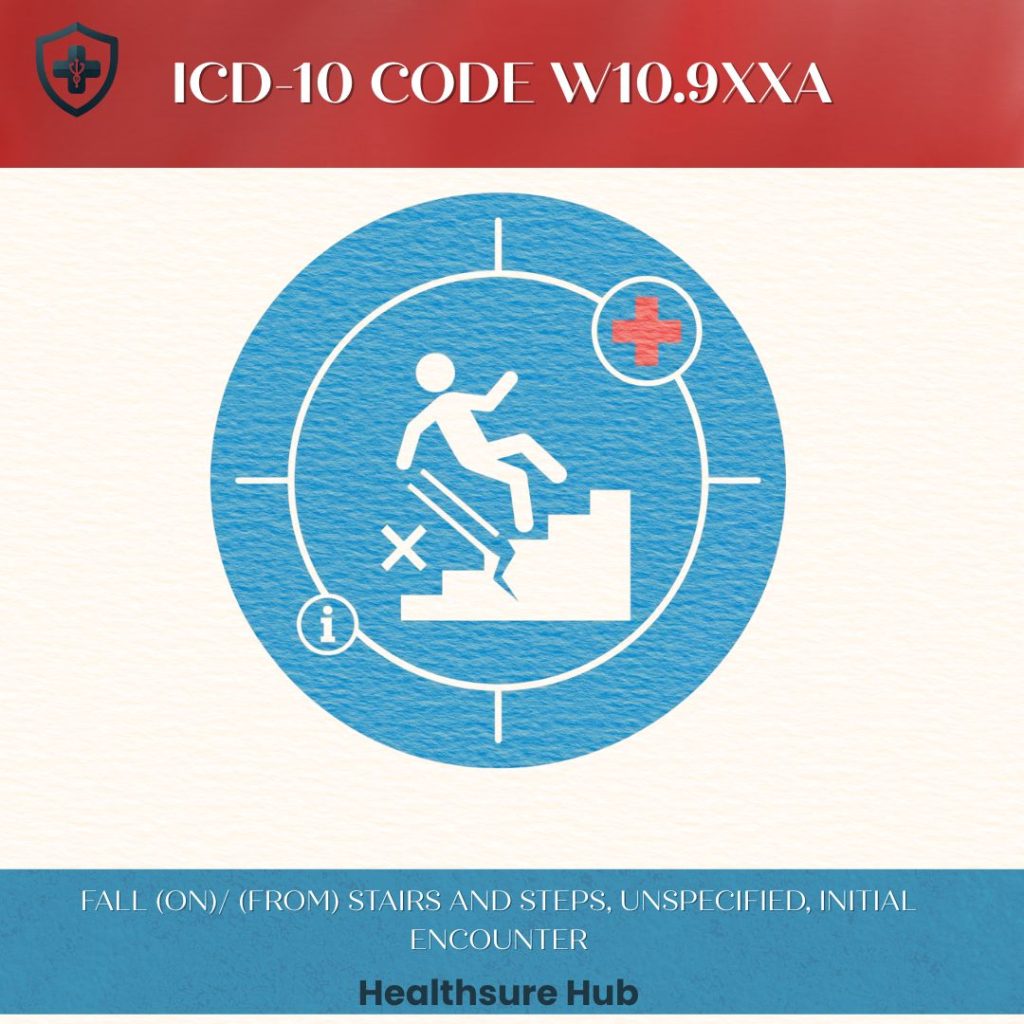
W10.9XXA is an ICD-10-CM external cause code defined as fall on and from stairs and steps, unspecified, initial encounter.
This code belongs to Chapter 20 of ICD-10, which covers external causes of morbidity. Unlike diagnosis codes that describe the injury itself (such as fractures or knee sprains), W10.9XXA explains how the injury occurred.
External cause codes like this are used to:
- Establish injury mechanisms
- Support medical necessity in claims
- Improve injury surveillance and public health data
- Assist payers and researchers in understanding risk patterns
Importantly, this code does not describe the injury, it must always be reported alongside a primary injury diagnosis.
ICD-10 Code Structure Explained
Breaking down the structure of this specific ICD-10 code helps clarify its correct application:
- W10 – Fall on and from stairs and steps
- .9 – Unspecified circumstances of the stair fall
- XX – Placeholder characters required to allow a 7th character
- A – Initial encounter, meaning the patient is receiving active treatment
The placeholder “X” characters are mandatory for proper formatting and claim acceptance. Omitting them results in an invalid ICD-10 code.
When Should W10.9XXA Be Used?
W10.9XXA is appropriate when a patient presents for initial medical evaluation after falling on or from stairs or steps, but specific details about the fall are not documented or known.
Common clinical scenarios include:
- A patient reports “falling down the stairs” without additional detail
- Emergency evaluation where mechanism is clear but circumstances are limited
- Urgent care or primary care visits immediately following the incident
This code is most commonly used in:
- Emergency departments
- Urgent care centers
- Outpatient clinics during first evaluation
If more detailed information is available, such as slipping, tripping, or falling due to structural failure, a more specific W10 subcode may be appropriate instead.
Injuries Commonly Associated With Stair Falls
Falls involving stairs and steps frequently result in upper and lower extremity injuries due to sudden impact and instinctive bracing during the fall. Wrist injuries of left or right wrist are particularly common, as patients often extend their hands to break the fall, leading to documented cases of wrist pain or associated fractures.
Finger injuries may also occur when the hand strikes railings, steps, or walls, resulting in swelling, stiffness, or persistent finger pain following the incident.
Lower extremity injuries are another frequent outcome. Patients may present with knee pain after twisting, landing awkwardly, or absorbing direct force on the joint. Similarly, hip pain is commonly reported, especially among older adults, where stair falls pose a higher risk of significant injury and mobility impairment.
These injury diagnoses are typically coded separately and reported alongside W10.9XXA to clearly establish the mechanism of injury during the initial encounter.
Documentation Best Practices
Accurate documentation is essential for proper use of W10.9XXA. Clinical notes should clearly indicate:
- That the injury resulted from a fall on or from stairs or steps
- That the encounter represents initial treatment
- Any available context, even if limited
While the code allows for unspecified circumstances, adding brief details, such as location (home, workplace) or contributing factors, can improve coding accuracy and support more specific code selection when appropriate.
Clear documentation reduces ambiguity, supports downstream coding decisions, and strengthens payer confidence in the claim.
W10.9XXA and Insurance Claims
Although external cause codes are not always required by every payer, they are widely encouraged and often expected in injury-related claims. W10.9XXA can:
- Support accident-related billing
- Help distinguish traumatic injuries from chronic conditions
- Strengthen claims involving liability or workers’ compensation
Claims are more likely to be delayed or denied when the mechanism of injury documented in clinical notes does not align with the coded external cause.
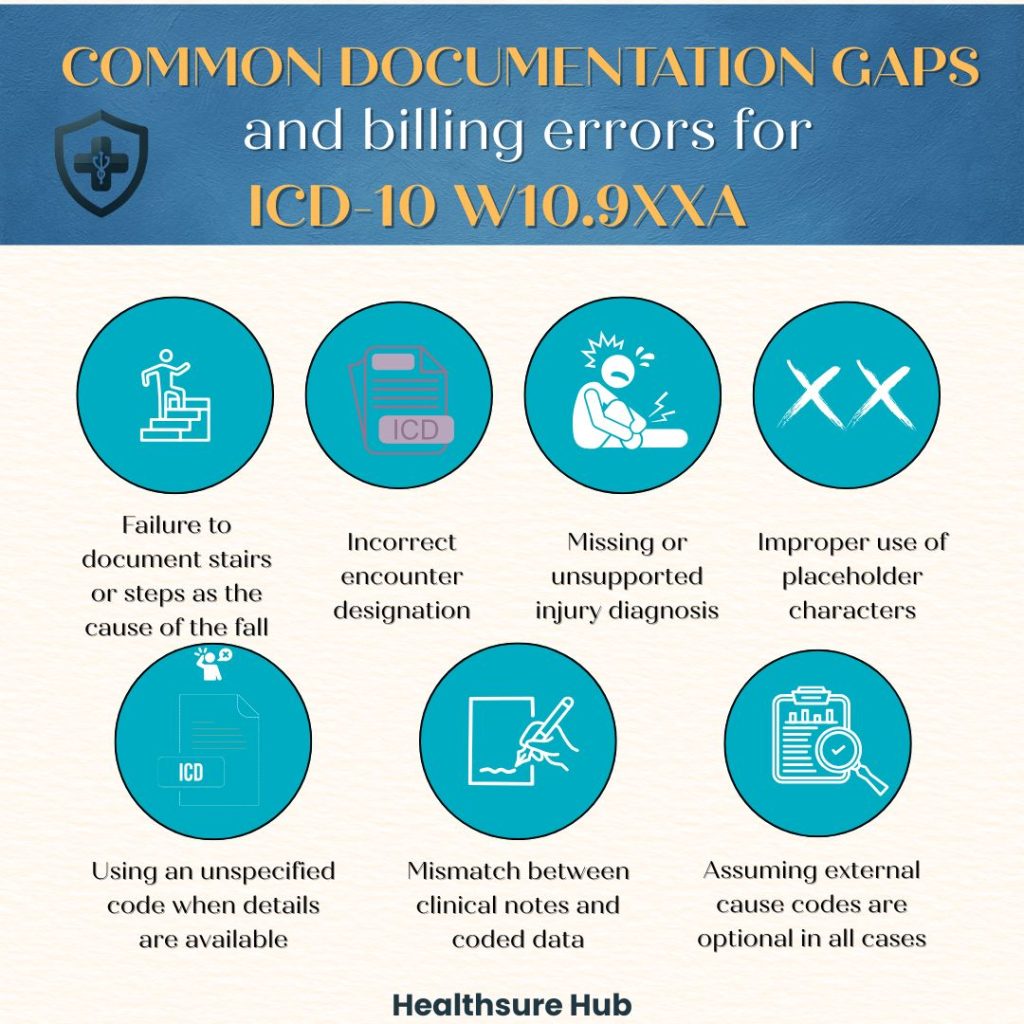
Common Documentation Gaps and Billing Errors for W10.9XXA
- Failure to document stairs or steps as the cause of the fall– clinical notes that state only “patient fell” without specifying stairs, steps, or a stairway do not adequately support W10.9XXA. Clear identification of the fall location is required to justify use of this code.
- Incorrect encounter designation- W10.9XXA is limited to the initial encounter when active treatment is being provided. Using this code during follow-up visits, rehabilitation, or routine reassessments is a common error.
- Missing or unsupported injury diagnosis- external cause codes must be reported alongside a valid injury diagnosis. Submitting W10.9XXA without a documented contusion, sprain, fracture, or other injury may result in claim denial.
- Improper use of placeholder characters- the ICD-10 format requires two placeholder “X” characters before the 7th character. Omitting them results in an invalid code and automatic claim rejection.
- Using an unspecified code when details are available- when documentation clearly describes a specific stair-related circumstance, continued use of W10.9XXA instead of a more specific W10 subcode may be considered inaccurate coding.
- Mismatch between clinical notes and coded data– discrepancies between provider documentation and the reported external cause can trigger payer reviews or audits.
- Assuming external cause codes are optional in all cases- while not always mandatory, many payers expect external cause codes for injury claims. Omission or inconsistent use may delay processing or reduce claim credibility.
Conclusion
W10.9XXA is a valuable ICD-10 external cause code used to document initial encounters involving falls on stairs or steps when details are unspecified. When paired with appropriate injury diagnoses and supported by clear documentation, it enhances claim accuracy, supports injury tracking, and contributes to reliable healthcare data.
Correct use of this code benefits providers, coders, payers, and public health efforts alike.
About the Author