A simple misstep can lead to serious consequences. ICD-10-CM W18.30XA captures initial encounters for falls on the same level when the circumstances are unspecified. These incidents, common in homes, workplaces, and public spaces, may appear minor but can result in injuries that require medical attention.
At HealthSure Hub, we explore the code’s placement within ICD-10, break down its components, review common clinical scenarios, highlight documentation best practices, identify typical injuries, examine coding pitfalls, and discuss related codes.
Brief Overview of the Code
W18.30XA is specifically used for initial encounters involving falls on the same level when details about the fall are unknown. It is part of Chapter 20: External Causes of Morbidity in ICD-10-CM, which categorizes causes of injury. It. This allows clinicians to capture incidents that don’t fit more specific fall codes, supporting accurate medical records, proper claims, and patient safety tracking.
Breaking Down the Code
- W18 – Fall on same level
- .30 – Unspecified circumstances
- X – Placeholder for ICD-10 formatting
- A – Initial encounter
Each element is crucial for correct coding. Misuse, such as applying it for subsequent encounters or known circumstances, can lead to claim denials and inaccurate patient records.
Fall on the Same Level Statistics
Falls on the same level are surprisingly common, both at work and at home. In the workplace, there are approximately 17,000 lost-time injuries each year due to falls, and about 65% of these involve same-level incidents, such as slipping or tripping while walking. In fact, one in five lost-time workplace injuries is caused by a fall.
At home, the risk is even higher. Research shows that 55% of all falls occur inside the home, and more than three-quarters happen either inside or in close proximity to it. Most of these injuries result from falls on the same level rather than from stairs or elevated surfaces, often occurring when someone simply trips while walking or moving around their living space.
Common Clinical Scenarios
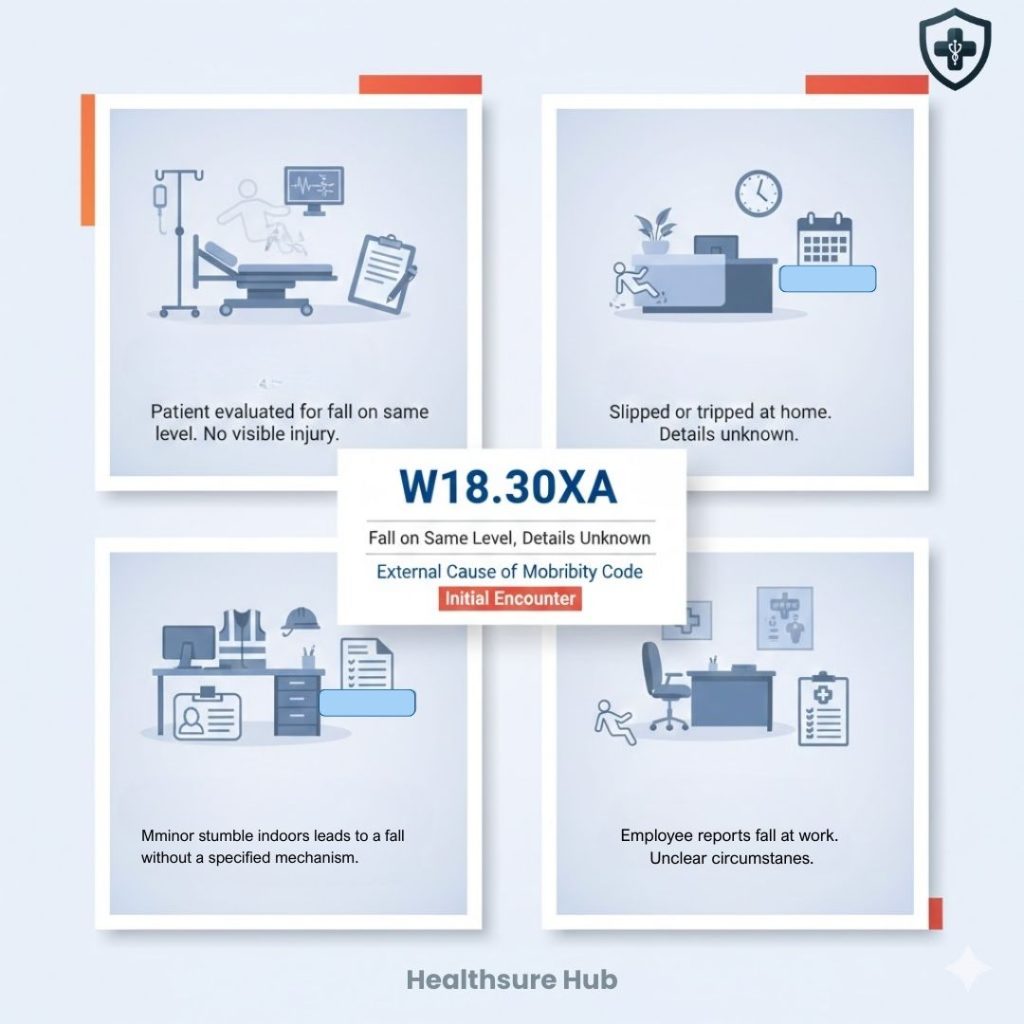
W18.30XA applies in situations such as:
- Patient slips on a wet floor at home or work, with no additional details.
- Individual trips over an uneven surface at home, and the cause is unclear.
- A minor stumble indoors leads to a fall without a specified mechanism.
Settings include emergency departments, urgent care clinics, primary care offices, and occupational health evaluations. The “unspecified” designation is used when the exact cause or contributing factors are unknown.
Documentation Guidelines for W18.30XA
Proper documentation is critical:
- Record how the fall occurred, including environmental factors if known.
- Note location (home, workplace, public space).
- Document any injuries sustained during the fall.
- Specify that it is the initial encounter; subsequent visits require different codes.
Accurate notes ensure proper use of the code and prevent insurance claim issues.
How to Code a Fall in ICD-10
Coding a fall in ICD-10 requires identifying the type of fall, the circumstances, and the encounter. A step-by-step guide would include:
- Determining the Type of Fall – It all depends on where and how the fall occurred. More specific codes for same-level falls such as slips, trips or stumbles go under the W18 codes, whereas other falls such as fall from stairs, ladders or heights go billed under the W00-W19 codes. For example, if a patient slips on a wet floor at home, that’s a same-level fall and you use W18.
- Identifying the Encounter – Next, you want to figure out the encounter type. If it’s the patient’s first visit after the fall, you’ll use a code that ends with “A” to indicate an initial encounter. For any follow-up visits, the code should end with “D” to show it’s a subsequent encounter. And if the visit is about complications resulting from the fall, the code will end with “S” for sequela.
- Checking the Circumstances – After identifying the encounter type, the next step is to consider the circumstances of the fall. If the cause is clear, for example, the patient slipped on a wet floor or tripped over an object, you should choose a more specific code, such as W18.20XA. On the other hand, if the exact cause of the fall is unknown or unspecified, the correct choice would be W18.30XA, which is used when the details of the fall aren’t clear.
- Correlating it with other ICD-10 codes – Falls often lead to injuries such as sprains, bruises, or fractures, and it’s important to document each one carefully. Each injury should be coded separately. For example, an ankle sprain would be coded as S93.409A, and the notes should clearly show that the injury resulted from the fall. Taking the time to link injuries accurately to the fall not only ensures proper coding but also helps prevent denied insurance claims and supports patient safety.
Coding a fall correctly might take a few extra minutes, but it makes a big difference. Clear documentation protects patients, avoids insurance issues, and helps healthcare teams understand how and why falls happen.
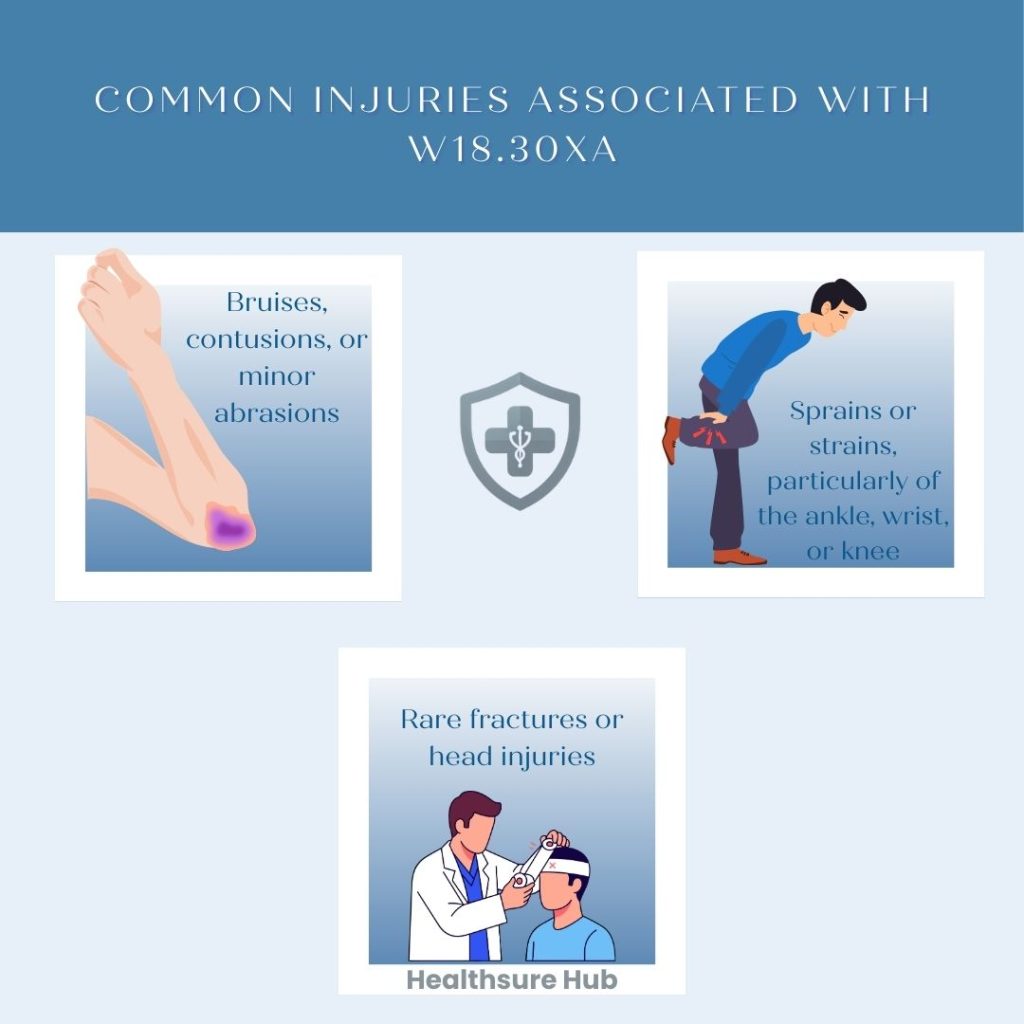
Common Injuries Associated with W18.30XA
Falls on the same level can lead to:
- Bruises, contusions, or minor abrasions
- Sprains or strains, particularly of the ankle, wrist, or knee
- Rare fractures or head injuries
Many injuries require additional ICD-10 codes, like S93.4XXA for ankle sprains. Coding both the external cause and the injury ensures accurate billing and complete patient records.
Common Coding Errors Associated with W18.30XA
Mistakes to avoid include:
- Using W18.30XA when the circumstances of the fall are known and could be coded more specifically.
- Confusing initial and subsequent encounters.
- Omitting codes for related injuries.
Best practices: verify patient records, code both the fall and any injuries, and maintain up-to-date staff training on ICD-10 guidelines.
Relationship with Other Codes
This ICD-10 code is part of a group of codes that describe falls and similar incidents, and it’s important to know how it relates to others. For example, W18.20XA is used when documenting a subsequent encounter for a fall on the same level, while W19.XXXA covers unspecified falls during an initial encounter that don’t fit more specific codes. Injuries that result from a fall, like an ankle sprain (S93.4XXA), should also be coded alongside the external cause. Similarly, W01.0XXA captures falls on the same level caused by slipping or tripping. Understanding these relationships ensures that incidents are coded accurately, which supports proper documentation, billing, and patient care.
Conclusion
ICD-10-CM W18.30XA is essential for documenting initial encounters of falls on the same level when details are unknown. Proper use enhances patient care, streamlines insurance claims, and contributes to fall prevention research. Thorough documentation, coding associated injuries, and understanding related codes ensure compliance, accuracy, and safer outcomes for patients.
About the Author