Hand fractures are among the most frequently treated injuries in emergency departments and urgent care clinics, yet they are also some of the most challenging to fully diagnose at first presentation. Swelling, pain, and limited mobility often obscure the precise location of the fracture, making immediate specificity impossible.
In these early clinical moments, accurate—but flexible—medical coding becomes essential. This is where ICD-10-CM code S62.90XA plays a critical role. Our team at Healthsure Hub, explain the code in detail while keeping you informed of the possible medical billing errors associated with the code
Definition of S62.90XA
S62.90XA is defined as an unspecified fracture of unspecified hand, initial encounter for a closed fracture. This code is used when a patient presents with a confirmed fracture of the hand, but the specific bone involved, fracture pattern, or laterality has not yet been clearly documented. The fracture is classified as closed, meaning the skin remains intact, and the encounter represents the initial phase of active treatment.
The seventh character “XA” indicates that the patient is receiving active medical care, such as evaluation, imaging, immobilization, or pain management. Importantly, this code does not imply inadequate documentation or poor care—it reflects the clinical reality of early trauma assessment.
Hand Fracture Statistics and Risk Factors
Hand and wrist fractures are among the most common musculoskeletal injuries worldwide. Epidemiological studies show that roughly 179 per 100,000 people suffer hand or wrist fractures globally. These injuries are not evenly distributed across age or gender:
- Males are 2 to 5 times more likely to experience hand fractures than females, largely due to higher participation in contact sports and occupational hazards.
- Males aged 5–14 are at the highest risk for sports-related fractures, such as from football, basketball, or skateboarding injuries.
Understanding these patterns is crucial for clinicians and medical coders, as patient demographics can inform both clinical suspicion and documentation of the injury. Early recognition of high-risk groups helps guide imaging, treatment, and follow-up care.
Anatomical Scope of the “Hand” in ICD-10-CM
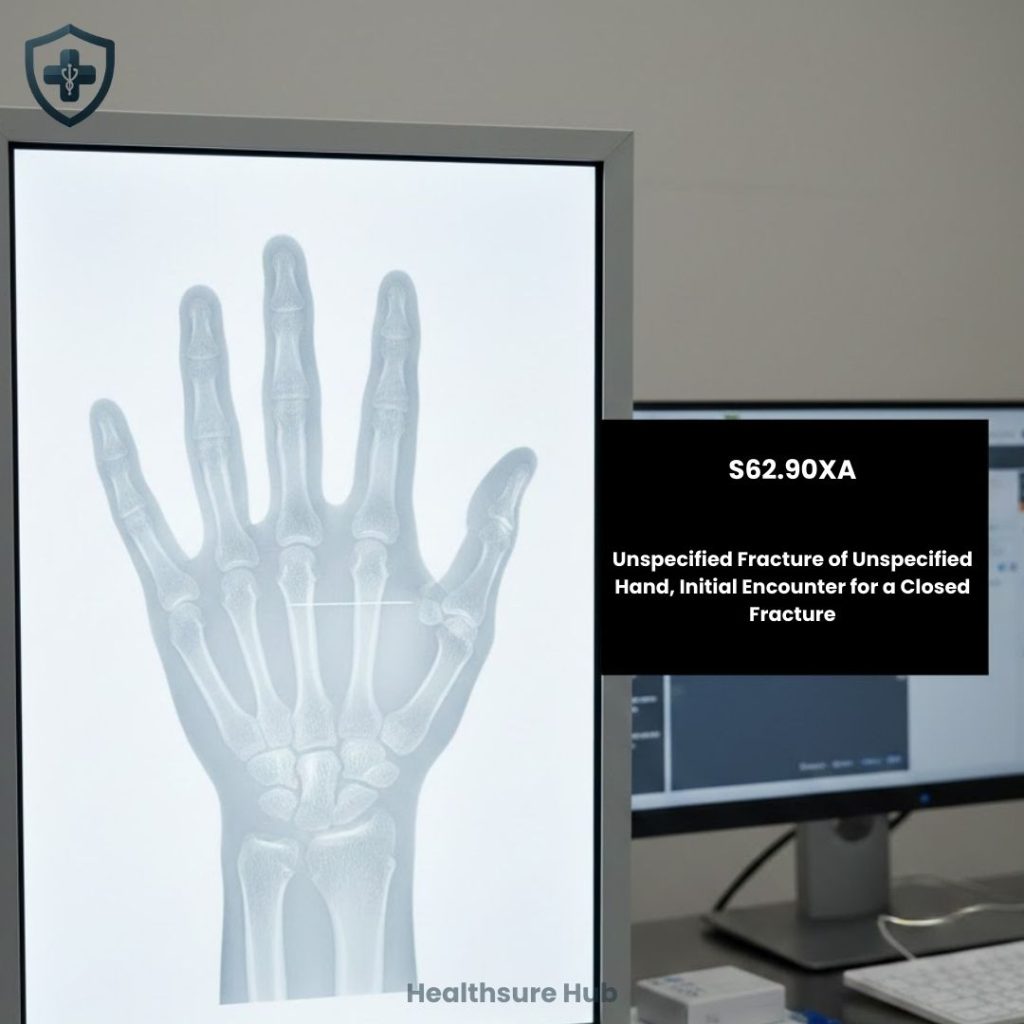
Within ICD-10-CM, the term hand includes the metacarpal bones and the phalanges (fingers and thumb). S62.90XA applies only to fractures involving these structures. It does not include wrist injuries, which are coded separately under different ICD-10-CM categories.
During an initial encounter, inflammation or patient discomfort may prevent clinicians from determining which specific hand bone is fractured. Until diagnostic clarity is achieved, S62.90XA provides a compliant and accurate way to document the injury.
Common Clinical Scenarios for Using S62.90XA
This code is most often used in fast-paced clinical settings where immediate decision-making is required. Falls onto an outstretched hand, crush injuries at work, sports-related trauma, or blunt force injuries are common mechanisms. In many cases, initial X-rays confirm the presence of a fracture but do not clearly identify the exact bone or fracture configuration.
Emergency physicians and urgent care providers may need to initiate treatment before definitive imaging or specialist consultation is completed. In these scenarios, S62.90XA allows care to proceed without delaying documentation or billing.
Symptoms at Initial Presentation
Patients with hand fractures typically present with pain, swelling, bruising, stiffness, and reduced grip strength. Deformity may or may not be visible. These symptoms overlap across multiple types of hand fractures, making it difficult to distinguish between metacarpal and phalangeal injuries during the initial evaluation.
Because clinical signs are often nonspecific at presentation, using an unspecified fracture code is appropriate and supported by ICD-10-CM guidelines when documentation does not yet allow greater detail.

Diagnostic Evaluation During the Initial Encounter
The initial diagnostic process includes a physical examination focused on tenderness, range of motion, and neurovascular status. Plain radiographs are usually ordered, but early imaging may be limited by swelling or suboptimal positioning. In some cases, additional imaging or specialist review is deferred until after initial stabilization.
S62.90XA reflects this diagnostic stage. It captures the confirmed presence of a fracture without forcing premature specificity that could later prove inaccurate.
Initial Treatment of Closed Hand Fractures
Active treatment during the initial encounter typically includes immobilization using a splint or temporary cast, pain control, and instructions for elevation and activity modification. Patients may be referred to an orthopedic or hand specialist for follow-up care.
All of these interventions qualify as active treatment, making S62.90XA appropriate for use at this stage of care.
ICD-10-CM Coding Guidelines and Compliance
S62.90XA belongs to the broader S62 category, which covers fractures of the hand and fingers. ICD-10-CM guidelines allow the use of unspecified codes when clinical documentation does not yet support a more specific diagnosis. However, these codes should be used thoughtfully and updated once additional information becomes available.
Accurate documentation of symptoms, imaging results, and treatment provided is essential to support the medical necessity of using an unspecified code.
Common Coding Errors to Avoid
One of the most frequent errors is continuing to use S62.90XA after the fracture has been clearly identified. Once the specific bone, laterality, or fracture type is documented, coders must transition to a more specific ICD-10-CM code.
Another common mistake is confusing hand fractures with wrist injuries. Using S62.90XA for wrist trauma is anatomically incorrect and may result in claim denials or audit risk.
Billing and Reimbursement Considerations
Most payers recognize S62.90XA as a valid, billable code for initial encounters involving hand fractures. However, insurers may scrutinize claims if unspecified codes are used repeatedly without follow-up specificity.
Timely code updates following diagnostic clarification help ensure reimbursement accuracy and reduce compliance risk.
Transitioning to a More Specific Code
While S62.90XA serves an important role during the initial evaluation of a hand fracture, it is considered a temporary placeholder until the specific details of the injury are confirmed. As diagnostic clarity improves, through imaging, specialist consultation, or further clinical assessment, it becomes essential to update the medical record and coding to reflect the precise nature of the fracture. This transition is not only a coding requirement but also supports accurate patient care and proper reimbursement.
This transition supports better clinical communication, improves data accuracy, and strengthens revenue cycle performance.
When to Transition
The update should occur once additional diagnostic information is available, such as:
- Advanced imaging results: X-rays, CT scans, or MRI may reveal the exact bone fractured (e.g., metacarpal vs phalange) and the fracture pattern (transverse, oblique, spiral, or comminuted).
- Laterality determination: Clarifying whether the fracture is in the right or left hand.
- Specialist assessment: An orthopedic or hand surgeon may identify details missed during the initial encounter, including involvement of multiple bones or associated soft tissue injury.
How to Transition
Medical coders and clinicians should follow these steps:
- Review updated imaging and specialist notes to identify:
- The exact bone (metacarpal, proximal, middle, or distal phalanx)
- Fracture type (closed, open, displaced, nondisplaced)
- Laterality (right or left hand)
- Update the patient’s record to reflect these findings.
- Replace S62.90XA with a more specific ICD-10-CM code that matches the updated documentation.
Once detailed information is available, the following codes may replace S62.90XA:
| Bone/Location | ICD-10-CM Code | Description |
|---|---|---|
| Right hand, metacarpal | S62.231A | Displaced fracture of the base of the 2nd metacarpal, initial encounter |
| Left hand, proximal phalanx | S62.321A | Nondisplaced fracture of the proximal phalanx of left index finger, initial encounter |
| Right hand, distal phalanx | S62.621A | Fracture of distal phalanx of right thumb, initial encounter |
Conclusion
S62.90XA serves an essential role in documenting hand fractures during the earliest phase of care. It allows clinicians to initiate treatment promptly while remaining compliant with coding guidelines.
When used appropriately and updated as diagnostic clarity improves, this code supports accurate billing, high-quality documentation, and patient-centered care.
About the Author