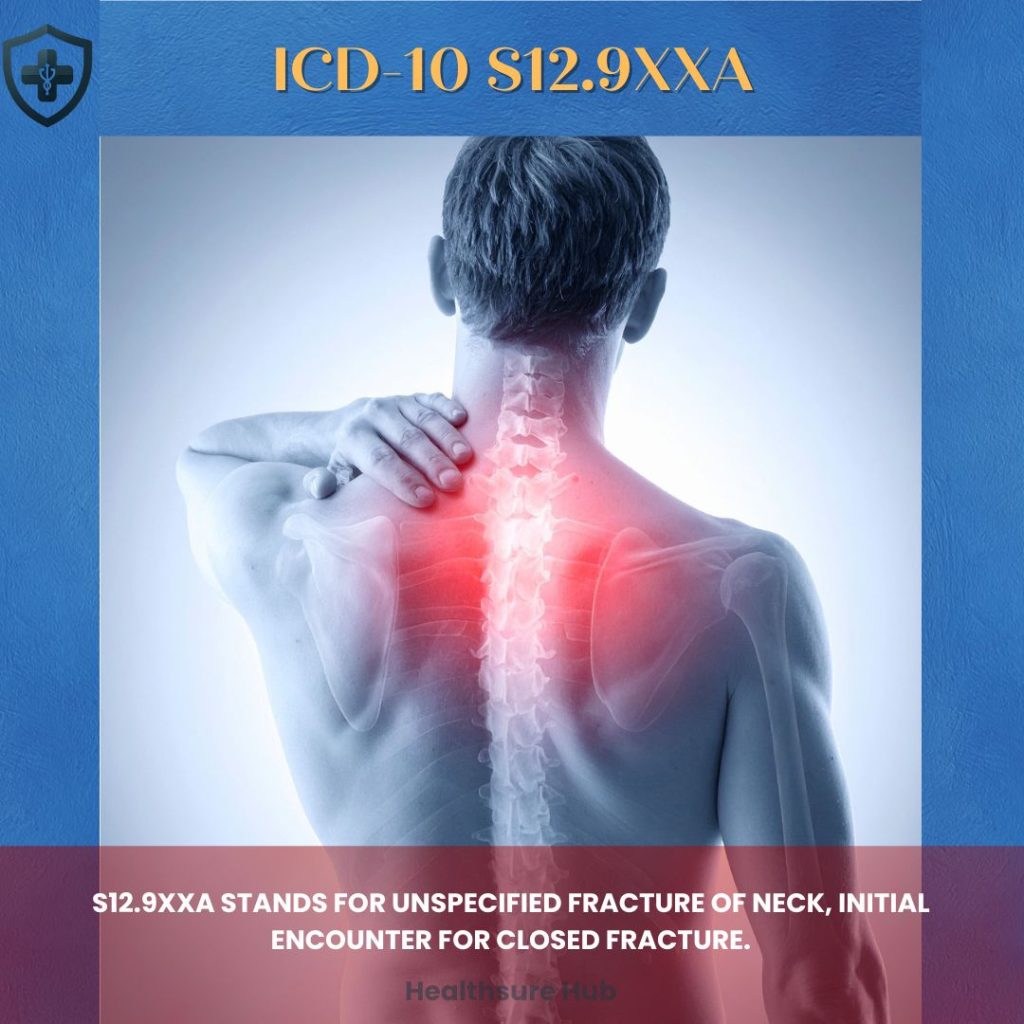
Even a seemingly minor injury can carry the risk of spinal cord damage, long-term disability, or life-threatening complications. Because of this, accurate diagnosis, documentation, and medical coding are essential from the very first encounter. One ICD-10-CM code commonly used in early trauma care is S12.9XXA, which represents an unspecified fracture of the neck during the initial encounter for a closed fracture.
At Healthsure Hub, we provide a detailed, clinically accurate explanation of S12.9XXA, including when it is used, why it matters, and how it supports both patient safety and proper medical documentation.
Break Down of S12.9XXA
S12.9XXA stands for unspecified fracture of neck, initial encounter for closed fracture. It’s a code used to document a fracture of one or more cervical vertebrae (C1–C7) when the specific vertebra or fracture type has not yet been fully identified during the initial encounter for active treatment such as immobilization, traction, or surgery. As data shows, one third of injuries occur at level C2 while the other half occurs at level C6 or C7 of the cervical vertebrae.
Breaking down the code helps clarify its purpose:
- S12 – Fracture of the cervical spine and other parts of the neck
- .9 – The fracture site within the neck is unspecified
- XX – Placeholder characters required to maintain ICD-10 formatting
- A – Initial encounter, meaning the patient is receiving active treatment
A “closed fracture” means the skin remains intact, without an open wound communicating with the fracture. Using S12.9XXA allows clinicians to document a confirmed injury promptly, even when imaging or specialist input is pending.
This code is typically assigned when a neck fracture is confirmed, but the exact vertebra or fracture pattern has not yet been fully identified.
Understanding Neck and Cervical Spine Fractures
The neck contains the cervical spine, composed of seven vertebrae (C1–C7), which protect the spinal cord while supporting head movement and stability. Fractures in this region are particularly dangerous because even minimal displacement can compromise neurological function.
Cervical fractures range from relatively stable injuries requiring immobilization to highly unstable fractures that demand urgent surgical intervention. Because of this wide spectrum, early identification and cautious management are critical.
When Is S12.9XXA Used in Clinical Practice?
S12.9XXA is most often used during the initial evaluation phase, particularly in emergency and trauma settings. It applies when:
- Imaging confirms a fracture of the neck
- The exact cervical vertebra has not yet been specified
- The fracture is closed
- The patient is receiving active treatment
This code allows clinicians to document a confirmed injury without delaying care while awaiting advanced imaging or specialist interpretation. Once more details are available, the diagnosis should be updated to a more specific cervical fracture code.
Common Causes of Unspecified Neck Fractures
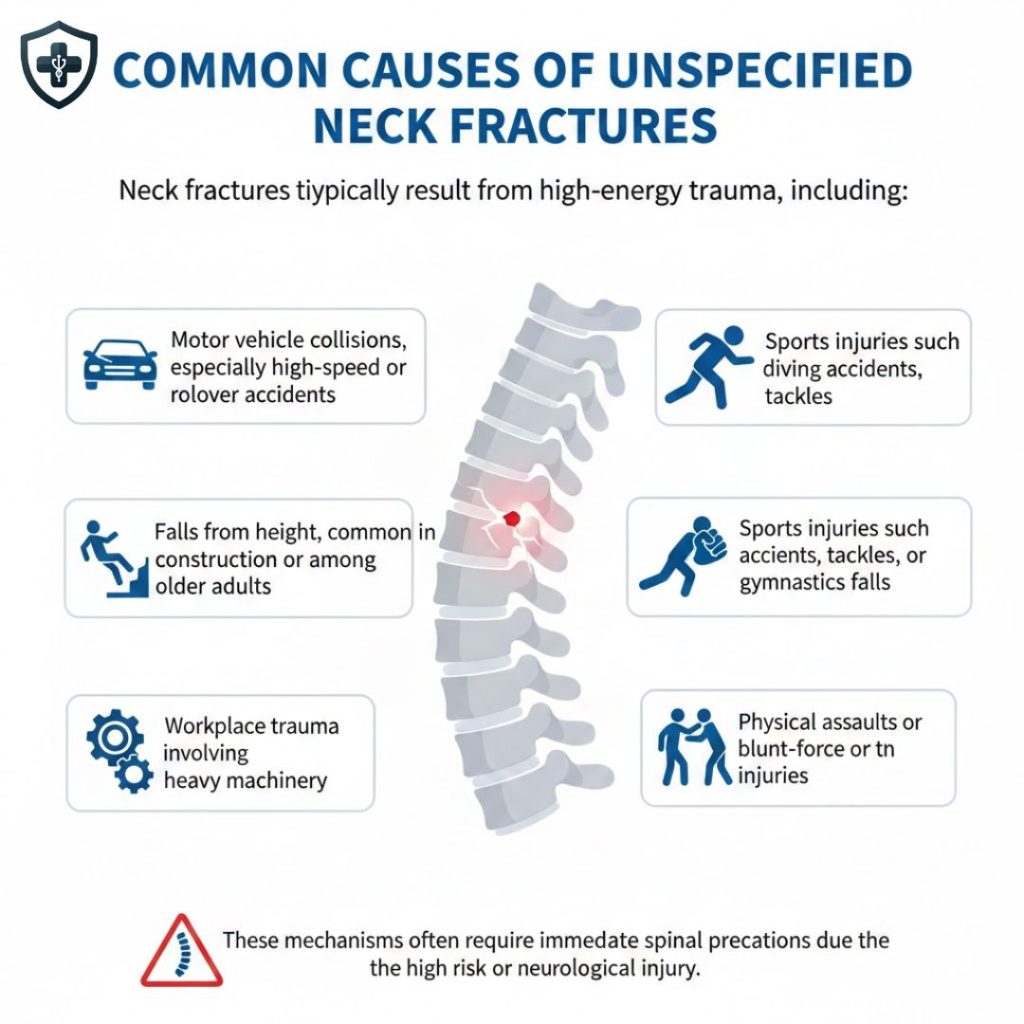
Neck fractures typically result from high-energy trauma, including:
- Motor vehicle collisions, especially high-speed or rollover accidents
- Falls from height, common in construction or among older adults
- Sports injuries such as diving accidents, football tackles, or gymnastics falls
- Workplace trauma involving heavy machinery
- Physical assaults or blunt-force injuries
These mechanisms often require immediate spinal precautions due to the high risk of neurological injury.
Signs and Symptoms of a Neck Fracture
Symptoms can vary widely depending on severity but often include:
- Severe neck pain or tenderness
- Stiffness or inability to move the neck
- Headache following trauma
- Swelling or bruising in the neck area
- Neurological symptoms such as numbness, tingling, or weakness in the arms or legs
In severe cases, patients may experience difficulty breathing, paralysis, or loss of consciousness. Importantly, symptoms may not always be dramatic at first, which is why imaging and cautious evaluation are essential.
Diagnostic Evaluation During the Initial Encounter
When a neck fracture is suspected, trauma protocols require immediate cervical spine immobilization to prevent further injury. Initial diagnostic imaging typically includes X-rays for screening, CT scans for rapid and precise assessment, and MRI if soft tissue or spinal cord injury is suspected. During this early phase, S12.9XXA may be assigned even before the full diagnostic workup is complete.
Treatment during the initial encounter focuses on stabilization and preventing secondary injury. This may involve cervical collars or braces, pain management, hospital admission for monitoring, and specialist consultation. Surgical intervention may be necessary if the fracture is unstable or neurological compromise is present. Prompt treatment improves outcomes, while delayed diagnosis or inadequate stabilization can lead to spinal cord injury, chronic pain, reduced mobility, or permanent neurological deficits.
Treatment During the Initial Encounter
Management depends on injury severity but often includes:
- Cervical spine immobilization using collars or braces
- Pain management and anti-inflammatory medications
- Hospital admission for monitoring in moderate to severe cases
- Consultation with orthopedic or neurosurgical specialists
- Surgical intervention if instability or neurological compromise is identified
Early treatment focuses on stabilization and preventing secondary injury.
Prognosis and Potential Complications
Outcomes vary depending on the fracture type, patient age, and timeliness of care. With prompt treatment, many patients recover well. However, delayed diagnosis or inadequate stabilization can result in serious complications, including:
- Spinal cord injury
- Chronic neck pain
- Reduced mobility or range of motion
- Permanent neurological deficits
This underscores the importance of early recognition and accurate documentation.
Coding and Documentation Considerations
S12.9XXA is intended solely for the initial encounter when a cervical spine fracture is confirmed but not fully classified. Once imaging, specialist evaluation, or surgical findings clarify the exact vertebra and fracture type, the unspecified code should be replaced with a more precise ICD-10-CM code.
For example:
- S12.0 – Fracture of the atlas (C1)
- S12.1 – Fracture of the axis (C2)
- S12.2 – Fracture of the first cervical vertebra other than C1 or C2
- S12.3 – Fracture of other specified cervical vertebrae
- S12.4 – Fracture of multiple cervical vertebrae
Each of these codes also has the same encounter extension system:
- A for initial encounter
- D for subsequent encounter for routine healing
- S for sequela (complications or long-term effects)
For instance, if imaging later identifies a C2 (axis) fracture during the initial active treatment, the correct code would be S12.1XXA instead of the generic S12.9XXA. Similarly, if multiple cervical vertebrae are fractured, S12.4XXA would be appropriate.
Updating from an unspecified to a specific code is not just a coding formality—it ensures:
- Accurate clinical documentation for the patient’s medical record
- Proper reimbursement from insurers
- Reliable epidemiologic data for trauma registries and research
- Clear communication among care teams, particularly when surgery or rehab is required
In short, S12.9XXA is a temporary placeholder, and careful follow-up coding guarantees precision and supports both patient safety and administrative compliance.
Conclusion
S12.9XXA plays a critical role in early trauma care by allowing clinicians to document serious neck injuries promptly and accurately. While it is a temporary and unspecified code, it supports immediate treatment, patient safety, and proper medical communication.
As care progresses, transitioning to a more specific diagnosis ensures optimal outcomes, precise data reporting, and compliance with coding standards. When used appropriately, the code is an essential tool in the management of cervical spine trauma.
About the Author