Accidental injuries happen more often than most people realize. From bumping into a door at home to colliding with equipment at work, minor impacts can sometimes lead to serious medical issues.
In the world of medical coding, these incidents are precisely categorized using ICD-10 codes, which help healthcare providers document, treat, and track injuries effectively. One such code is W22.8XXA. At HealthSure Hub, we help you understand this code and why it is essential for medical professionals, insurance providers, and patients seeking clarity on their injuries.
What is W22.8XXA?
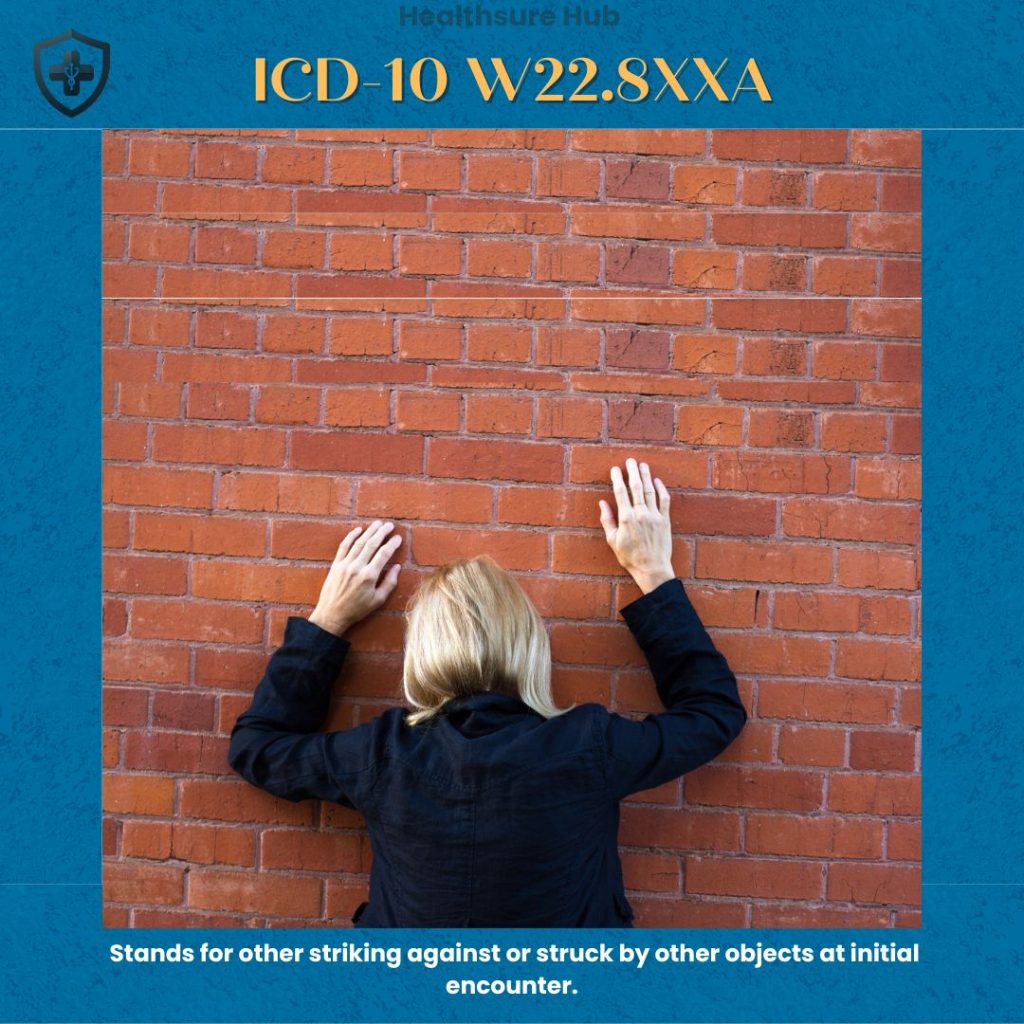
W22.8XXA is an ICD-10 diagnosis code for an initial encounter where you strike against or are being struck by other objects. W22.8XXA is an external cause ICD-10-CM code used during an initial encounter for an injury resulting from contact with an object that is not otherwise classified under more specific codes. Specifically, this code applies when the object causing the injury does not fall under other predefined categories like the case with the ICD-10 code W20.8XXA for falling objects. The code is broken down as follows:
| Code Component | Meaning |
| W22 | Striking against or struck by objects |
| .8 | Other specified objects not classified elsewhere |
| XX | Placeholder for specificity (laterality if applicable) |
| A | Initial encounter (the first treatment for this injury) |
The “A” at the end of the code indicates that this is the first time the patient is receiving active treatment for the injury. This distinction is important because follow-up visits and long-term effects require different encounter extensions for accurate reporting and reimbursement.
How W22.8XXA Differs From Similar Codes
One of the most common coding mistakes is using W22.8XXA when a more specific external cause code applies. ICD-10 follows a hierarchy that prioritizes specificity whenever possible.
For example:
- W20.- codes apply when an injury is caused by a falling object
- W21.- codes apply to injuries caused by sports equipment
- W22.0 applies to injuries from thrown or projected objects
W22.8XXA should only be used when the object involved does not clearly fit into these categories. This distinction is especially important during payer audits, where overuse of “other specified” codes may trigger requests for additional documentation.
Common Causes and Real-Life Examples
In clinical practice, injuries coded under W22.8XXA tend to arise from ordinary, unscripted events rather than dramatic accidents. Patients may not even realize the seriousness of the incident until symptoms worsen.
Common examples include:
- Walking into low-hanging cabinets, beams, or open doors
- Striking a wall or railing while carrying bulky items
- Colliding with fixed machinery or shelving in a workplace
- Impact with gym equipment or structural obstacles
- Contact with playground structures, posts, or barriers
These situations share a key feature: the object involved is stationary or incidental, not falling, thrown, or moving in a way that qualifies for a different ICD-10 category.
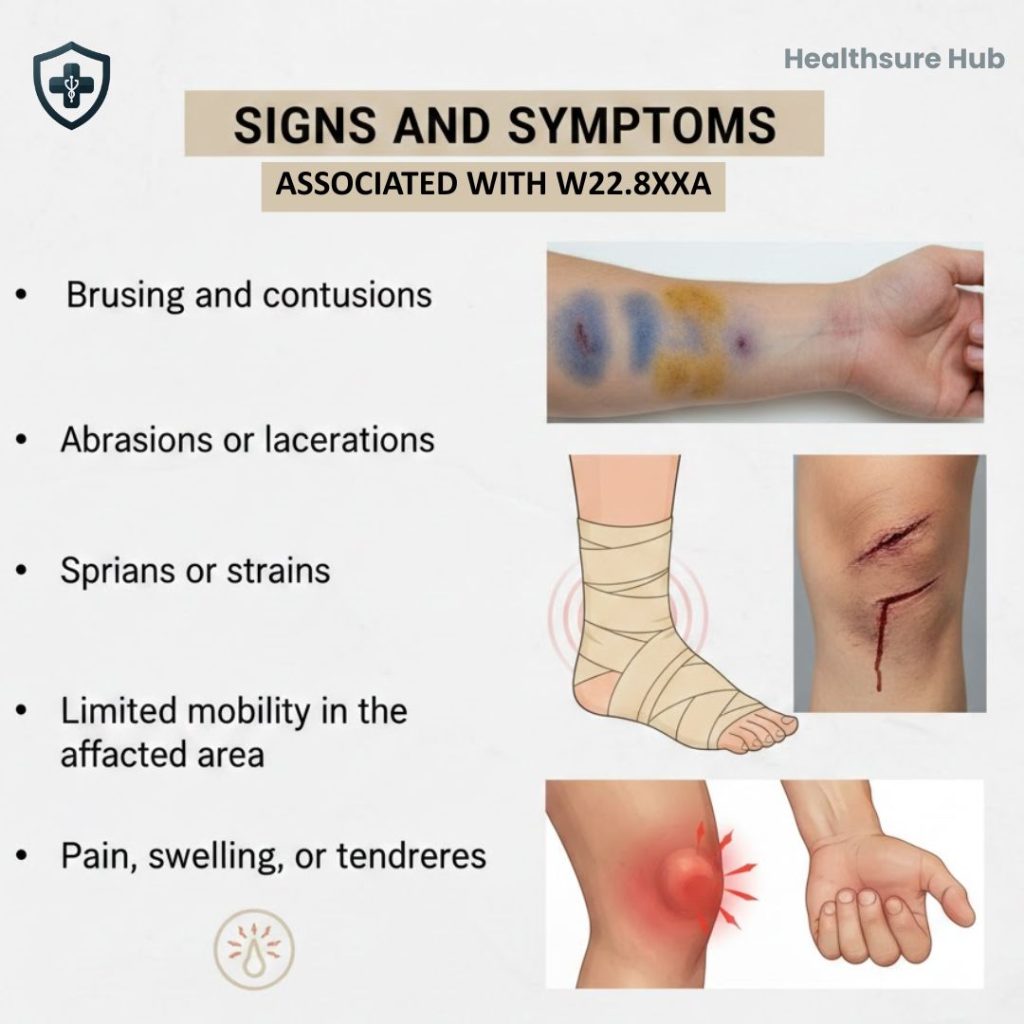
Signs and Symptoms
The injuries associated with this specific ICD-10 code can vary depending on the force and location of impact. Common symptoms include:
- Bruising and contusions – patients experience bruising or contusions caused by damage to small blood vessels beneath the skin, which may become more pronounced over the first 24 to 48 hours.
- Abrasions or lacerations – occur when the skin makes contact with rough or sharp surfaces, increasing the risk of infection if not properly cleaned and treated.
- Pain, swelling, or tenderness – common across most presentations and can range from mild discomfort to significant functional impairment.
Impacts involving joints or muscles may lead to sprains or strains, often accompanied by stiffness, weakness, or limited mobility that interferes with normal daily activities.
It is crucial to monitor the injury for more severe symptoms such as persistent pain, deep cuts, or signs of fractures. Immediate medical evaluation ensures complications are prevented and proper treatment begins promptly.
How Common Are Striking-Object Injuries?
According to the National Safety Council, contact with objects is one of the leading causes of work-related deaths and injuries, with about 700 workplace fatalities each year attributed to these types of incidents over the past decade and hundreds of thousands of nonfatal injuries annually that result in days away from work. The risk is not limited to heavy industry: while approximately 75 % of struck-by fatalities involve heavy equipment such as trucks or cranes, workers across agriculture, construction, manufacturing, emergency services, transportation, and even office environments can experience serious consequences when attention lapses or hazards are not controlled.
This real-world injury burden helps explain why accurate documentation and proper use of codes like W22.8XXA are critical for patient care tracking, injury prevention programs, and workplace safety analysis.
Medical Evaluation and Diagnosis
When treating a patient whose injury falls under W22.8XXA, clinicians focus on both the injury itself and the mechanism of impact. A detailed patient history helps clarify what object was involved, how the collision occurred, and whether protective factors—or risk factors—were present.
Physical examinations typically assess tenderness, swelling, skin integrity, and joint stability. If the clinical picture suggests deeper injury, imaging such as X-rays or CT scans may be ordered. All of this information supports accurate coding and helps distinguish this event from similar but more specifically classified incidents.
Coding Tips for Healthcare Professionals
For medical coders and billing professionals, precision is critical. W22.8XXA should only be used when no more specific external cause code applies and when the visit represents the initial encounter. Clear documentation of the object involved, the circumstances of the injury, and the affected body area helps prevent claim denials and supports continuity of care.
As treatment progresses, subsequent visits must be updated with the appropriate encounter extension to reflect ongoing care or recovery.
Legal and Insurance Considerations
For workplace incidents, accurate documentation under W22.8XXA is essential for workers’ compensation claims. Insurance providers rely on precise ICD-10 coding to process claims, reimburse treatment costs, and assess liability. Detailed medical records protect both the patient and the provider in legal or insurance disputes.
Conclusion
The ICD-10 code W22.8XXA plays a crucial role in documenting injuries caused by striking against or being struck by miscellaneous objects. From minor bumps at home to workplace collisions, this code ensures that injuries are properly tracked, treated, and reported. For healthcare professionals, accurate coding, thorough documentation, and patient follow-up are essential.
For patients, awareness of the circumstances and preventive measures can minimize the risk of future injuries. Understanding and using W22.8XXA effectively contributes to better healthcare outcomes, precise insurance processing, and improved overall safety.
About the Author