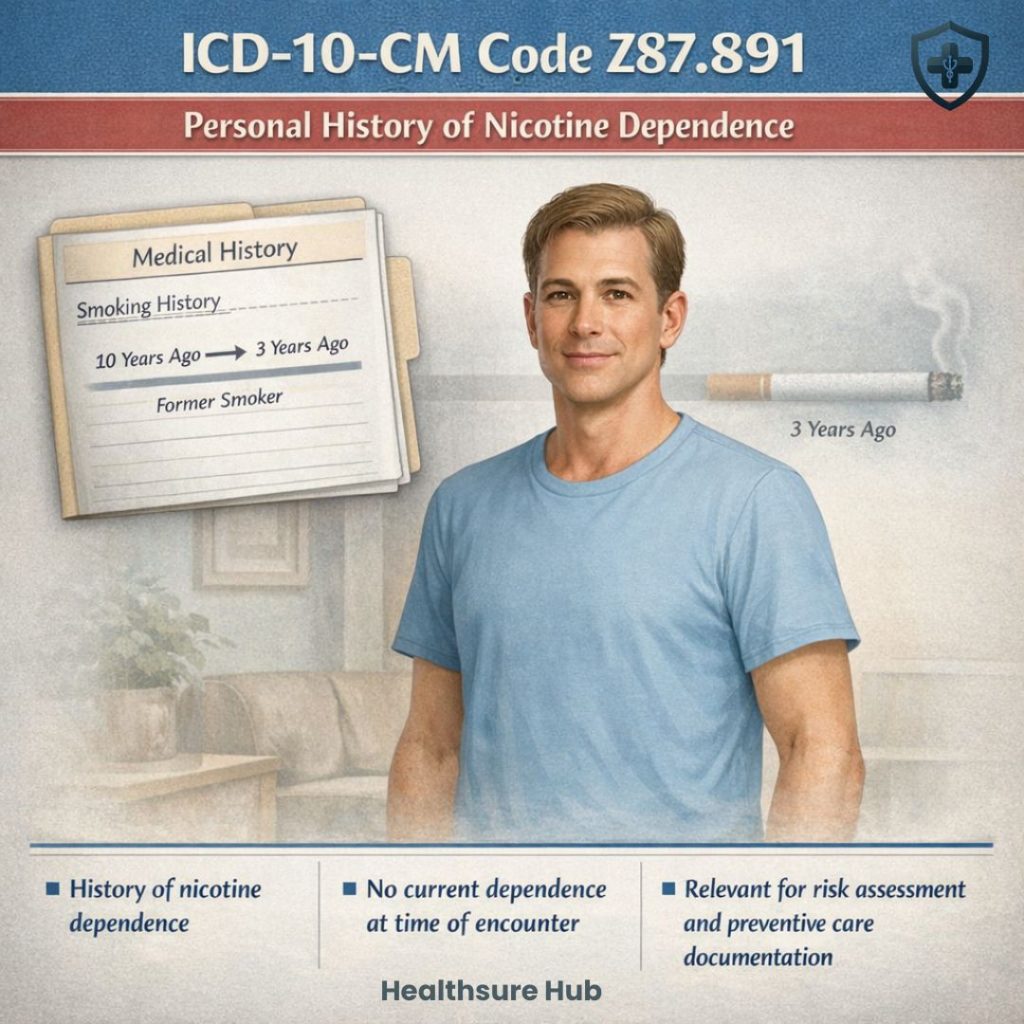
Accurate medical documentation goes beyond identifying active conditions. A patient’s medical history often plays a critical role in clinical decision-making, preventive care, and risk assessment. One ICD-10 code frequently used to capture this information is Z87.891. The ICD-10 code Z87.891 represents a personal history of nicotine dependence, indicating that the patient previously met criteria for nicotine dependence but no longer does at the time of the encounter.
This code commonly appears in primary care visits, preventive screenings, and chronic disease management. At Healthsure Hub, we help readers understand why this code is essential for accurate coding, clean claims submission, and meaningful interpretation of medical records.
Overview of ICD-10 Code Z87.891
Z87.891 belongs to the ICD-10-CM “Z” chapter, which includes factors influencing health status and reasons for encounters other than active illness or injury. Unlike diagnosis codes that describe current conditions, the code documents resolved or historical conditions that may still affect a patient’s health risks or care planning.
Providers frequently report this during annual exams, cardiovascular risk assessments, and metabolic evaluations, similar to how R73.03 (prediabetes) is documented to capture early risk factors rather than active disease.
This code is used when nicotine dependence is no longer active but remains clinically relevant. Providers frequently report Z87.891 during annual exams, cardiovascular risk assessments, cancer screenings, and preoperative evaluations. Proper use of this ICD-10 code ensures that the patient’s health history is accurately represented without misclassifying them as a current tobacco user.
What “Personal History of Nicotine Dependence” Means in Coding
In ICD-10 terminology, a personal history code indicates a condition that is no longer active but remains clinically relevant. When this ICD-10 code gets assigned, it confirms that nicotine dependence has resolved and does not require active treatment or counseling.
In the United States alone, there were over 56 million former smokers in 2022, and public health data show that this number continues to rise each year as cessation efforts improve. This growing population explains why history-based ICD-10-CM codes are increasingly relevant in everyday clinical documentation.
Common Scenarios for Z87.891
Healthcare providers frequently assign the code in scenarios such as:
- Annual wellness exams for former smokers
- Chronic condition follow-ups where past nicotine use affects care planning
- Pre-surgical assessments and hospital admissions
- Long-term health monitoring programs
During annual wellness exams, Z87.891 may appear alongside symptom-based codes such as R53.83, particularly when reviewing long-term health history.
In these cases, Z87.891 supports comprehensive documentation while maintaining accuracy regarding current patient behavior.
Importance of Accurate Coding
Correct use of this code is essential for:
- Billing compliance and reduced claim denials
- Clinical clarity in patient records
- Population health accuracy and public health reporting
- Continuity of care across providers and encounters
Although the code reflects a resolved condition, it remains a meaningful part of the patient’s medical history.
Acceptable Documentation Indicators
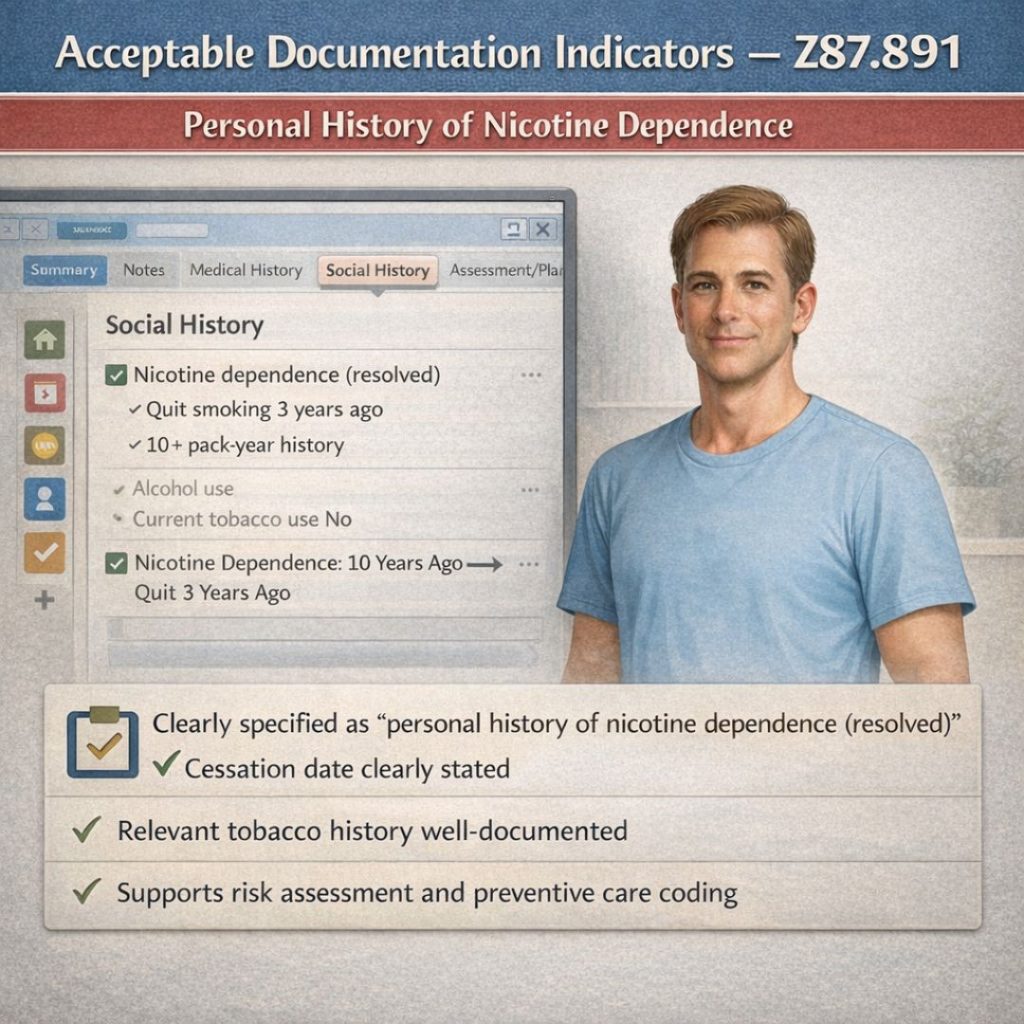
ICD-10-CM code Z87.891 is used to document a personal history of nicotine dependence that is no longer active. Accurate documentation of this resolved condition is essential for clinical recordkeeping, risk assessment, and preventive care planning. While the patient no longer uses nicotine, proper recording of their history ensures continuity of care and supports appropriate coding and billing practices.
Key Elements of Acceptable Documentation
Effective documentation should clearly distinguish between past and current tobacco use. Indicators of acceptable documentation include:
- Resolved Nicotine Dependence: The patient’s history should explicitly note that nicotine dependence is no longer present. This may be recorded as “former smoker” or “quit smoking.”
- Cessation Date: Including the date or approximate time since quitting is important to provide context for risk assessment and preventive care recommendations.
- Tobacco Use History: Relevant details such as duration of prior nicotine use, quantity (e.g., pack-years), and method of consumption help create a comprehensive social history.
- Support for Risk Assessment: Documentation should enable healthcare providers to identify residual risk factors related to prior tobacco use, such as cardiovascular or pulmonary conditions
Conclusion
ICD-10 code Z87.891 provides a standardized way to document a personal history of nicotine dependence without indicating current use. Supported by population-level data and clinical relevance, this code plays an important role in preventive care, risk stratification, and long-term health documentation.
Understanding how and when to apply the code helps ensure accurate records, compliant billing, and reliable health data. At Healthsure Hub, we’re committed to making ICD-10 coding clearer, more accurate, and easier to navigate.
About the Author