Imagine a patient walking into a clinic after noticing unusual bruising and prolonged bleeding from minor cuts. For clinicians, a small test could provide answers that impact diagnosis, treatment, and even surgical planning. Among the tools available, one lab procedure quietly plays a key role in evaluating the body’s primary defense against excessive bleeding. This is where CPT Code 85002 comes into play, a hematology test that might seem routine on paper, but in practice, can provide critical insights into platelet function and vascular health.
From here, our team at HealthSure Hub explains what the test is, why it’s ordered, and its clinical and billing relevance.
What is CPT Code 85002?
CPT code 85002 is the code for the bleeding time test; a specialized hemostasis assay focused on how fast bleeding stops after a controlled incision. CPT code 85002 belongs to Pathology and Laboratory Procedures (CPT 85002–85999) under Hematology and Coagulation.
By assessing primary hemostasis, the ability of platelets and small blood vessels to form an initial clot, it helps detect functional problems in the blood that are not apparent from routine complete blood counts (CBCs) or tests that measure how long it takes for your blood to clot.
This is particularly important in situations such as:
- Suspected platelet dysfunction- patients may present with excessive bruising, nosebleeds, or heavy menstrual bleeding.
- Evaluation of von Willebrand disease – a genetic disorder that affects platelet adhesion and clot formation.
- Monitoring the impact of antiplatelet medications- drugs like aspirin or clopidogrel can prolong bleeding time and may require close monitoring.
- Preoperative assessment- understanding platelet function before surgery or invasive procedures reduces the risk of excessive bleeding complications.
Because the bleeding time test directly measures how the body controls bleeding after a minor injury, it can give specific information not available from simple cell counts or clotting factor tests visible when other hematology cpt codes are ordered.
What Is the Bleeding Time Test?
The bleeding time test is designed to measure the duration of bleeding after a controlled incision. A trained healthcare professional makes a standardized cut on the skin (commonly the forearm), often using a specific device. The time from incision until the bleeding stops, measured in minutes, is recorded.
This measurement reflects the ability of the blood vessel walls and platelets (not clotting factors) to stop bleeding through vasoconstriction and platelet aggregation. In other words, it evaluates primary hemostasis, not the coagulation cascade studied in tests like PT/INR or aPTT.
What Does the CPT Code 85002 Test?
In essence, CPT code 85002 tests how efficiently the body stops bleeding in the early phase of clot formation. The test assesses:
- Platelet adhesion and aggregation at the wound site
- The ability of small blood vessels to constrict and control blood flow
- Overall primary hemostatic function
This functional evaluation is particularly useful when other blood tests, like complete blood counts or coagulation factor assays, cannot explain abnormal bleeding patterns.
Correct use of this code ensures that healthcare providers can monitor, diagnose, and manage bleeding disorders accurately, while coders and billing staff can document the test properly for reimbursement.
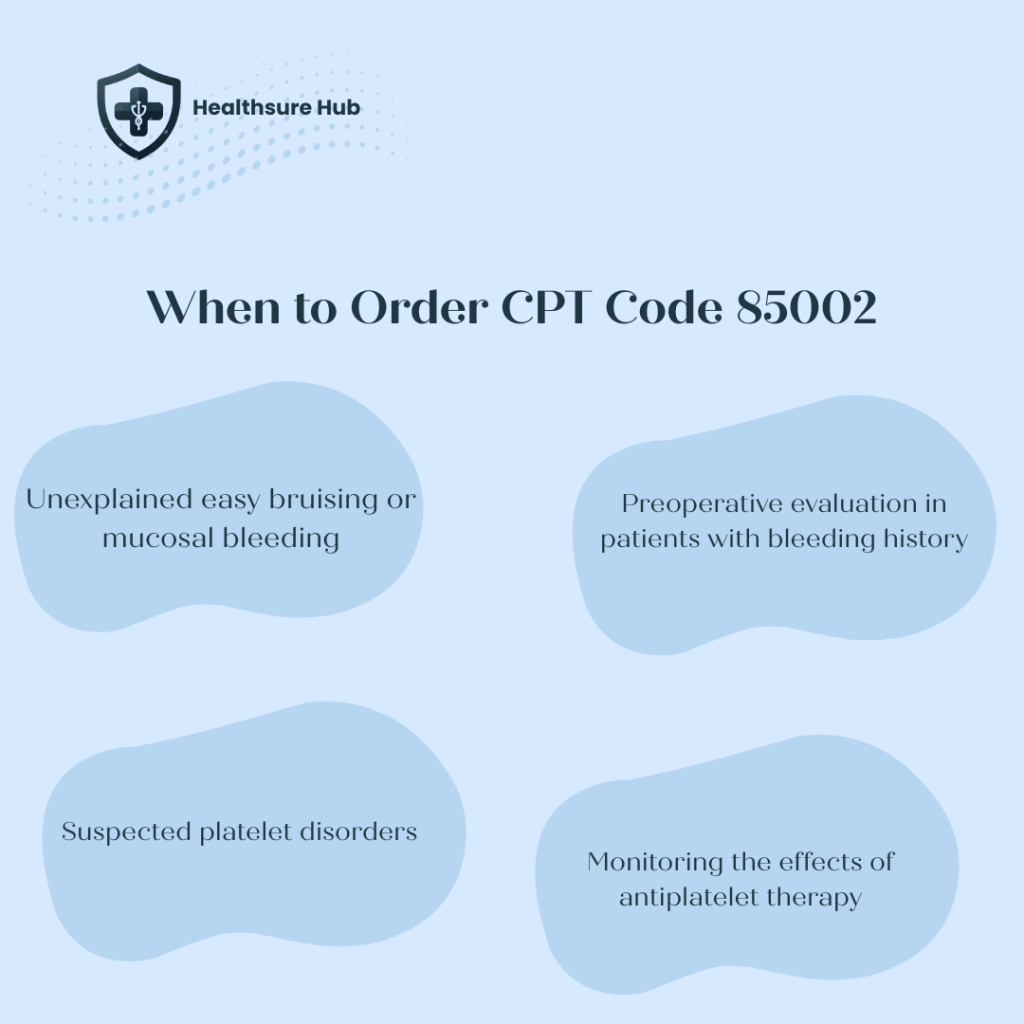
When to Order CPT Code 85002
Healthcare providers order this test when other routine hematology tests fail to explain bleeding symptoms, or when a specific functional assessment of platelets is required. Typical clinical scenarios include:
- Unexplained easy bruising or mucosal bleeding
- Preoperative evaluation in patients with bleeding history
- Suspected platelet disorders (congenital or acquired)
- Monitoring the effects of antiplatelet therapy
While newer platelet function tests exist (e.g., platelet aggregation assays), the bleeding time test remains relevant in resource-limited settings or when initial functional assessment is needed.
Billing and Coding Considerations of CPT code 85002
CPT code 85002 is part of hematology and coagulation procedures, making its proper billing important for compliance and reimbursement:
- Medical Necessity- claims must document clinical indications for the test.
- Standalone Billing- 85002 should not be bundled with routine CBCs or panels unless specifically indicated.
- Modifiers- Depending on payer policy, technical (TC) and professional (26) components may need modifiers. Repeat testing may require modifier 91.
- Documentation- Clinical notes should justify the test and provide results to support claims.
Coverage: Medicare and most private payers cover CPT code 85002 when medically necessary, though documentation is essential. Denials may occur if clinical justification is insufficient or the test is inappropriately bundled.
Conclusion
CPT code 85002 may seem like a small line in a coding manual, but it represents a critical tool in hematology.
By measuring the body’s ability to form an initial clot, it provides unique insights into platelet function and vascular integrity, information that routine blood counts cannot reveal.
For clinicians, coders, and lab professionals, understanding when and how to use 85002 ensures accurate billing, compliance, and most importantly, better patient care.
About the Author