Blood tests are a cornerstone of modern medicine. Whether during a routine check-up or investigating an illness, a simple blood test provides a wealth of information about your health. But if you’ve ever looked at a lab report or insurance statement, you might have noticed cryptic codes like the CPT code 85027.
But what does CPT 85027 on a blood report actually mean? Should you be concerned, or is it simply a common code used in hematology? Healthsure Hub explains the CPT code 85027 in detail, what it measures, and how it differs from similar codes.
What is CPT Code 85027?
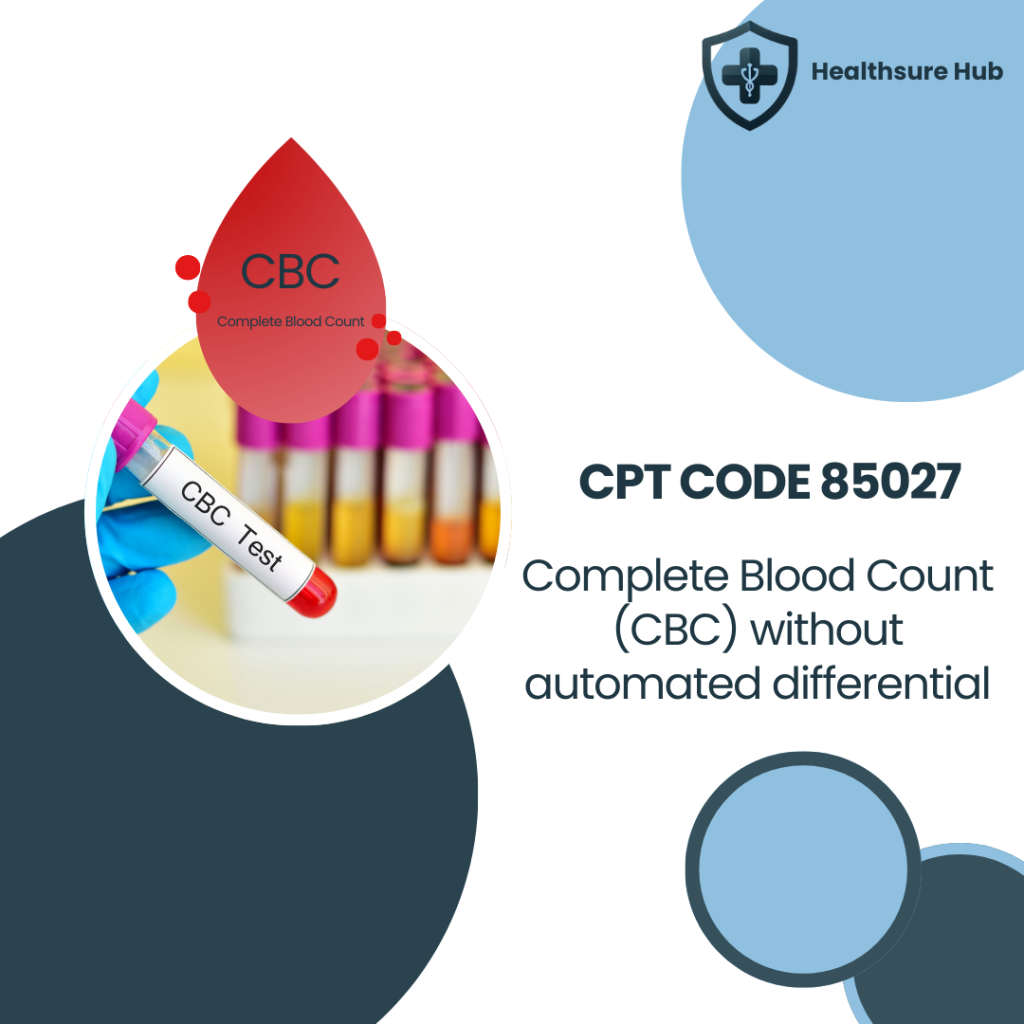
CPT code 85027 refers to a Complete Blood Count (CBC) without a differential. This test evaluates overall blood health by measuring the quantity and characteristics of major blood components, without analyzing the individual types of white blood cells.
In other words, CPT 85027 provides a broad overview of blood cell levels but does not include a white blood cell differential.
What Does CPT Code 85027 Measure?
A CBC billed under CPT 85027 typically includes:
- Red blood cell (RBC) count – reflects oxygen-carrying capacity
- Hemoglobin (Hgb) – the protein in RBCs that carries oxygen
- Hematocrit (Hct) – the percentage of blood made up of RBCs
- White blood cell (WBC) total count – overall immune cell level (no breakdown)
- Platelet count – important for blood clotting
- Red blood cell indices, such as:
- Mean corpuscular volume (MCV)
- Mean corpuscular hemoglobin (MCH)
- Mean corpuscular hemoglobin concentration (MCHC)
- Red cell distribution width (RDW)
- Mean corpuscular volume (MCV)
Who Typically Orders CPT Code 85027?
CPT 85027 is commonly ordered by:
- Primary care providers during routine exams or annual physicals
- Specialists monitoring chronic medical conditions
- Hospitals or outpatient clinics for baseline or follow-up blood testing
This test is especially useful when a general assessment of blood health is needed, rather than detailed immune analysis.
How is the Test Performed?
The test is simple and minimally invasive:
- A healthcare professional draws a small blood sample, usually from your arm’s vein.
- Fasting is generally not required for this test.
- The blood sample is sent to a lab, where machines count and categorize your blood cells automatically.
Patients might experience slight discomfort or minor bruising at the needle site, but serious complications are extremely rare.
When CPT Code 85027 is Typically Used
Using CPT Code 85027 correctly helps prevent coding mistakes, which can delay insurance payments or create confusion. This code is applicable in a variety of clinical scenarios, especially when detailed information about a patient’s blood cells is needed.
Investigating Unexplained Symptoms
Medically unexplained symptoms, like persistent fatigue, low-grade fever, or general malaise, account for a significant portion of primary care visits. When a patient presents with such symptoms, healthcare providers often order a complete blood count without automated differential to identify possible infections or blood disorders.
For example, a 28 year-old female patient visits a primary care clinic complaining of ongoing fatigue and intermittent fevers. To determine whether there’s an underlying infection or anemia, the physician orders a CBC with an automated differential. The lab performs the test, measures red and white blood cells, platelets, and hemoglobin, and reports the test using CPT code 85027.
Monitoring Chronic Health Conditions
Patients with chronic conditions often require regular blood monitoring. The conditions include :
CPT 85027 provides a detailed snapshot of blood cell levels, helping physicians track disease progression or complications like anemia.
Let’s say a 60-year-old man with stage 4 chronic kidney disease visits the hospital for a routine follow-up. He’s experiencing new symptoms, including fatigue and shortness of breath. To monitor his blood counts, the physician orders a standard blood count test. The lab performs the test and documents it using CPT 85027.
Evaluating Treatment Effectiveness
With 25% of cancer patients going to chemotherapy via different methods, healthcare providers need to evaluate the effectiveness of their treatment using various tests, including a CBC with automated differential. A 55-year-old woman undergoing chemotherapy for breast cancer completes her second cycle. To check the impact on her blood cells, her oncologist orders a CBC without automated differential. The lab collects her sample, runs the analysis, and bills it under CPT 85027.
Monitoring Bone Marrow Disorders
Patients with conditions affecting bone marrow, like leukemia or myelodysplastic syndromes, require detailed blood monitoring. A CBC with automated differential helps track the production and proportion of different white blood cell types.
For instance, let’s take a 45-year-old patient diagnosed with a mild bone marrow disorder undergoing routine blood monitoring. The lab performs a CBC without automated differential to evaluate the patient’s white blood cell populations, billing it using CPT 85027.
Modifiers That Can Be Used with CPT 85027
Certain modifiers may apply to provide additional context or avoid a high claim denial rate:
- Modifier 59 – used to indicate that the CBC without differential was a distinct and separately identifiable service from other laboratory tests performed on the same day.
- Modifier 90 – applied when the test is performed by an outside or reference laboratory.
- Modifier 91 – used when the CBC without differential is repeated on the same day due to medical necessity.
CPT 85027 vs CPT 85025
Many healthcare providers and patients often wonder how CPT 85027 differs from CPT code 85025. While both codes are commonly used as CPT codes in hematology and involve a complete blood count, the main difference is the level of detail provided about white blood cells.
CPT 85027 is a standard CBC without an automated differential, measuring red blood cells, hemoglobin, hematocrit, total white blood cells, and platelets. In contrast, CPT 85025 covers the basic CBC components but it includes an automated breakdown of the types of white blood cells such as:
This added detail can be crucial when evaluating infections, monitoring chronic conditions like leukemia, or tracking the effects of treatments such as chemotherapy.
Conclusion
CPT code 85027 is a powerful tool that provides a basic look at your blood and immune system. Whether for routine screenings, chronic condition monitoring, or acute diagnosis, it offers valuable insights for both patients and healthcare providers. Understanding this code, how it differs from similar tests like CPT 85025, and how to interpret results empowers patients to take a more active role in their healthcare.
Being informed about CPT codes helps ensure accurate billing, proper insurance coverage, and a clearer understanding of the vital information your blood tests reveal.
About the Author