A single abnormal blood clotting result can delay surgery, change medications, or signal a serious underlying disorder and CPT code 85730 is often the test behind that decision. For many patients and even non-clinical professionals, this code can feel confusing or overly technical at first glance.
CPT 85730 refers to a commonly ordered blood clotting test that helps providers evaluate bleeding risk, monitor certain medications, and assess underlying clotting disorders. Our team at Healthsure Hub is here to explain what the code is, why it is used, and how it’s performed, among many other things.
What Is CPT Code 85730?
CPT 85730 is the billing code used to report the standard Activated Partial Thromboplastin Time (aPTT) test. CPT codes are standardized identifiers used by laboratories, hospitals, and insurers to describe medical procedures and services in a consistent way. This code is used for a blood test that evaluates how long it takes blood plasma to clot.
It is important to distinguish between:
- The test itself: the aPTT blood test
- The CPT code: the administrative code used for documentation and billing
When a laboratory performs an aPTT test, CPT code 85730 is the code most commonly used to represent that service on claims and patient statements. The code falls within the most common hematology codes and coagulation testing category.
What Does the aPTT Test Measure?
The aPTT test measures how long it takes for blood plasma to form a clot under controlled laboratory conditions. Rather than counting blood cells with automated differential or without automated differential, this test evaluates how effectively certain clotting factors are working together.
Blood clotting is a complex, multi-step process involving proteins known as clotting factors. The aPTT test focuses on specific parts of this process, often referred to clinically as the intrinsic and common pathways of coagulation. If one or more clotting factors are missing, reduced, or inhibited, clot formation may take longer than expected.
Because of this, aPTT testing is especially useful when providers need insight into clotting function rather than overall blood composition.
What Is Included in CPT Code 85730?
From a laboratory standpoint, CPT 85730 includes the performance and analysis of the aPTT test on a blood plasma sample. This typically involves automated or semi-automated clot detection methods used in clinical laboratory settings.
The code generally covers:
- Preparation of the plasma sample
- Measurement of clotting time
- Standard laboratory analysis and reporting
What CPT code 85730 does not include are additional or follow-up coagulation studies that may be ordered if results are abnormal. For example, more specialized clotting factor tests or confirmatory studies are usually reported under separate CPT codes. Understanding this distinction is important when reviewing claims that list multiple hematology-related services.
Why Is CPT Code 85730 Ordered?
In clinical practice, the aPTT test is ordered for several important reasons. Providers commonly rely on this test when evaluating patients who have unexplained bleeding, easy bruising, or a personal or family history of bleeding disorders.
CPT 85730 is also frequently used to:
- Monitor patients receiving certain anticoagulant medications, such as heparin
- Evaluate clotting function before surgery or invasive procedures
- Assist in diagnosing inherited or acquired clotting disorders
- Help investigate abnormal bleeding or clotting events
In many cases, aPTT results are interpreted alongside other laboratory findings to give providers a more complete picture of a patient’s coagulation status. To fully evaluate a patient’s clotting ability, clinicians often order CPT 85730 alongside CPT code 85610 a code that measures the extrinsic pathway of the coagulation cascade.
What Does CPT Code 85730 Test For?
CPT 85730 measures the time (in seconds) it takes for blood plasma to form a clot after specific activating substances are added in the laboratory. Prolonged or shortened clotting times can indicate abnormalities in clotting factor function.
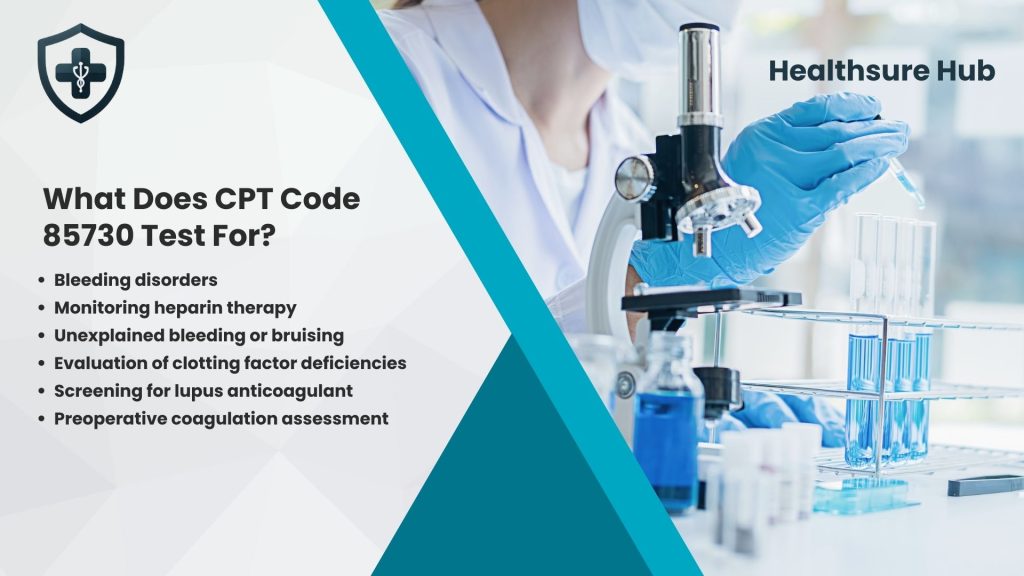
Conditions and situations that may prompt an aPTT test include:
- Bleeding disorders – such as hemophilia A or B, where clotting factor deficiencies delay clot formation
- Monitoring heparin therapy – aPTT is commonly used to ensure therapeutic but safe anticoagulation
- Unexplained bleeding or bruising – including prolonged bleeding after injury or surgery
- Evaluation of clotting factor deficiencies – especially in the intrinsic pathway
- Screening for lupus anticoagulant – an antibody that interferes with clotting tests and increases thrombosis risk
- Preoperative coagulation assessment – to identify bleeding risks before surgery
Importantly, CPT 85730 does not measure platelet aggregation or platelet function.
How Is the aPTT Test Performed?
The test is performed in a clinical laboratory using a blood sample drawn from a vein. The plasma portion of the blood is separated and combined with phospholipids, an activator, and calcium to initiate clot formation.
The laboratory measures how long it takes for a clot to form, and the result is reported in seconds. Abnormal values may signal clotting factor deficiencies, anticoagulant effects, or underlying coagulation disorders.
Insurance and Billing Considerations for CPT Code 85730
When CPT code 85730 appears on a lab bill or insurance statement, it indicates that an activated partial thromboplastin time test was performed. Coverage varies depending on the insurance plan and the documented medical necessity.
Patients can take proactive steps by:
- Asking their provider why the test was ordered
- Confirming coverage with their insurance carrier
- Keeping copies of lab results and billing statements
Understanding CPT codes helps patients become more informed participants in their healthcare decisions.
Conclusion
CPT Code 85730 plays a vital role in evaluating how effectively blood clots through the intrinsic and common coagulation pathways. Unlike platelet function tests, this assay focuses on clotting factors and anticoagulant effects, making it essential for diagnosing bleeding disorders, monitoring heparin therapy, and assessing surgical risk.
For both patients and providers, understanding CPT 85730 improves clarity, supports accurate diagnosis, and helps guide safe, effective treatment decisions in hematologic care.
About the Author