In pediatric healthcare, accurate documentation is essential for proper reimbursement, quality reporting, and smooth clinical workflows. One billing element that often leads to confusion, but plays a crucial role in vaccination services, is the CPT Code 90460.
This code specifically applies to immunization administration in children and adolescents and includes important components that impact both compliance and payment. In this article, our team at Healthsure Hub breaks down what CPT 90460 means, how it’s used, when it applies, and how it fits into pediatric practice today.
What Is CPT Code 90460?
CPT Code 90460 is used to report immunization administration for patients ages 18 and under when a healthcare provider gives counseling to the patient and/or their caregiver. The code includes both the administration of the vaccine and the counseling component, which makes it distinct from other immunization administration codes that do not require counseling (such as 90471 or 90472).
This code covers the first vaccine or toxoid component administered during a visit. A related code, 90461, is used for each additional component when vaccines contain multiple antigens.
Because 90460 bundles counseling with administration, it is most commonly used during routine pediatric visits where parents receive education about vaccine benefits, side effects, and expected outcomes.

When Should CPT Code 90460 Be Used?
CPT 90460 should be used when all of the following conditions are met:
- The patient is 18 years old or younger
- A physician or qualified health professional (QHP) provides face-to-face counseling about the vaccine
- The vaccine is administered the same day
- It applies to the first component of each vaccine product
This code is commonly used during visits such as:
- Well-child checkups
- School immunization appointments
- Adolescent preventive visits
- Catch-up vaccination schedules
However, if no counseling is provided—such as in a quick nurse-only visit—CPT code 90460 should not be used. Instead, the appropriate administration-only codes (90471–90474) should be used.
What Does “Vaccine Component” Mean for 90460 Billing?
Understanding the concept of “vaccine components” is essential for correct billing.
A component refers to each antigen within a vaccine that prevents a specific disease. For example:
- DTaP includes three components: diphtheria, tetanus, and pertussis
- MMR includes measles, mumps, and rubella
- Pediarix includes five components: diphtheria, tetanus, pertussis, hepatitis B, and polio
For a vaccine with multiple components:
- The first component is billed with the CPT code 90460
- Each additional component is billed with 90461
Correct component counting ensures accurate revenue capture and avoids underbilling, which is a common issue in pediatric medical billing.
Documentation Requirements for CPT Code 90460
To bill CPT 90460 appropriately, documentation must clearly support both administration and counseling. The medical record should include:
- The name of each vaccine administered
- Confirmation that face-to-face counseling was provided
- The topics discussed (e.g., side effects, benefits, safety)
- Who provided the counseling (must be a qualified healthcare professional)
- The route and site of vaccine administration
- Parent or caregiver consent
Many denials occur because the counseling component was not documented, even if it was given. A simple statement such as:
“Counseled parent on vaccine risks, benefits, side effects; parent verbalized understanding” can help ensure compliance.
Billing Examples Using CPT 90460
| Example | Scenario | Vaccine Components | Correct Billing Codes |
| Example 1: Single-Component Vaccine | A 10-year-old receives an influenza vaccine with counseling. | Influenza = 1 component | 90460 × 1 |
| Example 2: Multi-Component Vaccine | A child receives MMR with counseling. | MMR = 3 components | 90460 × 1 (first component) 90461 × 2 (additional components) |
| Example 3: Multiple Vaccines in One Visit | A 4-year-old receives DTaP and IPV with counseling. | DTaP = 3 components IPV = 1 component | DTaP: 90460 × 1 + 90461 × 2 IPV: 90460 × 1 |
These examples show how quickly units can add up and why understanding vaccine components is key for accurate billing.
CPT Code 90460 vs. 90471: What’s the Difference?
These two immunization administration codes are often confused, and using the wrong one can lead to medical billing errors, denied claim, compliance issues, or lost revenue. While they both relate to vaccine administration, the criteria for each code are very different, especially when it comes to patient age and whether counseling is provided.
CPT 90460
CPT 90460 is specifically designed for pediatric patients 18 years old or younger when a physician or qualified healthcare professional provides face-to-face vaccine counseling. It applies to the first component of each vaccine, and additional components within the same vaccine are billed using CPT 90461. Because it bundles administration and counseling, this code reflects both the technical and educational aspects of the visit.
CPT 90471
CPT 90471 is used when a vaccine is administered without counseling, and it can be billed for patients of any age. Unlike 90460, this code is billed per vaccine rather than per component, making it simpler but more limited. It also cannot be used in situations where counseling was given, even briefly, since counseling automatically shifts the service into CPT 90460 billing requirements.
How to Choose the Correct Code
The distinction between the two codes comes down to one key question: Was counseling provided by a qualified clinician?
If counseling took place, even briefly, the visit should be billed with CPT 90460 (plus 90461 for additional components).
If no counseling was provided and the patient simply received a vaccine, then CPT 90471 is the correct choice.
Common Billing Errors With CPT 90460
Even experienced billers and pediatric practices sometimes struggle with CPT 90460. The most common mistakes include:
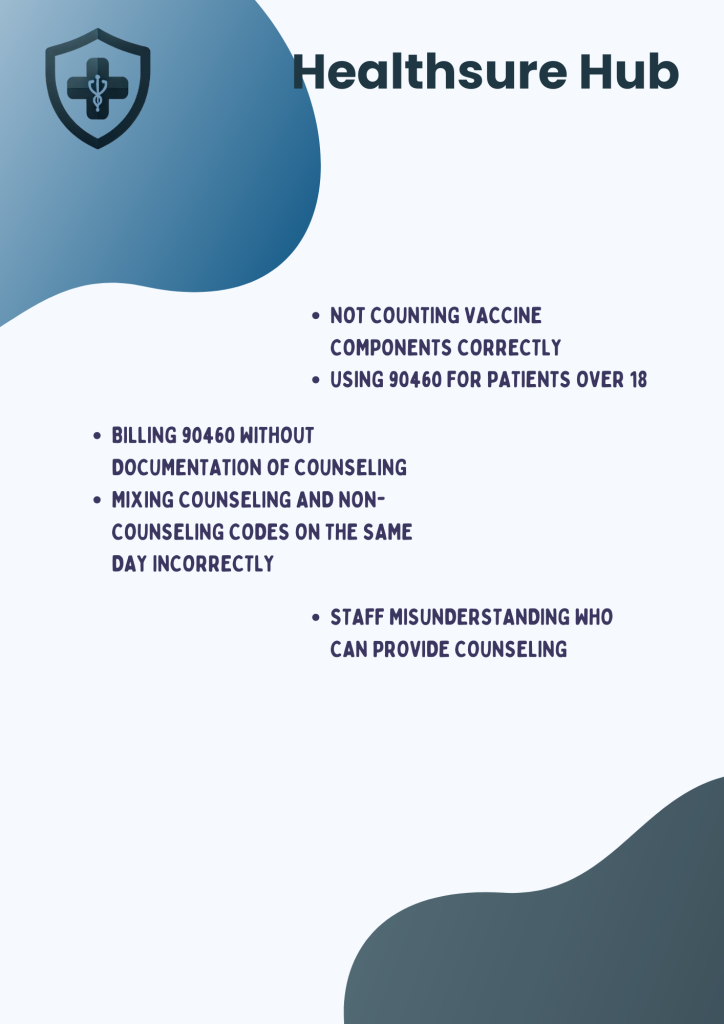
Not counting vaccine components correctly
Underbilling multi-component vaccines results in significant revenue loss because each antigen must be counted and billed accurately. Many practices miss additional components in combination vaccines, which leads to incomplete reimbursement for the service provided.
Using 90460 for patients over 18
This is one of the most frequent causes of claim denials, as the code is strictly limited to patients who are 18 years old or younger. Any administration to an adult—even with counseling—must be coded with adult immunization administration codes instead.
Billing 90460 without documentation of counseling
Payers require clear proof that a qualified clinician provided vaccine counseling, and missing documentation will almost always trigger a denial. Even if counseling occurred, the claim cannot be supported unless the medical record explicitly states what was discussed.
Mixing counseling and non-counseling codes on the same day incorrectly
If any vaccine given during the visit includes counseling, that vaccine must be billed using 90460 and 90461 rather than administration-only codes. Incorrectly mixing these code sets during a single encounter often causes confusion during audits and leads to rejections.
Staff misunderstanding who can provide counseling
Only a physician or qualified health professional can provide the counseling required to bill CPT 90460, not medical assistants or RNs alone. Misinterpreting this rule results in invalid claims, since counseling delivered by non-QHCP staff does not meet the criteria for this code.
Conclusion
CPT Code 90460 is a core part of pediatric billing, ensuring that providers are properly reimbursed for the time and expertise involved in counseling families about vaccinations.
Understanding when to use 90460, how to count vaccine components, and how to document accurately can significantly improve billing accuracy and revenue for pediatric practices.
With proper education and consistent workflow processes, practices can reduce denials, streamline immunization visits, and support high-quality pediatric care.
About the Author