Every physical therapy session starts long before a therapist touches a patient. Documentation forms the foundation for treatment planning, insurance reimbursement, and tracking measurable progress. Accurate records protect both patients and providers, ensuring care is medically necessary, compliant with payers, and targeted for optimal recovery.
In this article, Healthsure Hub explores CPT Code 97163, its role in high-complexity evaluations, and why detailed documentation is essential for patients, providers, and insurers. We break down its components, requirements, and common mistakes that can affect billing and clinical outcomes.
What Is CPT Code 97163?
CPT Code 97163 is used to report a physical therapy evaluation of high complexity. It applies when the patient presents with multiple body systems or functional limitations, and the evaluation requires high-level clinical decision-making.
Unlike low- or moderate-complexity codes, 97163 reflects a case where the therapist must analyze extensive information and synthesize findings to create a comprehensive plan of care. Insurers rely on this code to determine coverage, while therapists use it to document the clinical intensity of the evaluation.

When CPT Code 97163 Is Typically Used
This code is commonly used in situations such as:
- Patients with multiple musculoskeletal, neurological, or cardiopulmonary conditions
- Complex post-surgical rehabilitation affecting several body systems
- Cases where functional limitations significantly impact daily living
- Patients requiring extensive assessment and clinical reasoning for goal setting
It indicates that the evaluation required a higher degree of clinical judgment than standard assessments.
Key Components of a CPT 97163 Evaluation
High-complexity evaluations include three main components:
History
Therapists collect an extensive medical and functional history, including past interventions, comorbidities, medications, and patient goals.
Examination
A detailed examination assesses multiple body regions or systems. This may include strength testing, range of motion, posture, balance, gait, and functional movement evaluation.
Clinical Decision-Making
Therapists use history and exam findings to develop a detailed plan of care. CPT code 97163 requires high-complexity decision-making, meaning multiple factors influence therapy goals, interventions, and expected outcomes.
Time Considerations and Billing Guidelines
CPT 97163 focuses on complexity rather than time, although most high-complexity evaluations are longer than low-complexity visits. Insurers expect documentation to support the high-level assessment, including:
- Assessment of multiple body systems
- Significant functional limitations affecting activities of daily living
- High-level clinical judgment in developing treatment goals
Accurate documentation is crucial to justify the use of 97163 versus 97161 (low complexity) or 97162 (moderate complexity).
Documentation Requirements for CPT 97163
Proper documentation ensures compliance and reimbursement. Key elements include:
- Comprehensive patient history and subjective complaints
- Objective findings across multiple body systems
- Detailed problem list and functional limitations
- Specific, measurable short-term and long-term therapy goals
- Planned interventions and anticipated frequency/duration
Missing details may result in claims being downcoded or denied.
Common Mistakes That Affect Billing
Even experienced therapists can make errors affecting claims. Common mistakes include:
- Using 97163 for cases that are moderate or low complexity
- Failing to document multiple body systems or functional limitations
- Omitting measurable goals or rationale for high-complexity assessment
- Overlooking payer-specific coding rules or modifiers
Thorough documentation protects both patient care and revenue cycle integrity.
How CPT 97163 Fits Into the Physical Therapy Workflow
Therapists often use this code during the initial evaluation, which drives the plan of care. Benefits include:
- Establishes a clear baseline for patient progress
- guides selection of interventions and modalities, including therapeutic activities billed under CPT 97530 in chiropractic
- Supports medical necessity in insurance claims
- Provides measurable benchmarks for future re-evaluations
Using CPT code 97163 correctly ensures compliance and optimizes patient outcomes.
Differentiating CPT 97163 From Other Evaluation Codes
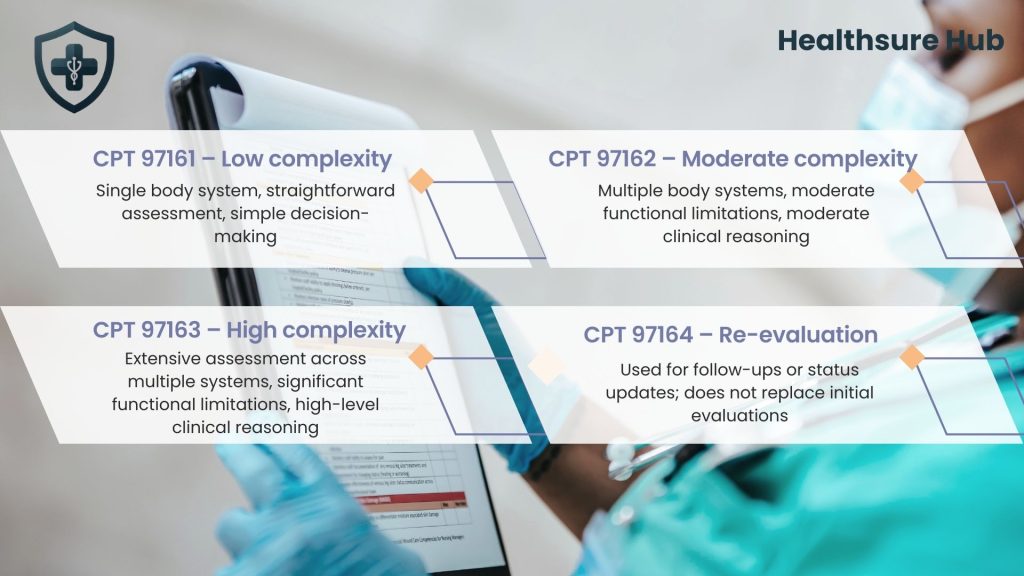
CPT 97161 – Low complexity
Single body system, straightforward assessment, simple decision-making
CPT 97162 – Moderate complexity
Multiple body systems, moderate functional limitations, moderate clinical reasoning
CPT 97163 – High complexity
Extensive assessment across multiple systems, significant functional limitations, high-level clinical reasoning
CPT 97164 – Re-evaluation
Used for follow-ups or status updates; does not replace initial evaluations
Correct coding ensures proper reimbursement, compliance, and audit defense.
Final Perspective
CPT code 97163 represents the therapist’s highest level of clinical judgment in initial evaluations. Documenting history, examination, and functional limitations accurately ensures patients receive appropriate care, insurers reimburse correctly, and providers maintain compliance.
Mastering CPT code 97163 strengthens clinical credibility, supports accurate billing, and helps therapists deliver effective, measurable outcomes for complex patients.
About the Author