Every year, motor-vehicle accidents impact millions of people worldwide, ranging from minor fender-benders to severe collisions. In many cases, patients arrive at emergency departments without being able to provide full details of the incident. This is where ICD-10 code V89.2XXA comes in.
Designed for situations where the specifics of a motor-vehicle accident are unknown, this code ensures that injuries are properly recorded, tracked, and billed. At Healthsure Hub, we help clinicians, coders, and healthcare administrators who aim to maintain accuracy in patient records and streamline the billing process with a complete analysis of this specific ICD-10 code.
What Is ICD-10-CM Code V89.2XXA?
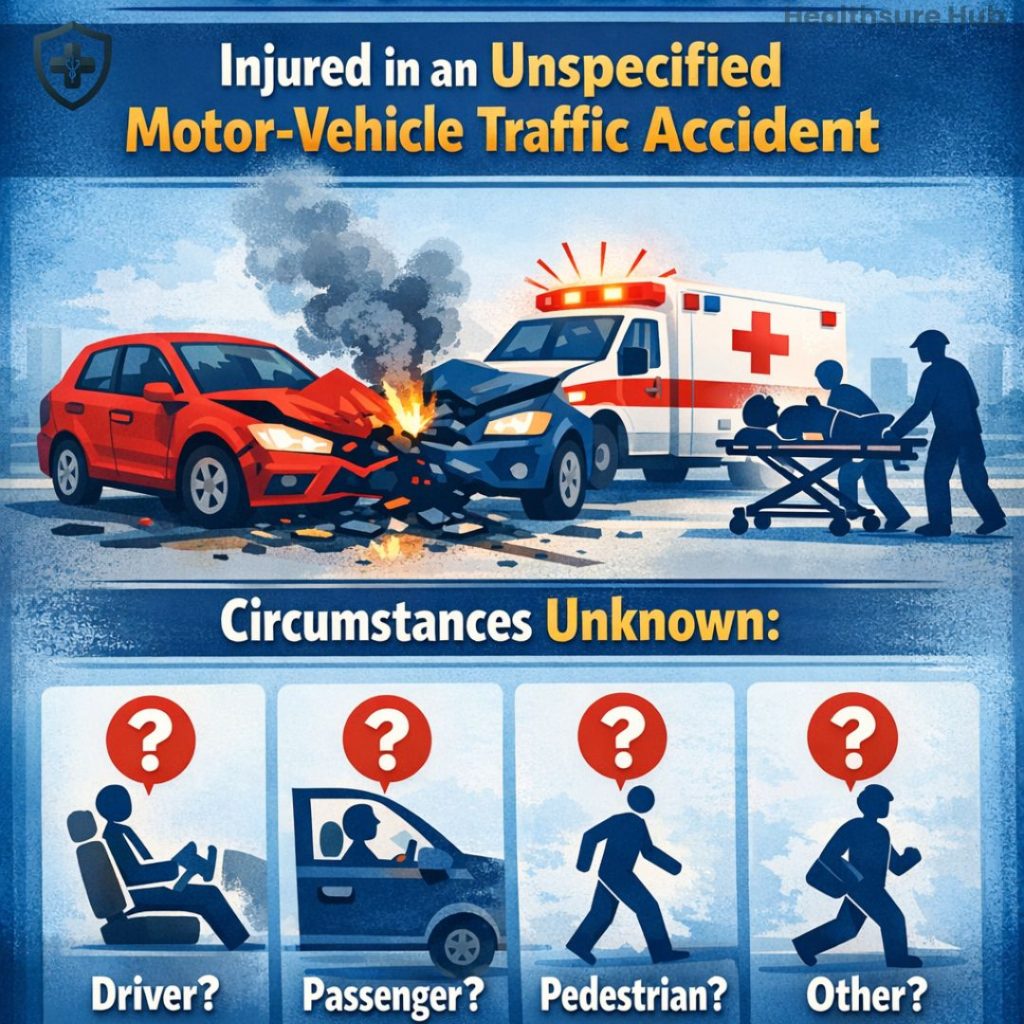
ICD-10 code V89.2XXA is used to classify a person injured in an unspecified motor-vehicle traffic accident, where the exact circumstances, such as whether the patient was a driver, passenger, pedestrian, or other, are unknown.
The final letter “A” is not optional. In ICD-10 conventions, it indicates that the patient is receiving active treatment for the injury, such as emergency care, surgical management, or physician evaluation. Subsequent visits for follow-up or healing would require different encounter characters.
In simpler terms, this code allows healthcare professionals to document that a traffic-related injury occurred, even when specific details about the accident are unavailable. Its proper use ensures that patient records accurately reflect the event, which is crucial for ongoing care, follow-up treatments, and medical research.
Motor-Vehicle Injury Statistics and Public Health Impact
Road traffic injuries remain one of the leading causes of death and disability worldwide. According to the World Health Organization, approximately 1.19 million people die each year due to road crashes, and tens of millions more sustain non-fatal injuries that may result in long-term disability. These injuries range from fractures and spinal trauma to traumatic brain injuries requiring prolonged rehabilitation.
In the United States alone, national crash data has shown millions of injuries annually from motor-vehicle incidents. Such figures highlight why detailed medical documentation is essential. Every coded record contributes to national databases that help experts identify high-risk populations, evaluate safety measures, and design prevention strategies such as improved road engineering, vehicle safety standards, and public awareness campaigns.
Without accurate external cause coding, much of this surveillance data would lose its reliability. Codes like V89.2XXA therefore play a small but meaningful role in global injury-prevention efforts.
Breakdown of the ICD-10-CM Code Structure
| Component | Meaning | Notes |
| V | External cause code | Indicates an external factor responsible for the injury |
| 89.2 | Specific classification | Person injured in unspecified motor-vehicle traffic accident |
| XX | Placeholder characters | Required to complete the code structure |
| A | Encounter type | Initial encounter for treatment of the injury |
Properly formatting the code, including the placeholder “X” characters, is essential. Even small errors can lead to claim denials or inaccurate medical records, which is why coders must adhere strictly to ICD-10-CM standards.
Common Scenarios Where V89.2XXA Is Used
V89.2XXA is most often used in emergency or urgent care environments where documentation must begin before investigative information becomes available. Trauma teams frequently treat patients who cannot provide reliable histories. In these cases, clinicians document what is known, namely that the injury is traffic-related, while leaving room for future clarification.
For example, if paramedics report that a patient was found injured near a roadway with signs of a collision but no confirmed witness account, the provider can code the encounter appropriately without guessing the patient’s role in the accident. Later, once police reports or patient statements clarify the details, the medical record can be updated for subsequent encounters.
Using a more specific code without evidence is considered inaccurate coding. The purpose of V89.2XXA is to ensure documentation remains truthful while still complete.
Real-Life Clinical Example
Consider a scenario in which a 32-year-old patient is brought to the emergency department after being discovered unconscious near a damaged vehicle. Emergency medical services suspect a crash but cannot determine whether the individual was driving, riding as a passenger, or walking nearby when the accident occurred. The patient has a fractured wrist, multiple contusions, and a concussion.
During the initial evaluation, the physician documents the confirmed injuries and notes that the trauma resulted from a motor-vehicle traffic incident of unknown circumstances. Because the patient cannot provide a history and official reports are not yet available, the coder assigns:
- V89.2XXA for the unspecified motor-vehicle traffic accident (initial encounter)
- Injury-specific codes for the wrist fracture, concussion, and contusions
This approach ensures the medical record accurately reflects both the injuries and their external cause. If later documentation reveals the patient was a driver, future visits may use a more specific external cause code. The initial encounter, however, remains correctly coded.
Common Injury Codes to Pair With V89.2XXA
In the U.S., traffic injury data reveals that there were an estimated 2,442,581 people injured in motor vehicle crashes in 2023 – a significant number of patients who would present with conditions requiring careful diagnosis and coding.
Fractures
| Example Injury | ICD-10-CM Injury Code |
| Femur fracture after unspecified traffic accident | S72.001A |
| Forearm fracture in a car accident | S52.501A |
| Cervical vertebra fracture in traffic collision | S12.001A |
| Wrist injury in motor-vehicle accident | S69.91XA |
Dislocations and Sprains
| Example Injury | ICD-10-CM Injury Code |
| Shoulder dislocation after a crash | S43.011A |
| Wrist sprain in motor-vehicle accident | S63.501A |
| Knee sprain after a collision | S83.91XA |
Traumatic Brain Injuries (TBI)
| Example Injury | ICD-10-CM Injury Code |
| Concussion after a car crash | S06.0X0A |
| Intracranial hemorrhage in motor-vehicle accident | S06.5X0A |
Motor‑vehicle accidents are a major public health issue globally and nationally. According to the World Health Organization, about 1.19 million people die each year in road crashes, and between 20 and 50 million more suffer non‑fatal injuries that can include fractures, neck and back pain, and traumatic brain injuries, all of which require medical coding for treatment, billing, and research. Pair pain codes with injury codes if the pain is related to a specific trauma or accident.
Importance of Accurate Documentation
Accurate medical coding is often associated with billing, but its impact extends far beyond reimbursement. External cause codes provide critical data used by public health agencies, policymakers, and safety researchers. When aggregated across thousands or millions of records, these codes reveal patterns about where, how, and why injuries occur.
For clinicians, noting that an injury is traffic-related may influence treatment decisions. Motor-vehicle trauma carries a higher risk of internal injuries than many other mechanisms, prompting closer monitoring. For healthcare organizations, precise coding supports legal documentation in case of insurance disputes or liability investigations.
Proper coding also protects providers. If documentation shows that a patient’s injuries were caused by a traffic accident, it establishes a clear timeline and context for care decisions, which can be crucial if questions arise later.
Guidelines and Common Mistakes
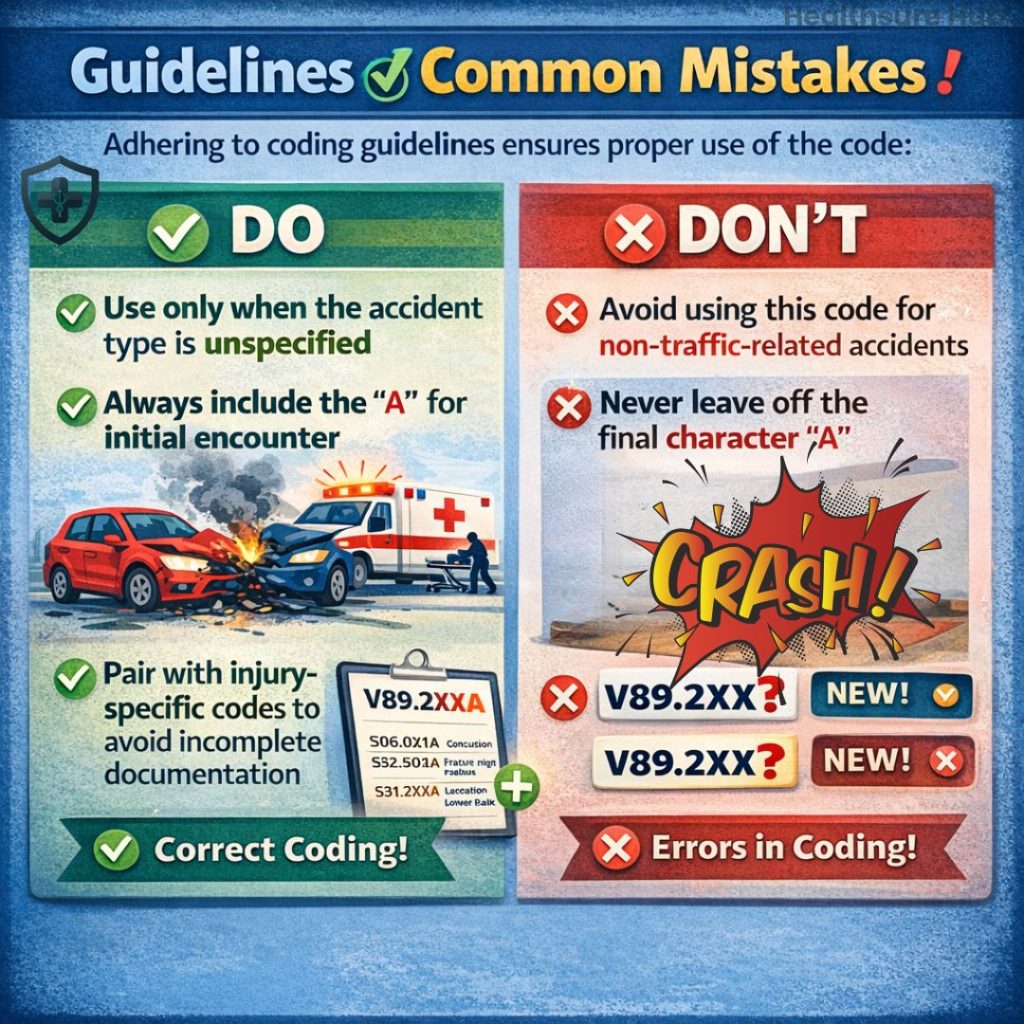
One of the most frequent mistakes is assigning V89.2XXA when documentation actually contains enough detail for a more specific code. Coders sometimes default to unspecified codes for convenience, but doing so can create compliance concerns if specificity is available.
Another common issue is omitting placeholder characters. Because ICD-10-CM requires a fixed code length, leaving out the “X” placeholders results in an invalid code. Finally, some records fail to include any external cause code at all. While not always mandatory, omitting it reduces clinical clarity and data quality.
Consistent training, internal audits, and clear provider documentation practices can prevent these problems and improve overall coding accuracy.
Conclusion
ICD-10 code V89.2XXA plays a vital role in documenting unspecified traffic-related injuries when the details of a motor-vehicle accident are unclear. Using this code accurately not only supports effective patient care but also ensures proper billing, compliance, and reporting to public health authorities.
By pairing this ICD-10 with specific injury codes and following ICD-10-CM guidelines, healthcare providers and coders can maintain complete, reliable records, streamline insurance processing, and safeguard against legal or administrative issues.
About the Author