Lower back pain is one of the most common reasons patients seek medical care, and accurate ICD-10 coding plays a key role in documenting symptoms, supporting medical necessity, and ensuring clean claims.
Understanding the ICD-10 code for lower back pain is essential for providers, coders, and billing teams who want to avoid denials and ensure that documentation aligns with the care provided. To bring clarity to this widely used diagnosis code, our team at Healthsure Hub explores what ICD-10 code is used for lower back pain, how it is applied, and what documentation requirements matter most.
What Is the ICD-10 Code for Lower Back Pain?
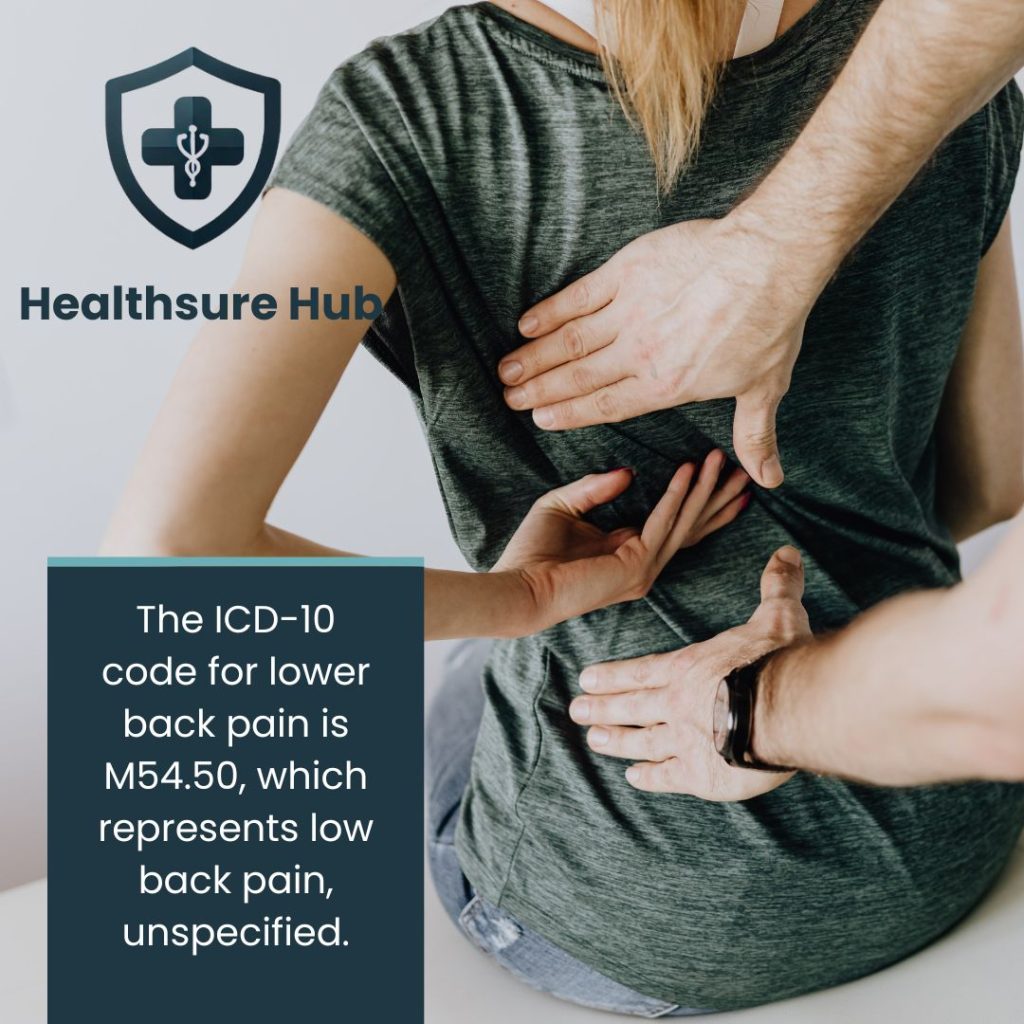
The ICD-10 code for lower back pain is M54.50, which represents low back pain, unspecified. This diagnosis code is used when a patient presents with lower back discomfort that has not been further classified by cause or specific condition.
Lower back pain, also known as lumbar pain, is generally located between the lower edge of the ribs and the top of the buttocks. It can involve muscles, ligaments, nerves, and vertebrae in the lumbar region, and can range from mild discomfort to severe pain affecting daily activities.
The M54.50 code belongs to the ICD-10 chapter covering dorsopathies, which includes various conditions affecting the spine and back. It was introduced to improve coding specificity, replacing the older, more general M54.5 code that was used before October 2021. Because lower back pain has many possible etiologies, from muscle strain to degenerative changes, M54.50 helps document the symptom without implying a particular cause.
Lower Back Pain: Global Impact and Statistics
Lower back pain is a major health concern worldwide. In 2020, approximately 619 million people globally were affected by low back pain. Trends suggest this number may rise to around 843 million by 2050, largely due to population growth and aging demographics.
LBP remains the leading cause of disability globally and represents the condition for which the largest number of individuals could benefit from rehabilitation and targeted interventions. The widespread prevalence underscores the importance of accurate documentation, coding, and clinical management to ensure proper treatment and insurance coverage.
When to Use ICD-10 Code M54.50 in Clinical Documentation
M54.50 should be used when the provider documents generalized low back pain without further detail. It is appropriate when the pain is present but:
- No specific spinal disorder has been diagnosed
- The provider has not identified or confirmed a structural cause
- The pain is not described as acute, chronic, radicular, or associated with sciatica
- A more precise code such as M54.51 (vertebrogenic low back pain) or M54.59 (other low back pain) does not apply
This code is commonly used in primary care, chiropractic care, physical therapy, orthopedic visits, and urgent care settings. It captures the patient’s symptom rather than a definitive diagnosis, making it useful early in an evaluation or when symptoms are nonspecific.
Related Codes and How They Compare to M54.50
While ICD M54.50 represents unspecified lower back pain, other ICD-10 codes may offer more detail depending on documented findings. Some related options include:
M54.51 – Vertebrogenic low back pain
Used when pain originates from vertebral endplate changes or other vertebrogenic sources. This code is appropriate when imaging or clinical findings support a structural vertebral cause.
M54.59 – Other low back pain
Used when the documentation specifies the nature of the pain but does not meet criteria for other subcodes. It serves as a flexible option for providers when low back pain is described but not tied to a specific pathology.
M54.40 – M54.42 – Lumbago with sciatica
For lower back pain accompanied by radiating neurological symptoms. These codes distinguish between unspecified laterality, right-sided sciatica, and left-sided sciatica to improve diagnostic accuracy.
M62.830 – Back muscle spasm
Used when the provider identifies muscle spasm as the primary issue. This code is commonly applied when the patient’s pain is driven by acute or chronic muscular tension.
Choosing between these codes depends entirely on the medical documentation. Coders should never infer the cause of lower back pain; they must code exactly what is written in the medical record.
Documentation Requirements for Using ICD 10 Code M54.50
Although M54.50 is an “unspecified” code, clear documentation remains important. Providers should describe:
- The patient’s reported symptoms
- Location of pain (lower back/lumbar region)
- Duration (acute, subacute, chronic—if known)
- Aggravating or relieving factors
- Any associated symptoms (e.g., numbness, weakness)
- Relevant history or prior episodes
If the provider documents details such as chronicity or associated sciatica, a more specific ICD-10 code may be more appropriate. However, when the cause or characteristics remain unclear, M54.50 is the accurate default code.
Common Clinical Scenarios Where ICD 10 M54.50 Is Used
ICD 10 code M54.50 often appears in visit notes for a variety of clinical settings. Some typical scenarios include:
Primary Care
A patient presents with lower back discomfort following yard work, but the provider has not determined whether it’s muscle strain, disc-related, or otherwise. Without a defined diagnosis, M54.50 is used.
Physical Therapy
On the initial evaluation, a therapist receives a referral with “low back pain.” Until further assessment clarifies the source, M54.50 may remain the primary code.
Chiropractic
A patient reports nonspecific lumbar pain without neurological findings or chronicity. If documentation does not specify more detail, M54.50 captures the symptom accurately.
Urgent Care
A patient reports lower back pain after lifting a box, but imaging is not performed and the cause is not confirmed. The code documents the symptom without suggesting an underlying condition.
These examples illustrate when the code is used to document symptoms rather than specific diagnoses.

Source: Pexels
Coding Tips for M54.50 to Reduce Documentation Errors
Accurate use of the ICD-10 code for lower back pain helps prevent claim delays and ensures the medical record reflects the patient’s condition. Consider these tips:
- Use the most specific code supported by documentation. If chronicity or complications are described, do not default to M54.50.
- Avoid assuming sciatica. Only code sciatica (M54.4-) when documented.
- Pair the code with relevant Z-codes (e.g., Z76.89 for other specified health services) only when appropriate and documented.
- Review provider notes carefully. Coders cannot interpret findings not explicitly documented.
- Do not code pain in multiple regions with M54.50; this code is specific to the lower back.
Staying aligned with documentation ensures compliance and reduces the risk of insurance claim denials.
Conclusion
The ICD-10 code for lower back pain, M54.50, is one of the most frequently used codes for documenting nonspecific lumbar pain. It captures the symptom when no further detail or underlying diagnosis is known, allowing providers and coders to document visits accurately and efficiently. Understanding when and how to use M54.50, versus more specific codes, helps ensure clean documentation and supports proper claims processing.
This article is for informational purposes only and does not constitute medical, legal, or insurance advice.
About the Author