Shoulder pain can interfere with everything from daily routines to long-term mobility, making it one of the most common reasons people seek medical care. From initial doctor visits to insurance claims and treatment planning, how shoulder pain is documented matters just as much as how it’s treated.
In this article, our team at HealthsureHub breaks down what the ICD-10 code for shoulder pain is, how it’s classified within the ICD-10 coding system, why accurate documentation is important, and how these codes are used across clinical, billing, and insurance settings. Whether you’re reviewing a medical record, submitting a claim, or simply trying to understand how shoulder pain is formally recorded, this guide provides clear, practical context.
What Is the ICD-10 Code for Shoulder Pain?
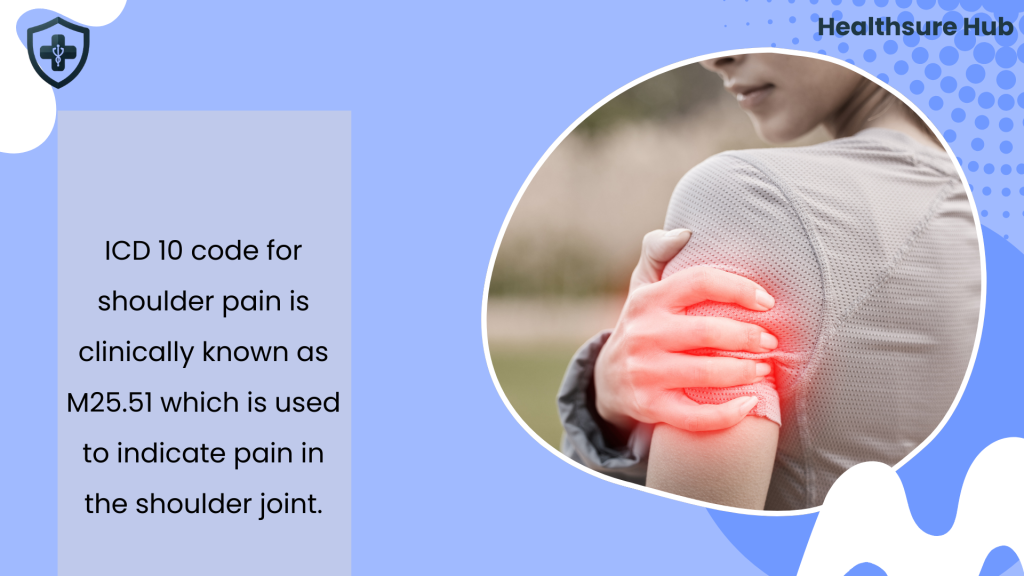
The ICD-10 code used to document shoulder pain is M25.51, which identifies pain in the shoulder joint when a specific underlying cause has not yet been determined. It falls under the broader category of “other joint disorders, not elsewhere classified,” allowing clinicians to formally record shoulder pain even before a definitive diagnosis is made.
This code is most commonly used during initial evaluations. When a patient presents with shoulder pain, the exact cause, such as muscle strain, tendon inflammation, arthritis, or nerve involvement, may not be immediately clear. M25.51 allows providers to document the primary symptom while further diagnostic steps, including imaging or specialist referral, are underway.
Why Does Laterality Matter in the ICD-10 Code for Shoulder Pain?
Laterality matters in the ICD-10 code for shoulder pain because it specifies whether the pain affects the right shoulder, left shoulder, or an unspecified side, which directly impacts treatment accuracy, billing, and medical record clarity. The ICD code M25.51 is often expanded into more specific codes:
- M25.511 – Pain in right shoulder
- M25.512 – Pain in left shoulder
- M25.519 – Pain in unspecified shoulder
This distinction may seem minor, but it plays an important role in treatment planning, insurance reimbursement, and long-term medical records. Accurate laterality ensures that care is directed appropriately and prevents confusion if future visits or procedures involve the opposite shoulder.
Billing and Claims Impact of ICD-10 Code for Shoulder Pain
Shoulder pain accounts for a significant share of musculoskeletal healthcare utilization, making accurate coding essential for clean claims processing. Studies estimate that shoulder pain affects up to 18–26% of adults at some point in their lives, and it is consistently ranked among the top musculoskeletal reasons for primary care and orthopedic visits. These encounters frequently lead to diagnostic imaging, follow-up visits, and physical therapy referrals, all of which rely on correct ICD-10 documentation at the initial stage of care.
From a billing perspective, coding accuracy has measurable financial implications. Industry analyses suggest that coding and documentation errors contribute to tens of billions of dollars in denied or delayed medical claims annually, with musculoskeletal conditions being a common area of review due to high visit volume and documentation variability. Incomplete diagnosis details, particularly missing laterality, are frequently cited during payer audits and claim rejections.
Clearly identifying the affected shoulder helps reduce claim rework, supports medical necessity for imaging and therapy services, and shortens reimbursement timelines. For revenue cycle teams, consistent and accurate use of ICD-10 code M25.51 allows providers to document symptoms appropriately while diagnostic evaluation is still ongoing, improving both compliance and financial performance.
Who Uses the ICD-10 Code for Shoulder Pain?
ICD 10 code M25.51 is not used by just one group within the healthcare system. It’s used with:
Patients
Patients often encounter M25.51 on medical bills, insurance statements, or digital health portals. Seeing ICD M25.51 listed can help clarify why a visit was billed and what condition was officially recorded. Understanding this code reduces confusion, eases anxiety, and empowers patients to ask informed questions about their diagnosis and treatment.
Healthcare Providers
Healthcare providers use M25.51 as part of routine clinical documentation. Primary care physicians, orthopedic specialists, physical therapists, and emergency clinicians rely on it to record shoulder pain when a definitive diagnosis has not yet been made. It supports referrals, imaging requests, and early treatment decisions.
Medical Coders
Medical coders and billing professionals depend on ICD code M25.51 to translate clinical notes into standardized data that insurers can process. Accurate use of ICD M25.51 helps reduce claim denials, delays, and costly corrections.
Insurance Companies
Insurance companies analyze ICD-10 codes to determine coverage eligibility, medical necessity, and reimbursement levels. M25.51 is widely recognized and accepted for evaluations, conservative treatment, and diagnostic testing related to shoulder pain.
Beyond individual care, researchers and public health professionals use aggregated ICD-10 data to understand how common shoulder pain is, how it affects different populations, and how treatment outcomes change over time.
When Is the ICD-10 Code for Shoulder Pain Used?
The ICD-10 code for shoulder pain, M25.51, is used during clinical encounters when a patient reports shoulder pain but a definitive diagnosis has not yet been established, in cases like:
- Initial evaluation of unexplained shoulder pain
- Follow-up visits when pain persists without a confirmed diagnosis
- Emergency department visits for acute shoulder discomfort
- Primary care assessments prior to imaging or specialist referral
- Physical therapy intake assessments
It acts as a placeholder diagnosis, allowing care to proceed while further evaluation is underway.
What M25.51 Does Not Describe?
The ICD-10 code M25.51 does not describe the cause, severity, duration, or structural origin of shoulder pain. This code does not specify:
- The cause of shoulder pain (injury, arthritis, tendon tear)
- Severity or duration (acute vs. chronic)
- Structural damage
- Whether the pain is work-related or traumatic
Once a definitive diagnosis is made, clinicians often replace M25.51 with a more specific ICD-10 code.

How M25.51 Differs From Other Shoulder-Related ICD-10 Codes
Unlike other shoulder-related ICD-10 codes that identify specific injuries or conditions, M25.51 is used when shoulder pain is documented without a confirmed underlying diagnosis. Examples include:
- Rotator cuff disorders
- Osteoarthritis of the shoulder
- Shoulder bursitis
- Dislocations and fractures
- Tendinitis and impingement syndromes
By contrast, M25.51 allows providers to accurately document shoulder pain without making diagnostic assumptions. It supports early-stage care, including physical examinations, imaging orders, referrals, and conservative management, while additional information is gathered. Once the cause of pain is identified, clinicians typically replace M25.51 with a more specific ICD-10 code that reflects the confirmed condition. In this way, M25.51 serves as a clinically appropriate starting point, bridging the gap between symptom presentation and definitive diagnosis.
Conclusion
The ICD-10 code for shoulder pain, M25.51, plays a critical role in modern healthcare. It provides a clear, standardized way to document shoulder pain when the cause is not yet fully defined, allowing evaluation and treatment to move forward without delay. For patients, it offers insight into medical records and billing. For clinicians and insurers, it supports accurate documentation and decision-making. And for researchers and policymakers, it contributes to a broader understanding of musculoskeletal health.
In essence, M25.51 is not just a billing code, it is the starting point for understanding, treating, and ultimately resolving shoulder pain across diverse populations.
This article is for informational purposes only and does not constitute medical, legal, or insurance advice.
About the Author