Wrist pain is a common musculoskeletal complaint seen across primary care, urgent care, and orthopedic settings. One ICD-10 code that commonly appears in medical records and insurance claims is M25.539, which represents pain in an unspecified wrist. While this code may appear straightforward, its use carries important implications for clinical documentation, coding accuracy, and claim reimbursement.
Understanding how this code should be applied, and its limitations, is essential for providers, coders, and billing professionals. Proper use supports clinical clarity, payer compliance, and smoother reimbursement workflows. Our team at HealthSure Hub breaks down the code and explains the documentation gaps that lead to increased claim denials.
Overview of ICD-10 Code M25.539
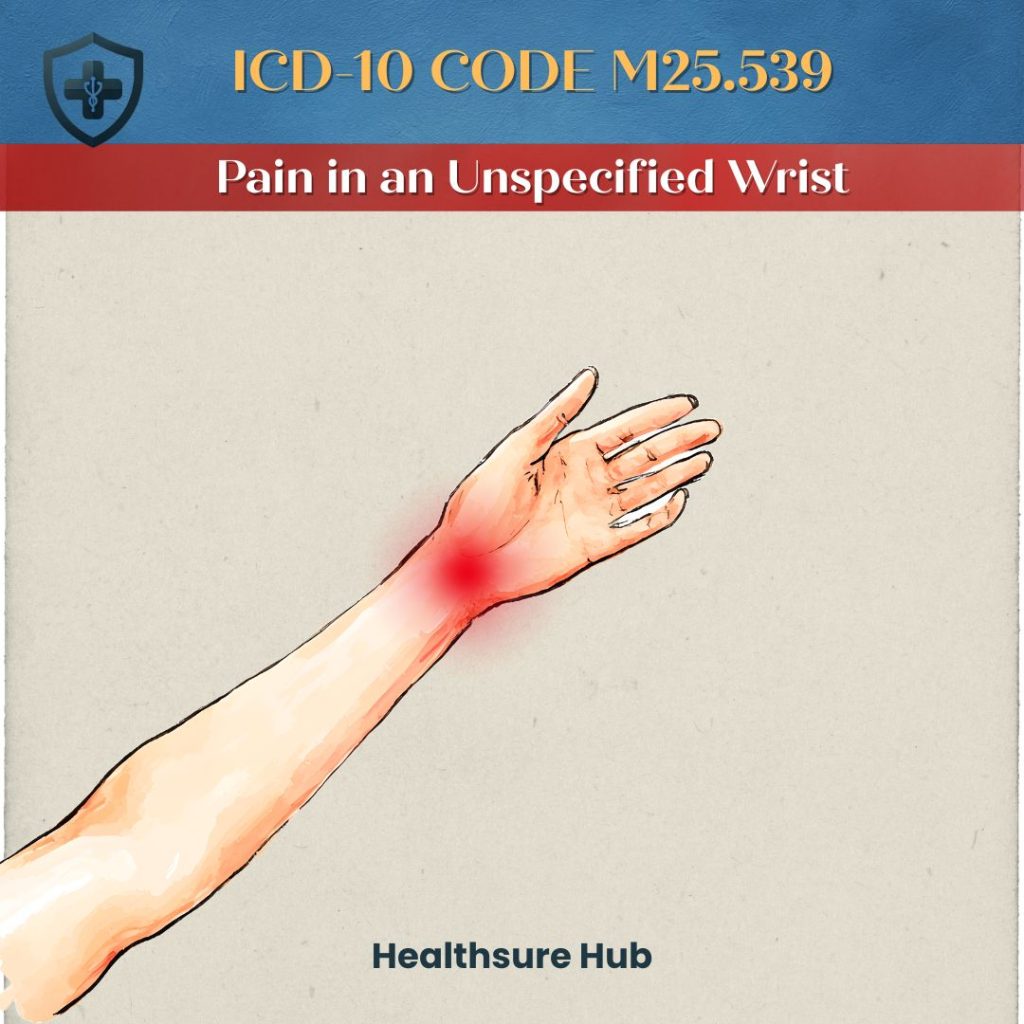
ICD-10-CM Code for unspecified wrist falls under the broader ICD-10 category:
- M25 – Other joint disorders, not elsewhere classified
This code is a symptom-based diagnosis code, meaning it describes a patient’s reported pain rather than a confirmed underlying condition. It is used when wrist pain is documented in the medical record but laterality (left or right wrist) is not specified.
Because ICD-10 coding prioritizes specificity, M25.539 is considered a less-specific option compared to its laterality-specific counterparts. The codes used for the left or right wrist are M25.532 and M25.531, respectively.
Breaking Down the Code Structure
Understanding the structure of the code helps clarify its intent and limitations:
- M – Diseases of the musculoskeletal system and connective tissue
- 25 – Other joint disorders
- .539 – Pain in wrist, unspecified
ICD-10 provides distinct codes for right and left wrist pain. When documentation fails to indicate laterality, coders must default to M25.539, even if the provider clinically knows which wrist is affected but does not explicitly document it.
Clinical Use of M25.539
In clinical practice, the ICD-10 code for unspecified wrist is most often used during early encounters when wrist pain is still being evaluated. It may appear in documentation when the patient reports discomfort but diagnostic imaging, physical examination findings, or detailed history have not yet clarified the condition.
This code is common in fast-paced care environments where documentation may be brief, such as urgent care or emergency departments. It may also be used when the provider’s focus is symptom management rather than diagnostic specificity during an initial visit.
Common Causes of Unspecified Wrist Pain
Although ICD-10 for unspecified wrist does not identify etiology, wrist pain commonly arises from:
- Repetitive motion
- Occupational strain
- Minor trauma
In some cases, early degenerative or inflammatory processes may be present but not yet confirmed. Patients may also experience transient pain related to activity level or posture. Because these causes overlap with more specific diagnoses, M25.539 is often replaced with a more precise code once further evaluation occurs.
Symptoms Associated With ICD-10 for Unspecified Wrist
Patients coded with the said code may report:
- Generalized wrist pain or soreness
- Pain during movement, gripping, or lifting
- Stiffness or discomfort after activity
- Reduced range of motion
- Intermittent or mild to moderate pain
Importantly, this code is used when no definitive diagnosis, such as fracture, arthritis, or nerve compression, has been established.
When to Use ICD-10 Code for Unspecified Wrist
The code for unspecified wrist is appropriate when:
- Wrist pain is clearly documented
- The provider does not specify left or right wrist
- No confirmed underlying diagnosis exists
- Pain is the primary focus of the visit
- The encounter involves evaluation or monitoring only
This code is often used during early visits or when documentation quality is limited.
When NOT to Use ICD-10 Code for Unspecified Wrist
The code should not be used when:
- Laterality is clearly documented
- A specific diagnosis is known (e.g., carpal tunnel syndrome, wrist sprain, arthritis)
- Imaging confirms fractures or joint pathology
- Chronic or inflammatory conditions are diagnosed
- A more precise ICD-10 code is available
In these cases, payers expect the most specific diagnosis code possible.
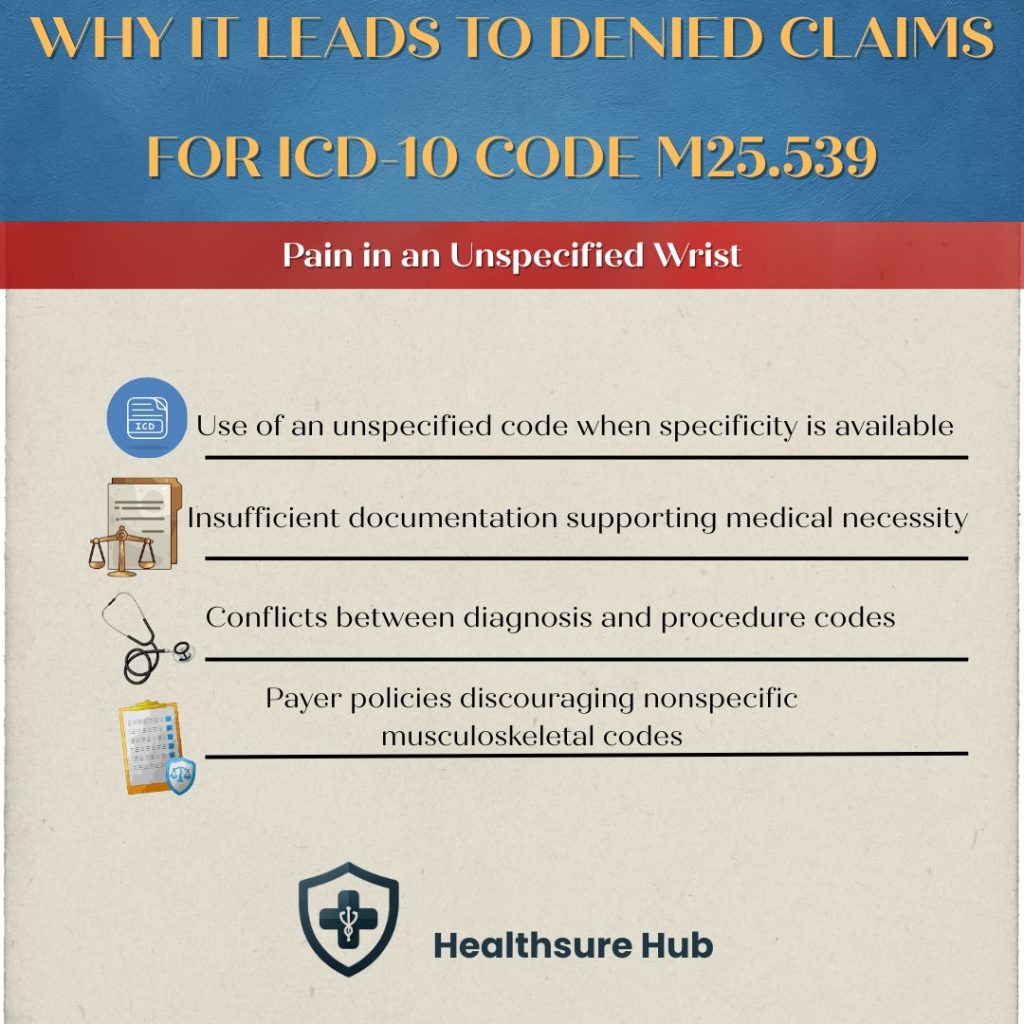
Why Claims Are Denied for ICD-10 Code M25.539
Several documentation issues commonly result in use of this code:
- Use of an unspecified code when specificity is available
- Insufficient documentation supporting medical necessity
- Conflicts between diagnosis and procedure codes
- Payer policies discouraging nonspecific musculoskeletal codes
These gaps not only affect coding accuracy but also increase claim denial risk.
Coding and Billing Best Practices
Reducing reliance on this code requires collaboration between providers and coding teams. Emphasizing laterality in clinical notes, updating diagnosis codes as evaluations progress, and performing routine documentation audits can significantly reduce denial risk.
Education on ICD-10 specificity remains one of the most effective strategies for improving coding accuracy.
Conclusion
ICD-10 code M25.539 accurately captures wrist pain when documentation does not specify laterality, but it should be used judiciously. While appropriate in limited scenarios, it carries a higher risk of claim denial and reduced data quality.
By strengthening documentation practices and transitioning to laterality-specific wrist pain codes whenever possible, healthcare organizations can improve reimbursement outcomes, compliance, and overall quality of care.
About the Author