Muscle pain is one of the most frequently documented complaints across outpatient clinics, primary care practices, and urgent care settings. While some cases involve clearly localized discomfort, many patient encounters describe muscle pain in broad or non-specific terms. Within the ICD-10-CM system, specific codes exist to ensure these encounters are captured consistently and compliantly—supporting reimbursement, reporting, and healthcare data integrity.
At HealthSure Hub we explain how and when to apply ICD-10-CM code M79.10 and why the code is essential for clinicians, medical coders, and healthcare organizations that rely on precise documentation and claims accuracy.
What Is ICD-10-CM Code M79.10?
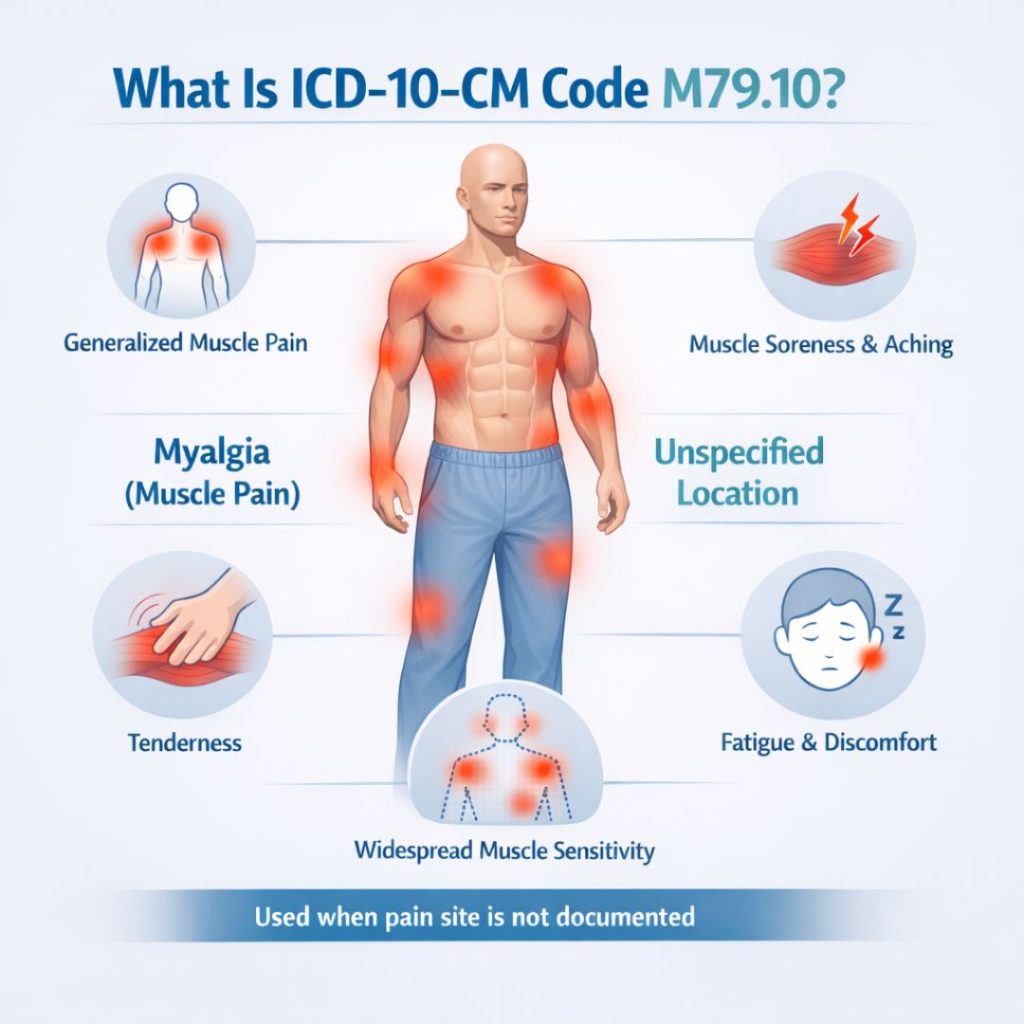
ICD-10-CM code M79.10 is used to classify myalgia (muscle pain) when the anatomical site is not specified in the medical record.
In medical billing and coding, this code applies when a provider documents muscle pain as a clinically relevant condition but does not identify a specific muscle group or body region. M79.10 allows healthcare organizations to accurately report encounters involving generalized or unspecified muscle pain while remaining compliant with ICD-10-CM coding guidelines.
Prevalence and Patterns of Myalgia
Muscle pain is a widespread health concern, with studies showing that it affects up to 47% of the global population at some point in their lives. Specific muscle-related conditions, such as chronic shoulder or neck pain, impact approximately 10%–20% of individuals, highlighting the importance of accurate clinical documentation. Research indicates that in 93% of cases, myalgia is provoked by physical activity, underscoring its clinical relevance in outpatient encounters.
These statistics demonstrate why ICD-10-CM code M79.10 (Myalgia, unspecified site) is essential. It allows healthcare providers and coders to capture generalized or non-localized muscle pain accurately, ensuring compliant reporting, reliable claims processing, and meaningful utilization data.
Official ICD-10-CM Classification and Code Details
- Code: M79.10
- Description: Myalgia, unspecified site
- Category: Diseases of the musculoskeletal system and connective tissue (M00–M99)
- Subcategory: M79 – Other soft tissue disorders, not elsewhere classified
- Laterality: Not applicable
- Billable/Specific Code: Yes
- Present on Admission (POA) Exempt: No
The code is a fully billable diagnosis code and may be reported independently or in conjunction with other relevant conditions, depending on the clinical scenario and documentation.
Understanding “Unspecified Site” in ICD-10-CM Coding
The term unspecified site indicates that the medical record does not identify the precise anatomical location of the muscle pain. In ICD-10, unspecified codes are acceptable when documentation does not support greater specificity.
The ICD-10 code should be selected only when:
- The provider documents muscle pain without naming a location
- No inference can be made from the clinical note
- Additional diagnostic clarification is not available at the time of coding
Unspecified codes are not inherently incorrect. However, they should reflect the true level of detail present in the documentation.
When Is M79.10 Appropriate to Use?
Broad observational research suggests that myalgia and related muscle pain symptoms may affect up to 60–85% of individuals at some point during their lives, making generalized or non-specific muscle pain a common reason for outpatient encounters and subsequent ICD-10-CM code selection. M79.10 is appropriate in a variety of clinical and administrative contexts, including:
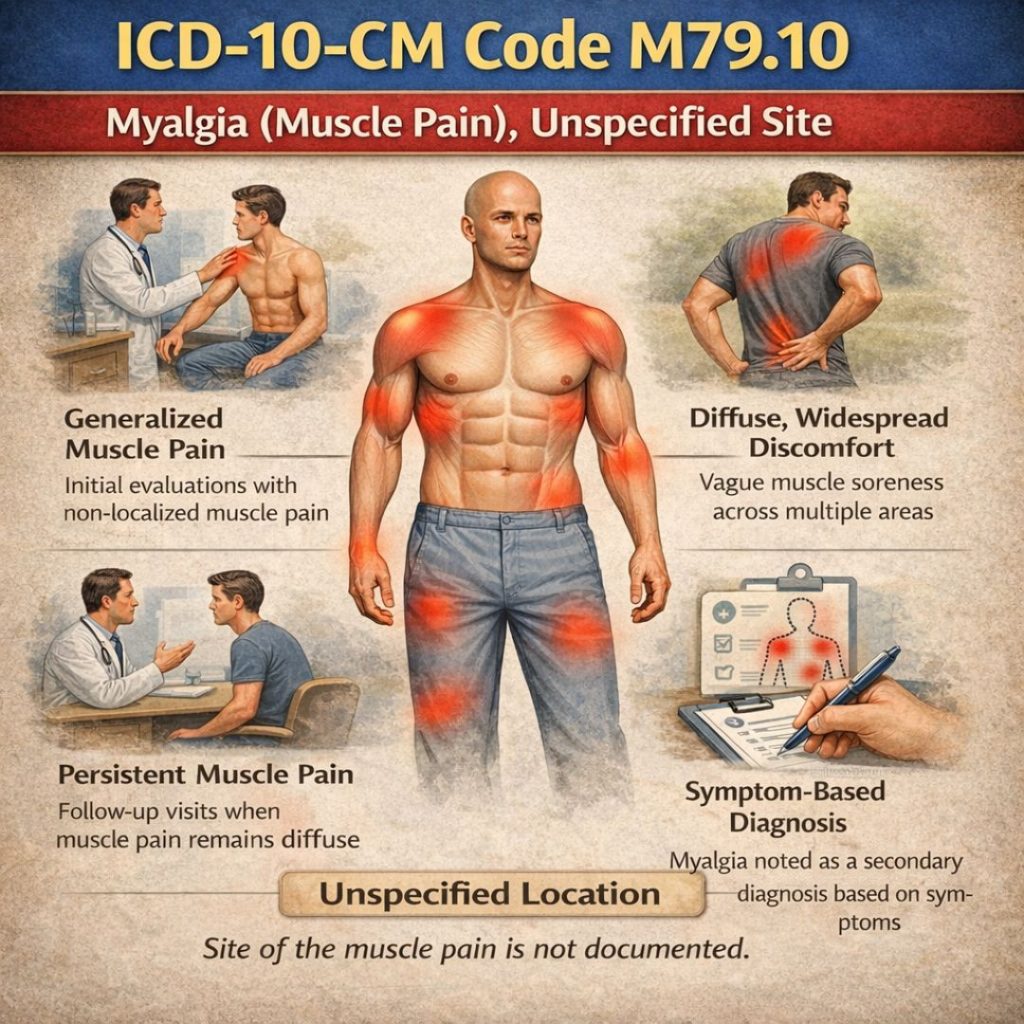
- Initial evaluations where muscle pain is reported generally
- Encounters documenting diffuse or generalized muscle discomfort
- Follow-up visits when muscle pain persists without clarified location
- Situations where myalgia is noted as a secondary diagnosis
- Outpatient visits where documentation focuses on symptom reporting rather than localization
The code is commonly used across primary care, urgent care, and other outpatient settings.
Documentation Requirements for Accurate Coding
Accurate reporting of ICD-10-CM code M79.10 depends on clear and complete provider documentation. The medical record should confirm the presence of muscle pain, its clinical relevance to the encounter, and the absence of anatomical site specificity. Coders should avoid inferring muscle location from context or assumptions. If documentation is unclear, it may be appropriate to query the provider to determine whether a site-specific code can be used instead.
M79.10 Compared to Related Myalgia Codes
Several ICD-10-CM codes describe myalgia with greater specificity. Examples include:
- M79.11 – Myalgia, shoulder
- M79.12 – Myalgia, upper arm
- M79.18 – Myalgia, other site
- M79.1 – Myalgia (general category)
The specific code for myalgia, unspecified site should be reserved for cases where no anatomical detail is documented. If a specific site is identified, the more precise code should be reported instead. For instance, when documentation identifies a specific anatomical location, such as foot pain (M79.671, M79.672) or wrist pain a site-specific code should be reported instead of M79.10
Coding and Billing Considerations
When submitting claims using ICD-10-CM code M79.10, it is important to apply the code thoughtfully to ensure compliance and accurate reimbursement. This code may be reported as either a primary or secondary diagnosis, depending on the clinical context. Payers often review unspecified codes closely to confirm that documentation supports their use, so accurate coding helps prevent claim denials and ensures reliable utilization data.
Overuse of unspecified codes, especially when more precise anatomical information is available, can trigger compliance concerns and potentially lead to audits. Proper code selection not only aligns with payer requirements but also contributes to high-quality clinical data, supports accurate reporting of population health trends, and enhances the overall integrity of medical records.
Common Coding Errors to Avoid
Frequent mistakes related to M79.10 include:
- Assigning the code when a muscle site is documented
- Confusing myalgia with joint pain (arthralgia)
- Reporting the code when muscle pain is clearly part of another diagnosed condition
- Defaulting to unspecified codes without reviewing documentation thoroughly
Muscle pain that is clearly attributable to an acute injury—such as a cervical ligament sprain or ankle sprain —should not be reported with the ICD-10 code for myalgia, unspecified site. Avoiding these errors improves claim accuracy and supports high-quality clinical data.
Use of M79.10 Across Care Settings
The ICD-10 code for myalgia, unspecified site is most commonly reported in:
- Primary care offices
- Urgent care centers
- Occupational health clinics
- General outpatient encounters
Its usage reflects the frequency of non-localized muscle pain presentations in routine clinical practice.
Conclusion
ICD-10-CM code M79.10 plays an important role in accurately capturing cases of myalgia when muscle pain is documented without anatomical specificity. While it may appear straightforward, correct use of this code depends entirely on the quality and clarity of provider documentation. When muscle pain is clinically relevant to the encounter but no specific site is identified, the code provides a compliant and billable option within the ICD-10-CM classification system.
About the Author