Head injuries range from minor bumps to life-threatening trauma, and distinguishing between them is critical for patient safety, medical documentation, and insurance compliance. While concussions and fractures often receive the most attention, superficial head contusions are among the most frequently treated injuries in emergency departments and urgent care settings.
ICD-10 code S00.83XA is used to document these injuries during the initial encounter, yet it is commonly misunderstood or improperly applied. At Healthsure Hub, we break down what this code truly represents, when it should be used, and how documentation gaps can lead to avoidable claim denials.
Overview of ICD-10 Code S00.83XA
S00.83XA is defined as contusion of other part of head, initial encounter. This code describes a bruise caused by blunt force trauma to a part of the head that is not otherwise specifically classified, such as areas of the scalp outside the face, eye region, or ear. A contusion involves damage to soft tissue with intact skin, distinguishing it from open wounds or lacerations.
The designation “initial encounter” indicates that the patient is receiving active treatment for the injury. This includes evaluation, imaging, observation, pain management, or other diagnostic and therapeutic interventions.
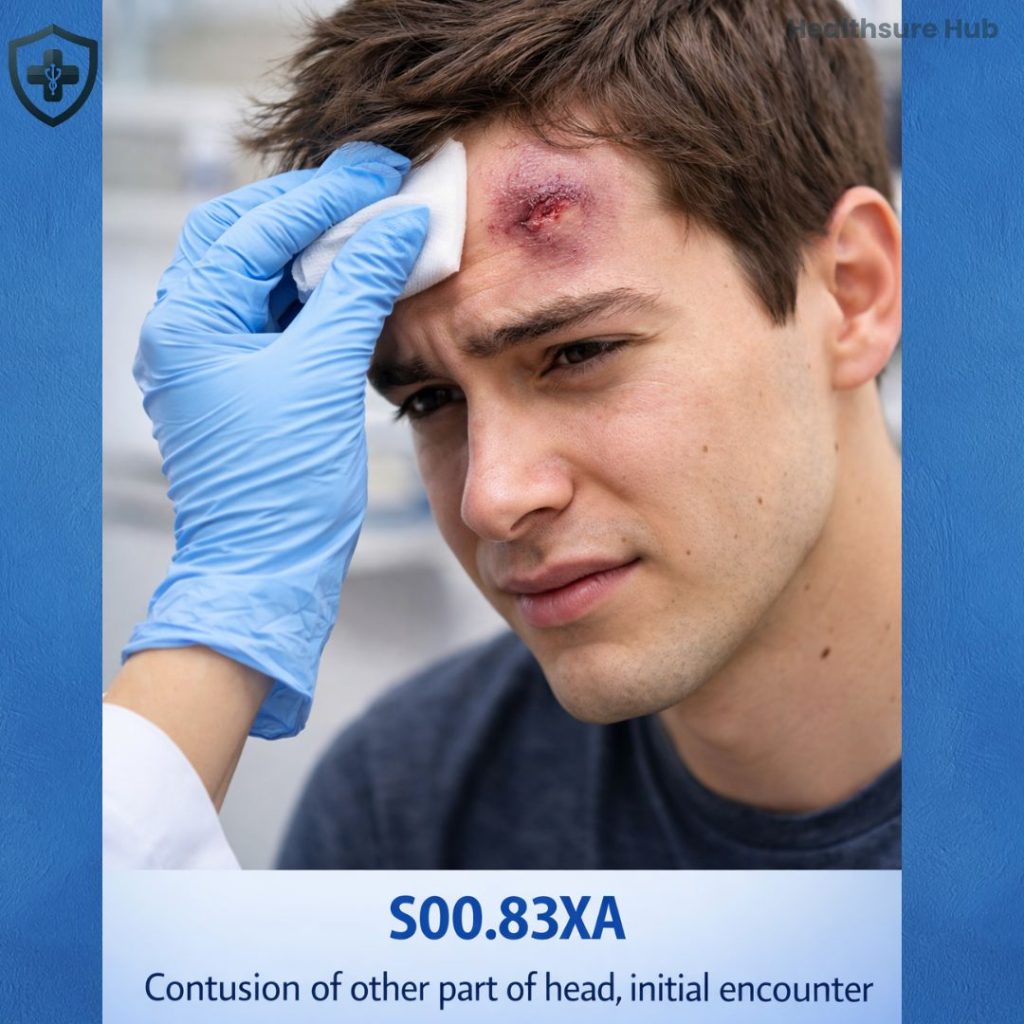
Breaking Down the Code Structure
Each component of the code provides important information:
- S00 – Superficial injury of the head
- .83 – Contusion of other part of head
- X – Placeholder character required by ICD-10 formatting rules
- A – Initial encounter
The seventh character is mandatory. Omitting or misusing it is a common cause of claim rejection.
Statistics on Head Injuries
Head injuries are a common occurrence in clinical settings, ranging from minor bumps to life-threatening trauma. In the United States alone, there are approximately 1.7 million new cases of head injury each year, highlighting the high prevalence of head trauma across the population. While many of these cases are minor and involve superficial injuries such as contusions, about 3 % of head injuries are fatal, emphasizing that even seemingly minor trauma should be carefully evaluated and documented.
These numbers illustrate the significant clinical and public health impact of head injuries. Even though the majority are non-fatal, healthcare providers frequently encounter patients with head trauma, making accurate coding with ICD-10 codes like S00.83XA critical for proper documentation, treatment, and insurance compliance.
Clinical Use of S00.83XA
In clinical practice, this ICD-10 code is most often used when a patient presents after a minor head impact without evidence of severe injury. Providers rely on this code when physical examination and diagnostic imaging confirm that the injury is limited to soft tissue bruising.
This code frequently appears in emergency departments, urgent care clinics, and occupational health settings where rapid assessment is required to rule out more serious conditions.
Real-Life Clinical Example
A 42-year-old woman presents to the emergency department after slipping on a wet floor at work. She reports striking the back of her head against the wall but denies loss of consciousness, dizziness, nausea, or vision changes. On examination, the provider notes localized swelling and tenderness on the posterior scalp with intact skin. A CT scan is performed and shows no intracranial injury or skull fracture.
The patient is diagnosed with a superficial scalp contusion, given pain management instructions, and discharged with return precautions.
In this case, S00.83XA is the appropriate diagnosis code because:
- The injury is a contusion without open wound
- No concussion or internal injury is present
- The visit represents the initial evaluation and treatment
- Active care was provided
An external cause code documenting the fall would typically be reported in addition to the code.
Symptoms Associated With S00.83XA
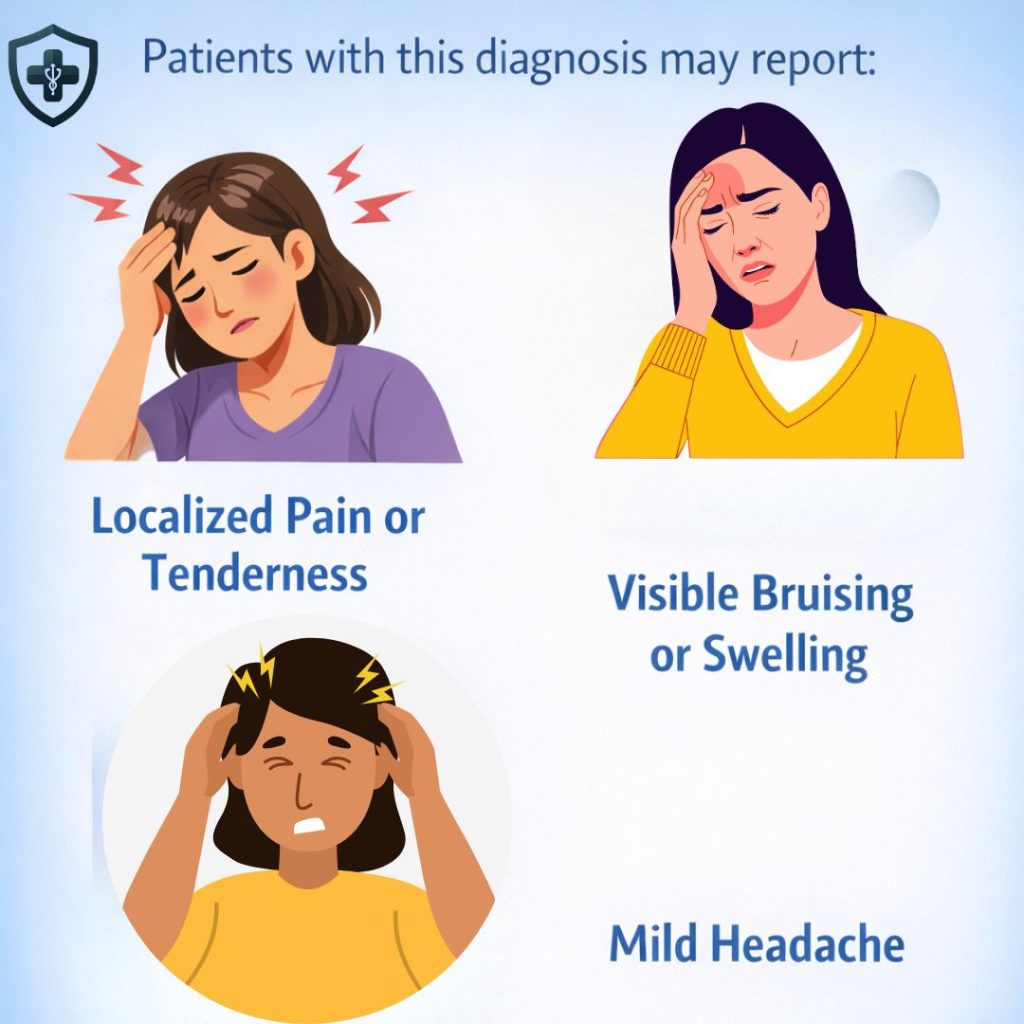
Patients with a superficial head contusion typically experience:
- Localized pain
- Tenderness
- Swelling at the site of impact.
The affected area may show visible bruising that develops gradually over several hours. Mild headaches are also common, resulting from the localized trauma. While these symptoms are generally minor, they can occasionally cause discomfort or temporary restriction of movement, particularly if the contusion involves muscles or connective tissue of the scalp.
Importantly, neurological symptoms, such as confusion, memory loss, dizziness, or altered consciousness, are not characteristic of a simple contusion and should prompt immediate evaluation for more serious head injuries. Providers must carefully assess and document any signs of potential intracranial injury to avoid coding inaccuracies and ensure patient safety.
When to and When Not to Use ICD-10 Code S00.83XA
This code is intended to capture minor blunt head trauma that does not involve deeper structures or complications. This specific code is appropriate when all of the following conditions are met:
- The injury is a contusion (bruise)- the provider documents soft tissue bruising caused by blunt force trauma, with no penetration of the skin.
- The skin remains intact- there are no lacerations, puncture wounds, or open injuries. If the skin is broken, an open wound code must be used instead.
- The affected area is a nonspecific part of the head- the contusion does not fall under more anatomically specific categories such as the face, eye, or ear, which have their own ICD-10 codes.
- The encounter represents active treatment- the patient is undergoing evaluation, diagnostic testing, observation, pain management, or clinical decision-making related to the injury.
- No intracranial injury or fracture is identified- imaging and clinical findings rule out concussion, skull fracture, hemorrhage, or traumatic brain injury.
- This is the first visit for the injury- the “A” seventh character confirms that this is the initial encounter, not follow-up or aftercare.
This code is commonly used in emergency departments, urgent care centers, occupational health clinics, and primary care settings, particularly when the provider’s goal is to rule out serious head trauma and manage symptoms conservatively.
S00.83XA should not be used when documentation or clinical findings indicate a more severe injury or a different stage of care. ICD-10 coding requires the highest level of specificity, and misuse of this code can lead to claim denials or compliance issues.
This code is not appropriate when there’s a concussion or traumatic brain injury. When there’s an altered mental status, memory impairment or neurological symptoms requires a code from the S06.- (intracranial injury) category.
Why Claims Are Denied for S00.83XA
Claims involving head injuries receive heightened scrutiny. Denials commonly occur due to missing encounter characters, documentation suggesting a more serious injury, lack of external cause codes, or inconsistency between imaging results and diagnosis selection.
Conclusion
ICD-10-CM code S00.83XA accurately captures superficial head contusions during the initial encounter, but it must be applied with precision. While appropriate for minor blunt trauma, it should never replace more specific diagnoses when clinical evidence supports them.
By strengthening documentation practices and understanding ICD-10 encounter requirements, healthcare organizations can improve reimbursement outcomes, reduce audit risk, and maintain high standards of patient care.
About the Author