A concussion does not need to involve loss of consciousness to be clinically significant. In fact, the majority of concussions occur without a patient ever blacking out—yet these injuries still represent traumatic brain injuries (TBIs) with potential short- and long-term consequences. Because symptoms can be subtle, delayed, or underestimated, proper clinical evaluation and accurate medical coding are essential for patient safety, data integrity, and reimbursement.
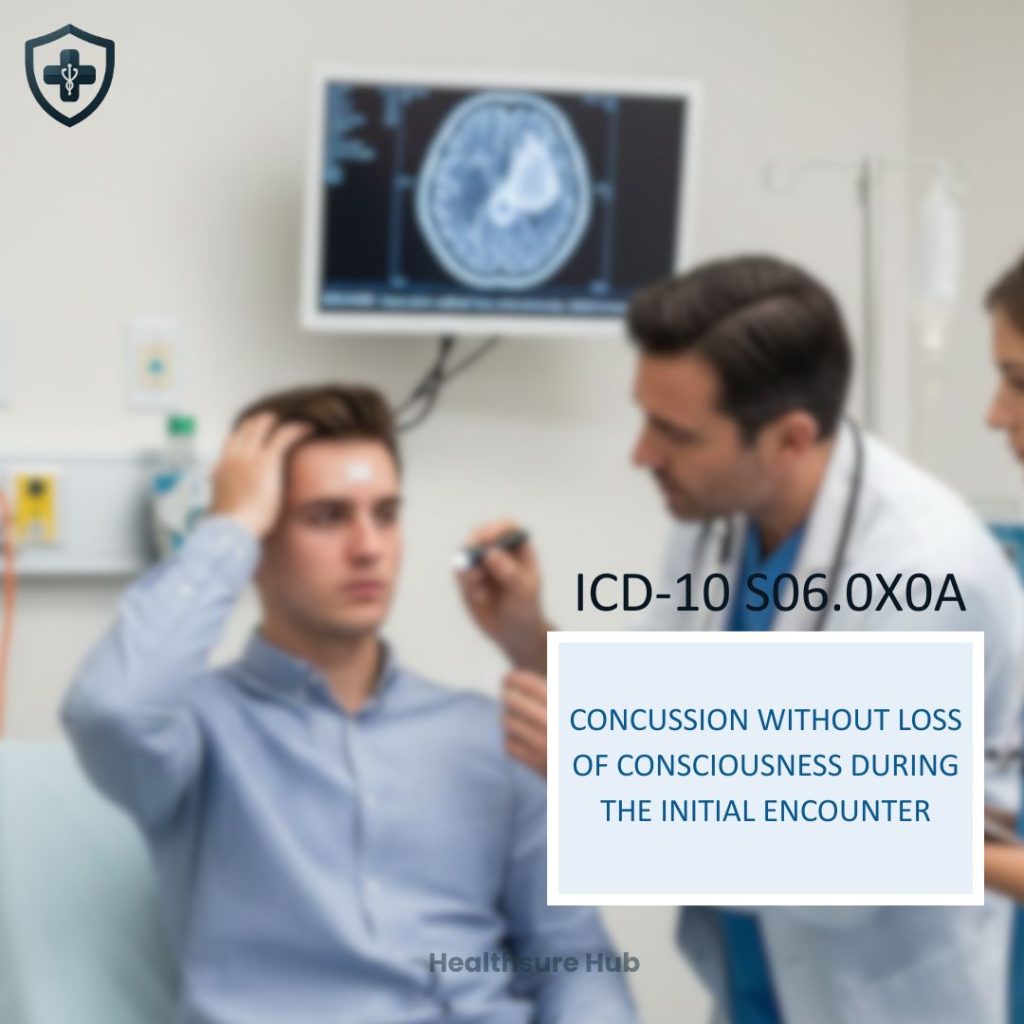
One ICD-10-CM code frequently used in these cases is S06.0X0A, which captures a concussion without loss of consciousness during the initial encounter. At HealthSure Hub, we break down this code to help providers, coders, and billing teams reduce errors, minimize denials, and improve overall care quality.
Overview of the ICD-10 Code S06.0X0A
S06.0X0A falls under Chapter 19 of ICD-10-CM, which covers Injury, Poisoning, and Certain Other Consequences of External Causes. ICD-10 code S06.0X0A is defined as concussion without loss of consciousness, initial encounter.
The code is used when a patient sustains a traumatic brain injury resulting in concussion symptoms without any documented loss of consciousness, and the visit represents the initial encounter, meaning the patient is receiving active treatment for the injury.
Within this chapter, the S06 category includes intracranial injuries, such as:
Although concussions are often labeled as “mild TBIs,” they are still classified as intracranial injuries, not merely neurological symptoms. This distinction is critical for coding accuracy, claims processing, and long-term outcome tracking.
Breaking Down the Code Structure
Understanding the structure of this ICD-10 code is essential for correct application and compliance. ICD-10 requires precise formatting, including placeholder characters.
| Code Component | Meaning |
| S | Injury, poisoning, and certain other consequences of external causes |
| 06 | Intracranial injury |
| .0 | Concussion |
| X | Placeholder character required to maintain code structure |
| 0 | Without loss of consciousness |
| A | Initial encounter (active treatment phase) |
The “X” placeholder is mandatory. Omitting it results in an invalid code and may cause claim rejections at the clearinghouse or payer level.
Clinical Description of a Concussion Without Loss of Consciousness
A concussion is a functional brain injury caused by a biomechanical force to the head or body that transmits energy to the brain. In cases coded as S06.0X0A, the patient does not experience loss of consciousness, but still exhibits neurological symptoms consistent with concussion.
This distinction is critical: absence of loss of consciousness does not equate to absence of brain injury. Many patients remain awake but experience alterations in cognition, balance, or sensory processing that warrant medical attention and monitoring.
Real-Life Clinical Example
Consider a 32-year-old patient who presents to the emergency department after slipping on ice and striking the back of their head on the ground. The patient reports that they never lost consciousness and remembers the entire event. However, within minutes of the fall, they began experiencing a persistent headache, dizziness when standing, and difficulty concentrating. A neurological examination reveals slowed response time and mild balance instability, but no focal deficits. A CT scan is performed and shows no acute intracranial bleeding.
In this scenario, the patient meets the clinical criteria for a concussion without loss of consciousness. Because the visit represents the first active medical evaluation and treatment of the injury, the specific ICD-10 code is the appropriate diagnosis code. Despite normal imaging and the absence of blackout, the patient’s symptoms clearly indicate a traumatic brain injury requiring monitoring, discharge instructions, and follow-up care.
Signs and Symptoms Associated With S06.0X0A
Patients diagnosed with concussion without loss of consciousness may present with a wide range of symptoms, including:
- Headache or head pressure
- Dizziness or balance disturbances
- Nausea without vomiting
- Difficulty concentrating or feeling “foggy”
- Memory disturbances
- Sensitivity to light or noise
- Fatigue or sleep disturbances
Symptoms may be immediate or delayed, and severity does not always correlate with the force of impact. Thorough documentation of symptom onset, duration, and progression is essential for both clinical management and coding support.
When to Use ICD-10-CM Code S06.0X0A
S06.0X0A is appropriate when all of the following conditions are met:
- A concussion is clinically diagnosed
- No loss of consciousness is documented
- The encounter represents active treatment
- Symptoms are directly related to head trauma
- No more severe intracranial injury is identified
This code is commonly used in emergency departments, urgent care centers, and initial outpatient evaluations.
When NOT to Use S06.0X0A
This code should not be used when:
- Any loss of consciousness is already documented (use appropriate S06.0X1–S06.0X9 codes)
- The encounter is a follow-up or healing phase (use the “D” extension)
- The visit addresses long-term effects or residual symptoms (use the “S” extension)
- A more severe traumatic brain injury is diagnosed
Using the wrong encounter extension is a frequent source of payer denials.
Coding and Billing Best Practices
To reduce risk and improve reimbursement accuracy:
- Explicitly document “no loss of consciousness” when applicable
- Use correct encounter extensions based on treatment phase
- Add appropriate external cause codes
- Update diagnosis codes as the patient progresses through care
- Educate providers on ICD-10 concussion distinctions
Strong collaboration between clinical and coding teams significantly improves compliance.
Conclusion
ICD-10 code S06.0X0A plays a critical role in accurately capturing concussions without loss of consciousness during the initial phase of care. While these injuries may appear mild, they represent legitimate traumatic brain injuries that require careful evaluation, documentation, and follow-up.
By understanding the structure, clinical intent, and documentation requirements of this code, healthcare organizations can reduce denials, improve data quality, and ensure patients receive appropriate care.
About the Author