Head injuries are one of the most common yet unpredictable types of trauma encountered in healthcare. From minor bumps to injuries with potentially serious long-term consequences, the accurate documentation of head trauma is crucial for both patient care and medical billing.
This is where ICD-10-CM code S09.90XA comes into play. Our team at Healthsure Hub breaks down the code, its clinical application, and medical billing considerations for the code, providing a comprehensive guide for healthcare professionals, coders, and medical billers.
Overview of S09.90XA
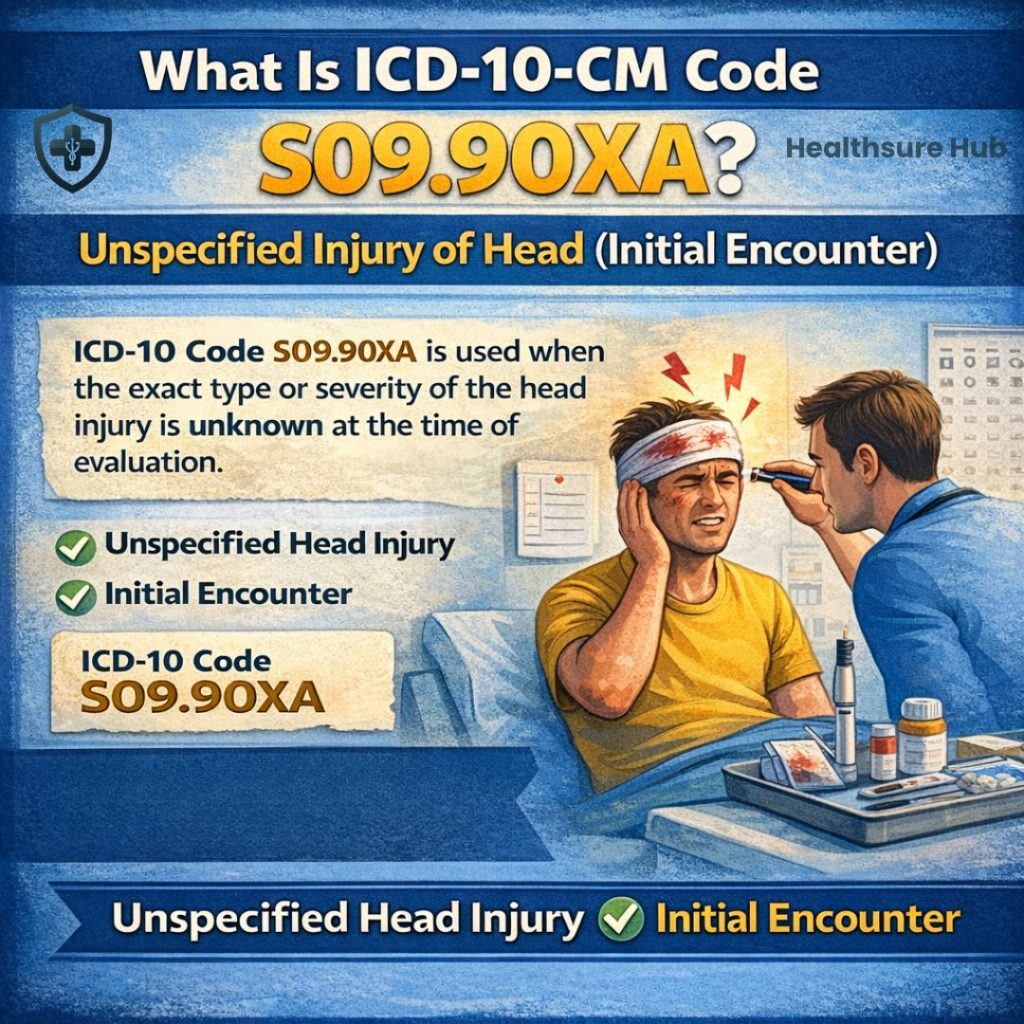
S09.90XA is an ICD-10-CM code used to classify an unspecified injury of the head during an initial encounter. It is applied when the exact type or severity of the head injury is unknown at the time of evaluation.
From a billing perspective, this ICD-10 code is used when healthcare providers cannot yet assign a more specific diagnosis. It ensures that the visit is documented, coded, and billed correctly, even when the exact injury remains unknown. This code acts as a bridge until further evaluation clarifies the type of head injury.
Breaking Down the Code
- S09: Injury of head, not specified elsewhere
- 90: Unspecified type of head injury
X: Placeholder to complete the ICD-10 format - A: Denotes initial encounter, meaning the patient is receiving active treatment
When S09.90XA is Used in Clinical Practice
Healthcare providers often encounter situations where the patient’s head injury cannot be precisely identified. The code is typically used in:
- Emergency settings: Patients arrive with head trauma, but imaging or examinations have not yet identified a specific diagnosis.
- Mild or nonspecific injuries: Patients may experience headaches, dizziness, or minor swelling after a fall or accident.
In the United States, an estimated more than 10.7 million head traumas were treated in emergency departments over a multi‑year period, averaging over 2.1 million visits annually, and the rate of head trauma increased significantly over time.
Differentiation from Other Head Injury Codes
If the injury type is known—such as a concussion, fracture, or open wound—clinicians must use the specific ICD-10-CM code. The said code is reserved exclusively for unspecified injuries, preventing gaps in documentation and ensuring proper continuity of care.
Common Scenarios and Examples
An estimated 1.7 million traumatic brain injuries occur annually in the U.S., with the majority considered mild but still requiring careful clinical evaluation and coding. This specific ICD-10 code is often used for:
Fall at Home
A patient falls in their home, striking their head on the floor or furniture. Upon evaluation, they present with mild swelling, bruising, and headache, but imaging results are not yet available or show no clear fracture or concussion.
- Why is the ICD-10 code for unspecified head injury appropriate: The exact type of injury cannot be confirmed at the time of the visit. Using this code allows the encounter to be documented and billed correctly.
Motor Vehicle Accident (MVA)
A patient is involved in a motor-vehicle accident and experiences a head impact. They may report headache, dizziness, or minor confusion, but clinical evaluation and imaging do not reveal a fracture, laceration, or concussion.
- Why is this ICD-10 code appropriate: The injury is present but unspecified; it ensures documentation during the initial encounter and allows for follow-up if symptoms persist or worsen
Sports-Related Head Injuries
An athlete suffers a blow to the head during a game. Initial evaluation reveals dizziness, mild headache, or lightheadedness, but no definitive diagnosis like concussion or skull fracture can be confirmed..
- Why S09.90XA is appropriate: Provides a temporary coding solution to document the injury while the patient is observed, monitored, or referred for further evaluation.
Differences Between S09.90XA and Other Head Injury Codes
S09.90XA is unspecified, unlike other head injury codes:
| Code | Description | When to Use |
| S06.0X0A | Concussion without loss of consciousness | When concussion is confirmed |
| S01.90XA | Open head wound | When a laceration or penetrating injury is present |
Conclusion
S09.90XA plays a critical role in documenting and managing unspecified head injuries during an initial encounter. This code ensures that even when the exact nature of a head injury is unknown, providers can maintain accurate clinical records, proper billing, and compliance with coding standards. By using this specific ICD-10 code responsibly, healthcare providers and coders can achieve high-quality documentation, proper reimbursement, and reliable data tracking.
About the Author