Knee injuries are among the most common musculoskeletal conditions treated in emergency rooms, orthopedic clinics, and primary care settings. Whether caused by sports, workplace accidents, or everyday falls, trauma to the knee joint often requires prompt evaluation and accurate documentation.
One commonly used diagnosis code in these situations is ICD-10 code S83.91XA. But what does the code actually refer to? Our team at HealthSure Hub, helps you understand what the code means, when and how to use the code correctly while helping providers, coders, and billers stay compliant while accurately reflecting the patient’s condition.
What Is ICD-10 Code S83.91XA?
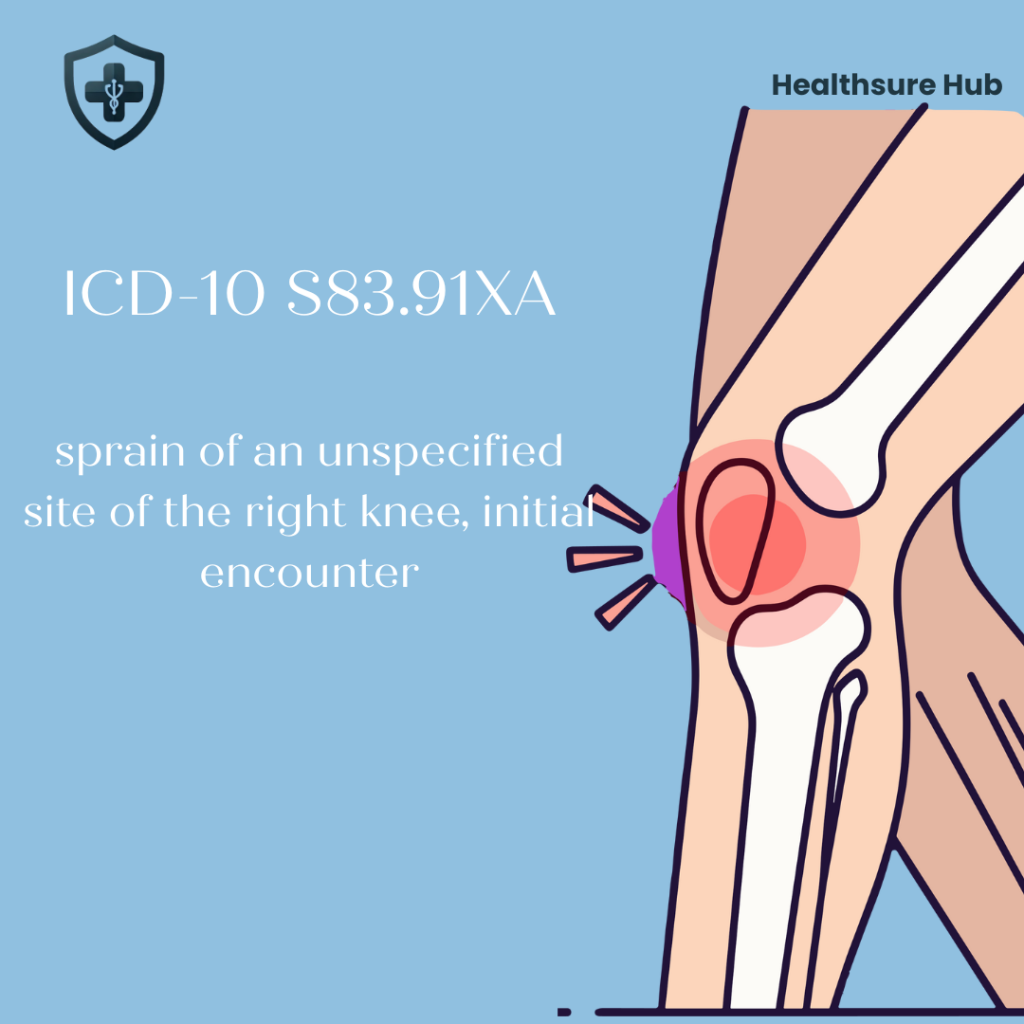
ICD-10 code, S83.91XA is defined as a sprain of an unspecified site of the right knee, initial encounter. This code belongs to the S83 category, which covers dislocations and sprains of joints and ligaments of the knee. It is considered a billable and specific ICD-10 code, provided all required elements, laterality and encounter type, are documented correctly.
Breaking down the code:
- S83 – Dislocation and sprain of joints and ligaments of the knee
- .91 – Unspecified site of the right knee
- X – Placeholder character to maintain proper code structure
- A – Initial encounter, meaning the patient is receiving active treatment
The term unspecified site does not mean vague or incorrect documentation. Rather, it reflects a real-world clinical scenario in which a knee ligament injury is suspected or confirmed, but the exact ligament (ACL, MCL, LCL, or PCL) has not yet been identified.
What “Initial Encounter” Means in ICD-10
The 7th character “A” indicates an initial encounter, which refers to the period when the patient is receiving active treatment for the injury.
This may include:
- Emergency department evaluation
- Diagnostic imaging such as X-rays or MRI
- Orthopedic consultation
- Immobilization or bracing
- Initiation of physical therapy
It does not necessarily mean the first visit ever—only that treatment is ongoing. Once care transitions to routine healing or follow-up, a subsequent encounter code (with “D”) should be used.
Clinical Meaning of S83.91XA in Practice
Clinically, this ICD-10 code represents an acute traumatic injury to the right knee joint or its supporting ligaments. These injuries often present with:
- Pain and tenderness
- Swelling or joint effusion
- Limited range of motion
- A feeling of instability or weakness
In many cases, providers initially document a knee sprain based on physical exam findings before advanced imaging confirms a more specific diagnosis. ICD-10 allows the use of S83.91XA during this early phase of evaluation and treatment.
It’s also important to distinguish ligament sprains from muscle or tendon strains of the lower leg, which fall under a different ICD-10 category and are not coded using S83 codes.
Conditions Included Under ICD-10 Code S83.91XA
According to ICD-10-CM guidelines, this code includes a broad range of acute traumatic knee injuries, provided they affect the right knee and no specific internal structure is identified.
This code may be used for:
- Avulsion injuries of the knee joint or ligaments, where force causes tissue to pull away from the bone
- Lacerations of the knee cartilage, joint, or ligaments associated with trauma
- Sprains of the knee joint or ligaments, including partial ligament tears
- Traumatic hemarthrosis, meaning bleeding into the knee joint following injury
- Traumatic subluxation of the knee, or partial dislocation caused by an acute injury
All of these conditions qualify under the code as long as the injury is traumatic, affects the right knee, and the patient is in the active treatment phase.
Common Causes of Right Knee Sprains
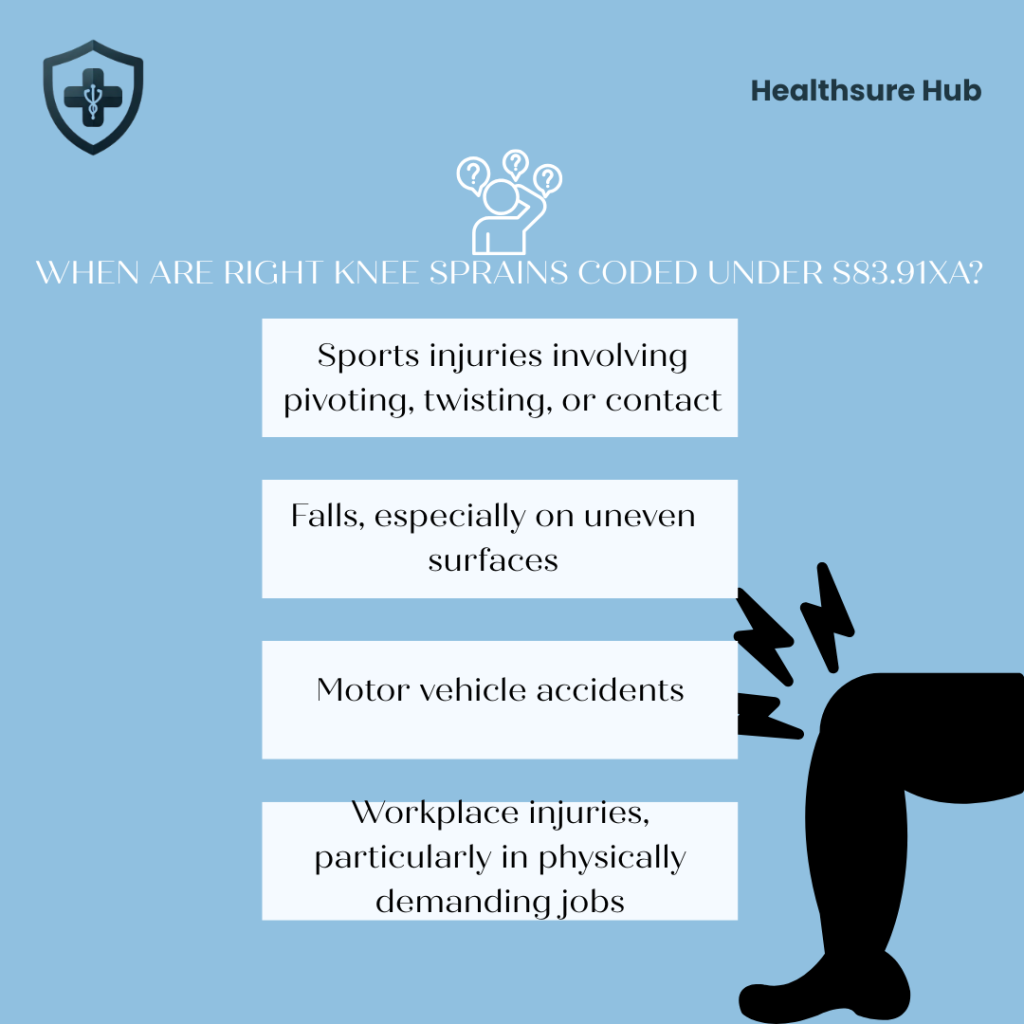
Right knee sprains coded under S83.91XA typically result from sudden or forceful trauma. Common causes include:
- Sports injuries involving pivoting, twisting, or contact
- Falls, especially on uneven surfaces
- Motor vehicle accidents
- Workplace injuries, particularly in physically demanding jobs
Risk factors such as prior knee injury, poor muscle conditioning, or participation in high-impact activities may increase susceptibility.
Documentation and Coding Best Practices
To support accurate use of this code you need to:
- Ensure right knee laterality is clearly documented
- Confirm the injury is acute and traumatic, not chronic or degenerative
- Use unspecified coding appropriately during early evaluation
- Update the diagnosis if imaging later identifies a specific ligament
High-quality documentation improves claim acceptance and allows for more specific coding when clinically appropriate.
Related ICD-10 Codes for Knee Sprains
S83.91XA is part of a small but important group of closely related knee injury codes. For complete documentation and internal linking, consider these related codes:
- S83.92XA – Sprain of unspecified site of left knee, initial encounter
- S83.90XA – Sprain of unspecified site of unspecified knee, initial encounter
Billing and Reimbursement Considerations
From a billing standpoint, the said code requires:
- Clear documentation of trauma and symptoms
- Alignment between clinical notes and diagnosis code
- Additional coding for any associated open wound, if present
Accurate ICD-10 coding supports medical necessity reviews and reduces delays in reimbursement.
Conclusion
ICD-10 code S83.91XA plays a vital role in documenting acute traumatic injuries of the right knee during the initial phase of care. When used correctly, it balances clinical reality with coding precision, ensuring that patients receive appropriate treatment while providers and billers maintain compliance.
Understanding how this code fits alongside S83.92XA and S83.90XA further strengthens documentation accuracy and supports a well-structured, authoritative knee injury coding resource.
About the Author