Ankle injuries are among the most frequently evaluated musculoskeletal complaints in emergency departments, urgent care centers, and primary care offices.. One code commonly used in these early encounters is S93.409A, which classifies a sprain involving an ankle ligament when specific anatomical details are not yet documented. Understanding how and when this code is applied is essential for healthcare providers, medical coders, and compliance professionals.
Our team at Healthsure Hub explains what this ICD-10 code represents, how it is used in medical billing, and why accurate documentation is essential for proper code selection.
What Is ICD-10-CM Code S93.409A?
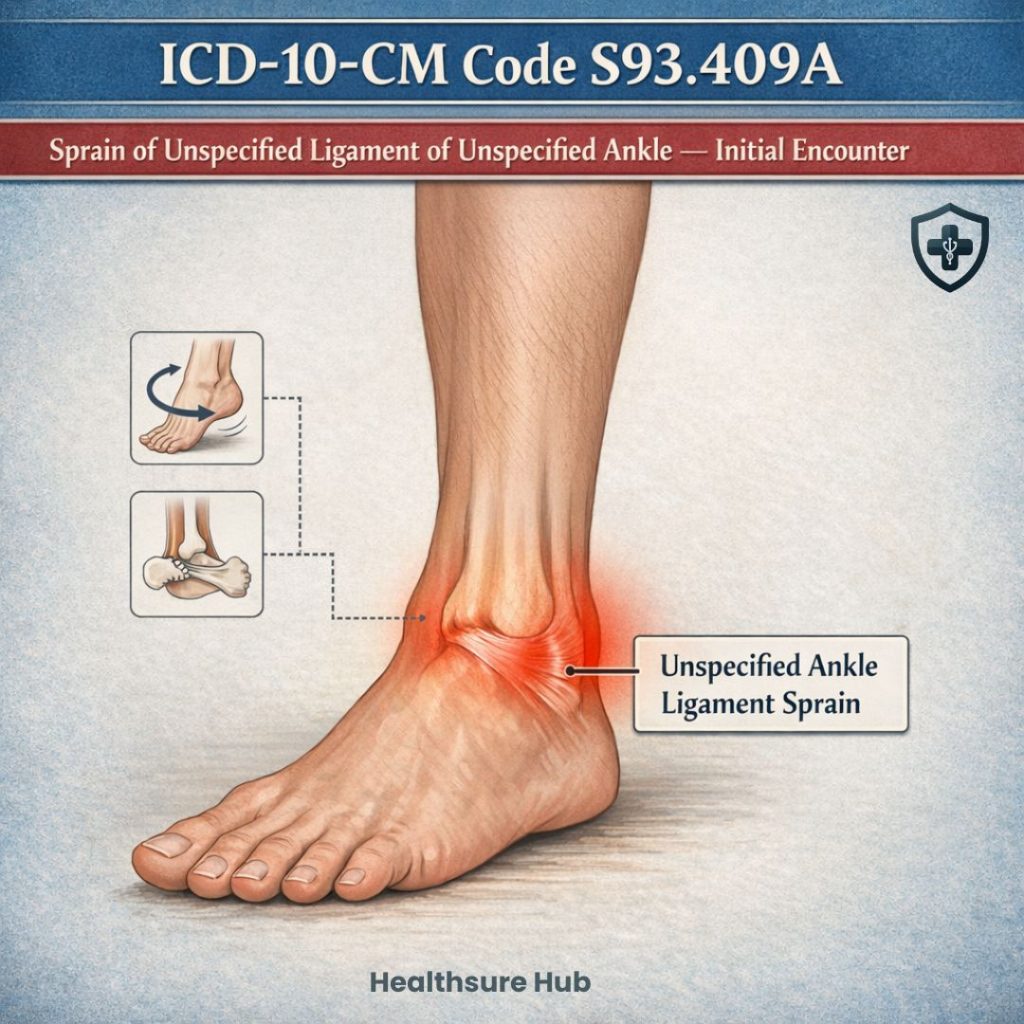
ICD-10code S93.409A is defined as sprain of unspecified ligament of unspecified ankle, initial encounter. This code belongs to the injury chapter of ICD-10-CM and is used to classify acute ankle ligament injuries during the first episode of active treatment.
Each component of the code has a specific meaning:
- The term sprain indicates an injury to a ligament rather than to bone or muscle.
- The phrase unspecified ligament means that the medical record does not identify which ankle ligament is involved.
- Unspecified ankle indicates that laterality—left or right—has not been documented. Initial encounter character signifies that the patient is receiving active treatment, such as evaluation, imaging, immobilization, or referral.
Importantly, this ICD-10 code does not describe severity or long-term outcome. It is strictly a classification code used for injury reporting and billing.
When Is S93.409A Used in Medical Billing?
S93.409A is used during the initial encounter, which refers to the period when the patient is receiving active treatment for the injury. This includes visits where the injury is first evaluated, diagnostic imaging is ordered, a brace or splint is applied, or the patient is referred for further care. Statistics show that an estimated 7.4 million ankle sprains presented to emergency departments between 2010 and 2024, yielding an incidence of about 1.53 per 1,000 person-years.
Common care settings where this code is applied include emergency departments, urgent care clinics, and initial outpatient visits. The code should not be used for routine follow-up appointments or long-term care after the active treatment phase has ended. Once the patient transitions to subsequent care or recovery, a different encounter character would be required.
Correctly identifying the encounter type is essential to ensure accurate claims processing and compliance with ICD-10-CM guidelines.
Documentation Requirements for Accurate Use
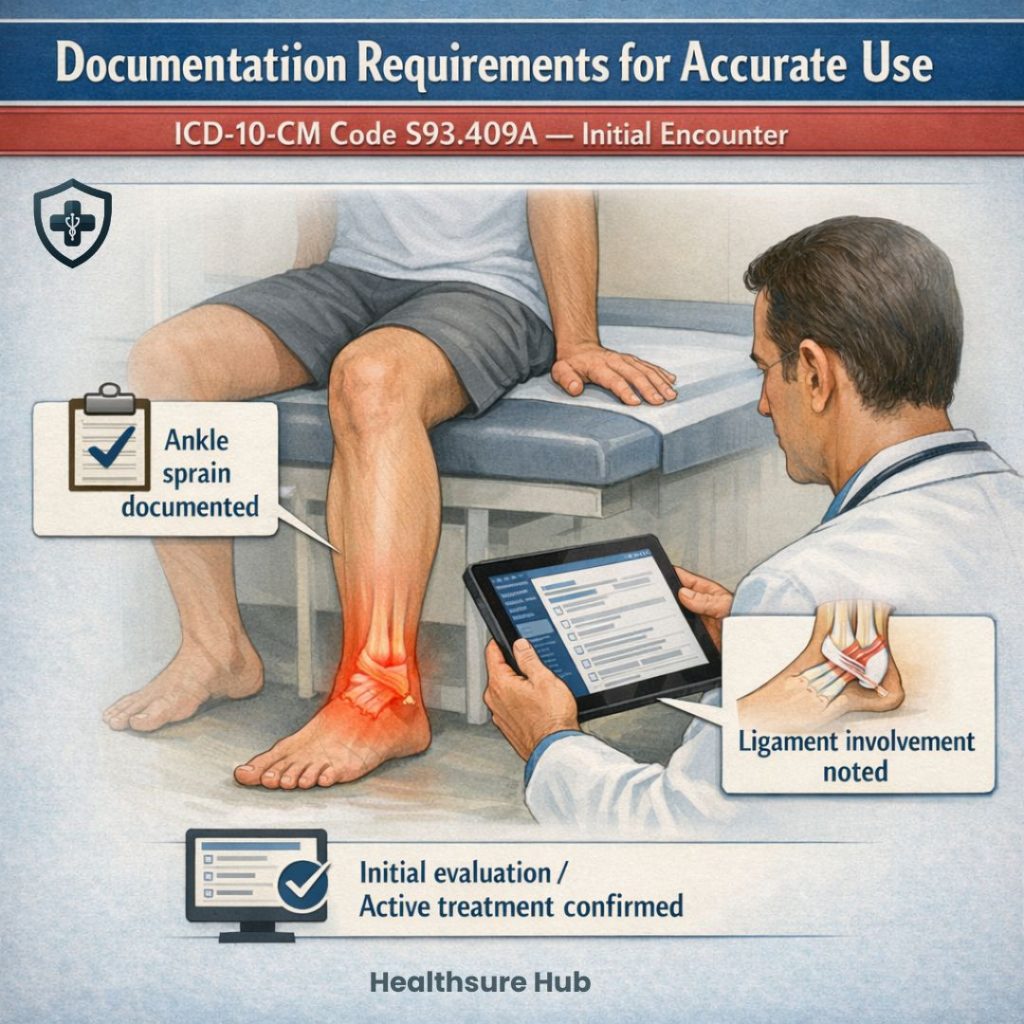
To support ICD-10 code for sprain of unspecified ligament of unspecified ankle, the medical record must clearly document that an ankle sprain has occurred and that the encounter represents active treatment. The provider’s notes should indicate ligament involvement and confirm that this is the initial evaluation or management of the injury.
What distinguishes this code is what is not documented. When this ICD-10 code is assigned, the record does not specify the exact ligament involved or the affected side. This does not imply poor care, but rather reflects the level of detail available at the time of documentation.
Clear, concise provider documentation is critical. Coders rely entirely on the clinical record, and absent details cannot be inferred. When laterality or ligament specificity is documented, a more specific code should be selected instead.
Comparison to More Specific Ankle Sprain Codes
Within the ICD-10-CM system, ankle sprain codes range from unspecified to highly specific. Ankle sprains are particularly common among adolescents and young adults, with the highest incidence observed in individuals aged 15–19 years.
More detailed codes identify the exact ligament involved and whether the injury affects the left or right ankle. These codes are preferred when documentation supports them, as they improve data quality and payer transparency.
However, S93.409A remains appropriate when such details are not available. It is a valid, billable code that aligns with ICD-10-CM guidelines when documentation is limited. The key is ensuring that the unspecified designation accurately reflects the provider’s notes rather than being used as a default when information is present.
Common Coding Errors Associated With S93.409A
One common error is assigning the ICD-10 code for sprain of unspecified ligament of unspecified ankle when the provider has documented laterality or identified a specific ligament. In these cases, failing to select a more specific code can lead to claim denials or audit issues.
Another frequent mistake is confusing ankle sprain codes with injuries of the foot or lower leg. Accurate anatomical identification is essential. Additionally, coders should ensure the correct encounter character is used, as applying the initial encounter designation to follow-up visits is incorrect.
Regular review of documentation and adherence to coding guidelines can help prevent these errors.
Relationship to Other Injury and Encounter Codes
S93.409A is part of a broader category of ICD-10 injury codes used to describe acute musculoskeletal trauma. While it may be reported alongside additional codes when appropriate, its primary role is to classify the ankle ligament injury itself during active treatment.
Proper sequencing and selection of codes support accurate clinical records without overcoding or misrepresentation of services.
Importance of S93.409A for Compliance and Reimbursement
Accurate use of ICD-10-CM code S93.409A is particularly important given how frequently ankle sprains are encountered across healthcare settings. Studies estimate that approximately 2 to 7 ankle sprains per 1,000 person-years are treated in emergency departments alone, a figure that likely underrepresents the true incidence since many patients seek care in urgent care or outpatient settings. In such high-volume clinical environments, correct application of initial encounter codes supports clean claims, reduces reimbursement delays, and improves audit readiness. Because unspecified injury codes are closely monitored by payers, their use must be clearly supported by documentation to ensure compliance while maintaining efficient clinical workflow.
Conclusion
ICD-10 code S93.409A plays an important role in reporting ankle ligament injuries during the initial phase of care when specific details are not yet documented. It accurately reflects a sprain of an unspecified ligament in an unspecified ankle and is appropriate for active treatment encounters supported by clinical notes. While greater specificity is always preferred when available, the ICD-10 code remains a compliant and necessary option in many real-world clinical scenarios.
About the Author