Accurate diagnosis coding is essential in obstetric care, not only for clinical documentation but also for billing accuracy, regulatory compliance, and healthcare data integrity. ICD-10-CM code O03.9 is used to report cases of complete or unspecified spontaneous abortion without complication.
While the clinical event itself is significant, Healthsure Hub focuses primarily on the correct application, documentation requirements, and coding implications of this ICD-10 code, making it a reliable reference for healthcare providers, medical coders, and billing professionals.
Overview of ICD-10-CM Code O03.9
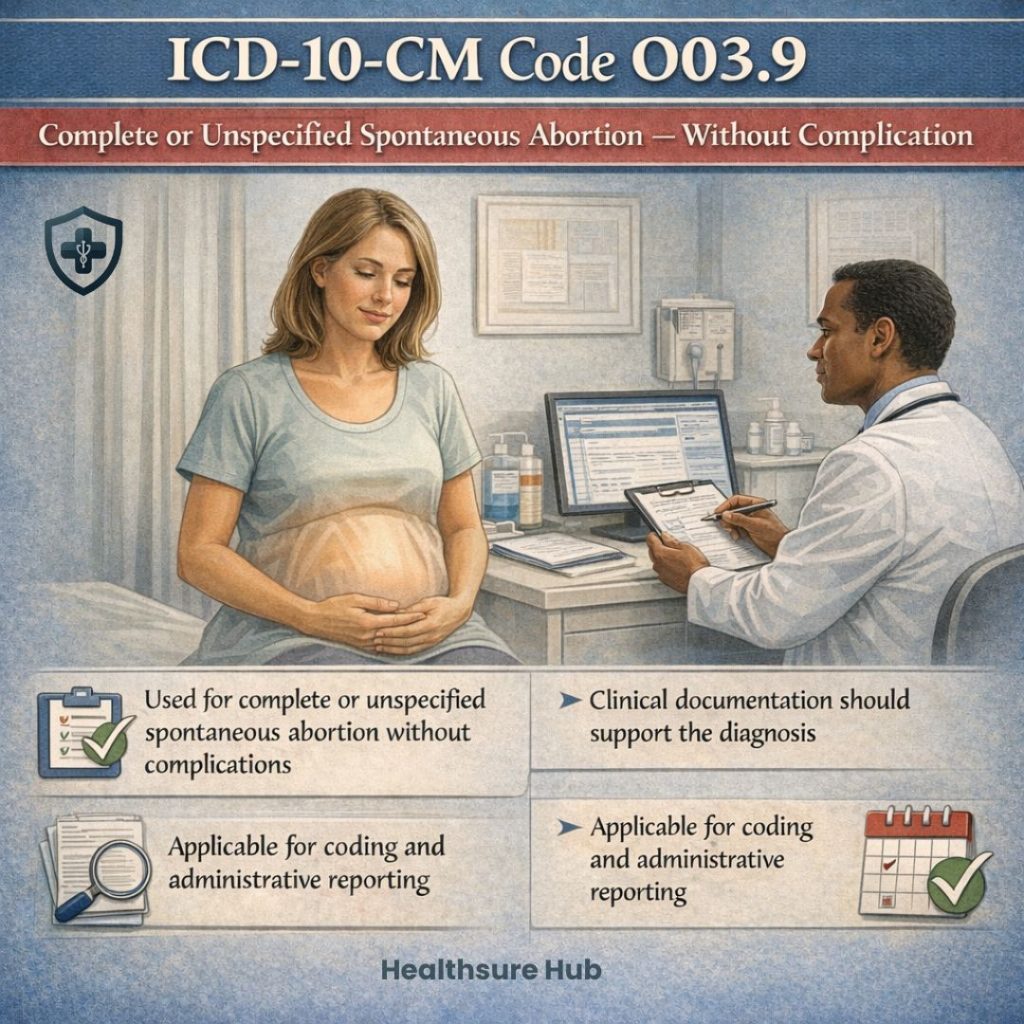
O03.9 is classified under Chapter 15 of ICD-10-CM (Pregnancy, Childbirth, and the Puerperium) and falls within category O03 – Spontaneous abortion. The code specifically applies when a spontaneous abortion is documented as either complete or unspecified and no complications are present or recorded.
The code applies when a clinician documents that a spontaneous abortion has occurred and notes either that it was complete or does not specify further detail. Crucially, it is only appropriate when no complications are documented. The absence of complications is not assumed; it must be supported by the medical record.
The term unspecified in this context does not indicate poor documentation. Rather, it reflects that the provider has clinically confirmed the event but has not indicated additional subclassification such as incomplete abortion, retained tissue, or associated conditions. When no further clinical detail exists, O03.9 may be the correct and compliant choice.
Spontaneous Abortion: Key Statistics
Spontaneous abortion, commonly referred to as miscarriage, is unfortunately a common experience in early pregnancy. Understanding the prevalence helps providers and coders contextualize clinical encounters and reinforce the importance of accurate documentation.
- Prevalence – studies estimate that 10–20% of clinically recognized pregnancies end in spontaneous abortion. Early miscarriages—those occurring before 12 weeks—account for the majority of cases.
- Timing – about 80% of spontaneous abortions happen in the first trimester, with the remainder occurring later in pregnancy.
- Causes – Chromosomal abnormalities are responsible for nearly 50% of first-trimester miscarriages, while other contributing factors include hormonal imbalances, uterine abnormalities, infections, and chronic maternal health conditions.
- Recurrence – women who experience one miscarriage have about a 15–20% chance of recurrence in subsequent pregnancies, though many go on to have successful pregnancies.
Including this data in clinical and coding discussions highlights the importance of accurate diagnosis and reporting. Coders using ICD-10-CM O03.9 can see how frequently spontaneous abortions occur, reinforcing that precise coding is essential for capturing these events in medical records, healthcare analytics, and public health reporting.
Clinical Context Supporting O03.9 Assignment
From a coding perspective, ICD-10-CM O03 is used when the provider clearly documents a spontaneous abortion that does not involve complications such as hemorrhage, infection, or retained products of conception. The code may be assigned across multiple care settings, including emergency departments, outpatient clinics, and inpatient admissions.
It is important to remember that diagnosis codes do not interpret clinical events; they reflect them. Coders must rely strictly on provider documentation. If the record confirms a spontaneous abortion and does not mention complications or clinical findings suggesting them, assigning O03.9 may be appropriate. If later documentation identifies complications, the code must be updated accordingly.
Why Spontaneous Abortions Occur
Including clinical context strengthens documentation quality and improves coding accuracy. Spontaneous abortions, commonly referred to as miscarriages, occur for a variety of medically recognized reasons. The most frequent cause is chromosomal abnormality, in which the embryo cannot develop normally. Other possible contributing factors include hormonal imbalance, uterine abnormalities, autoimmune disorders, infection, and certain chronic maternal health conditions.
In many cases, no definitive cause is identified, even after evaluation. This uncertainty is common and does not prevent accurate diagnosis coding as long as the clinical event itself is documented. Coders should not infer etiology unless explicitly stated by the provider.
Differentiating This Code From Related Diagnoses
This diagnosis should not be used when complications are present. Other codes within category O03 describe spontaneous abortion with specific conditions, including hemorrhage or infection. When such findings are documented, coders must select a more precise option rather than defaulting to O03.9.
It is equally important to distinguish spontaneous abortion from induced abortion or other abnormal pregnancy outcomes such as ectopic or molar pregnancy. Each of these has its own classification range and clinical criteria. Misclassification affects both clinical data integrity and reimbursement accuracy.
Real Clinician Scenario
Imagine a patient who comes to an outpatient clinic after experiencing vaginal bleeding and cramping shortly after a positive home pregnancy test. The clinician evaluates her symptoms, performs an exam, and reviews ultrasound results, which show that no pregnancy tissue remains. After assessment, the provider documents “complete spontaneous abortion, no complications” and sends the patient home with follow-up care instructions.
In this case, assigning code O03.9 is appropriate because the spontaneous abortion is clearly confirmed and the medical record specifies that no complications are present.
ICD-10-CM Guidelines and Coding Considerations
According to ICD-10-CM Official Guidelines, Chapter 15 codes are reported only on maternal records and must accurately reflect the clinical episode. Coders should review any applicable Excludes notes and sequencing instructions before final code assignment.
Using O03.9 in accordance with official guidance supports consistency across claims data and improves the reliability of medical records used for reporting and analytics.
Documentation Requirements and Best Practices
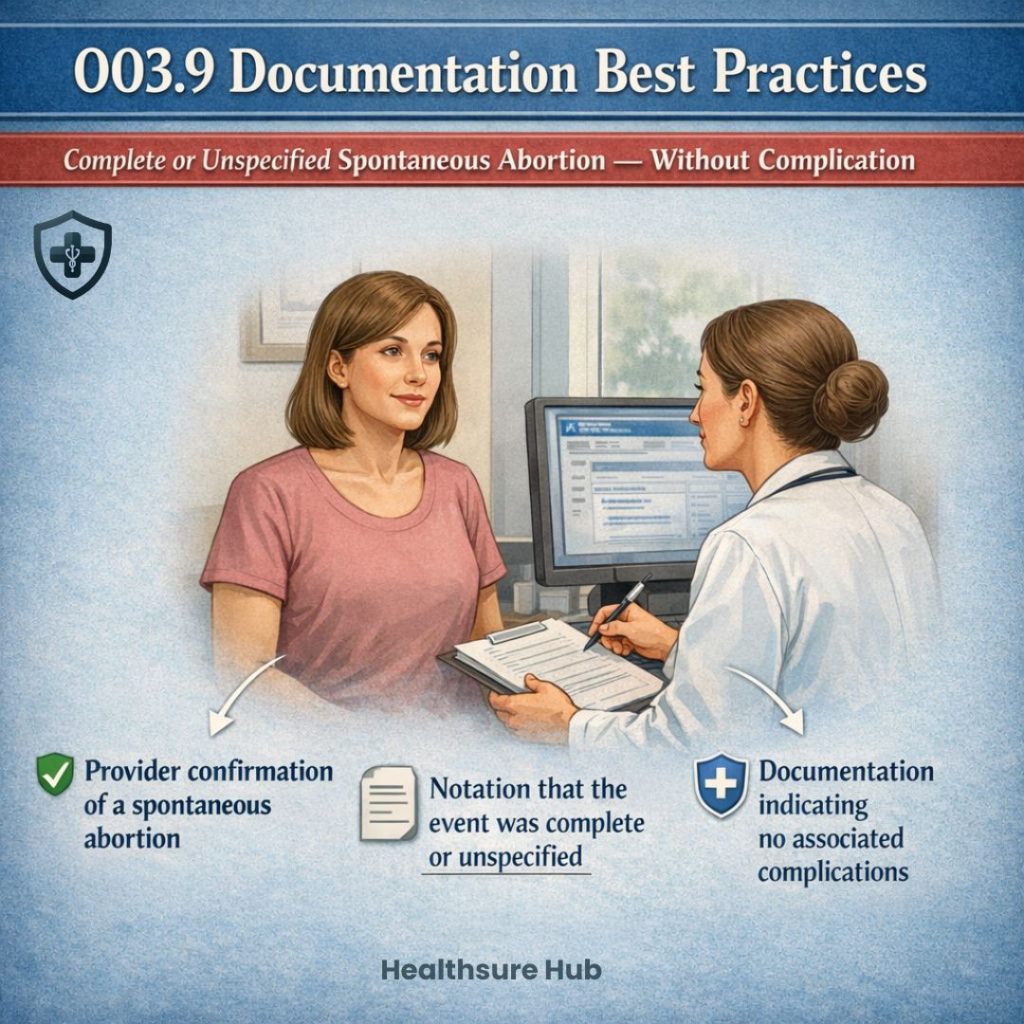
High-quality documentation is the foundation of correct code assignment. To support O03.9, the medical record should clearly indicate that a spontaneous abortion occurred and that no complications were present at the time of evaluation. The provider’s note should describe the clinical assessment, diagnostic findings if performed, and confirmation that the event was complete or not further specified. To support proper use, the medical record should include:
- Provider confirmation of a spontaneous abortion
- Notation that the event was complete or not further specified
- Documentation indicating no associated complications
If complications are documented at any point during the encounter, this code is no longer appropriate and a more specific alternative must be selected. Proper documentation supports audit readiness, reduces claim denials, and ensures regulatory compliance.
Billing, Reimbursement, and Compliance Impact
Diagnosis coding accuracy directly affects reimbursement, audit risk, and reporting integrity. While O03.9 may not always influence payment grouping on its own, incorrect assignment can trigger claim denials, medical necessity reviews, or retrospective audits. Payers expect coded data to match clinical documentation precisely.
Consistent and guideline-compliant code selection strengthens data reliability across healthcare systems. It also ensures that reported statistics on pregnancy outcomes reflect true clinical patterns, which is essential for research, policy development, and quality measurement initiatives.
Conclusion
ICD-10 code O03.9 is used to document complete or unspecified spontaneous abortion without complication and plays an important role in clinical records, billing, and healthcare reporting. Accurate documentation, guideline adherence, and thoughtful code selection ensure compliance while maintaining high-quality medical records.
When applied correctly, this code supports trustworthy data, appropriate reimbursement, and consistent healthcare documentation across care settings.
About the Author