Even seemingly minor trauma, such as a sudden stop in traffic or an awkward fall, can overstretch or tear the delicate ligaments that stabilize the cervical spine. When this occurs, accurate diagnosis and precise medical coding are essential to ensure appropriate treatment, documentation integrity, and insurance reimbursement.
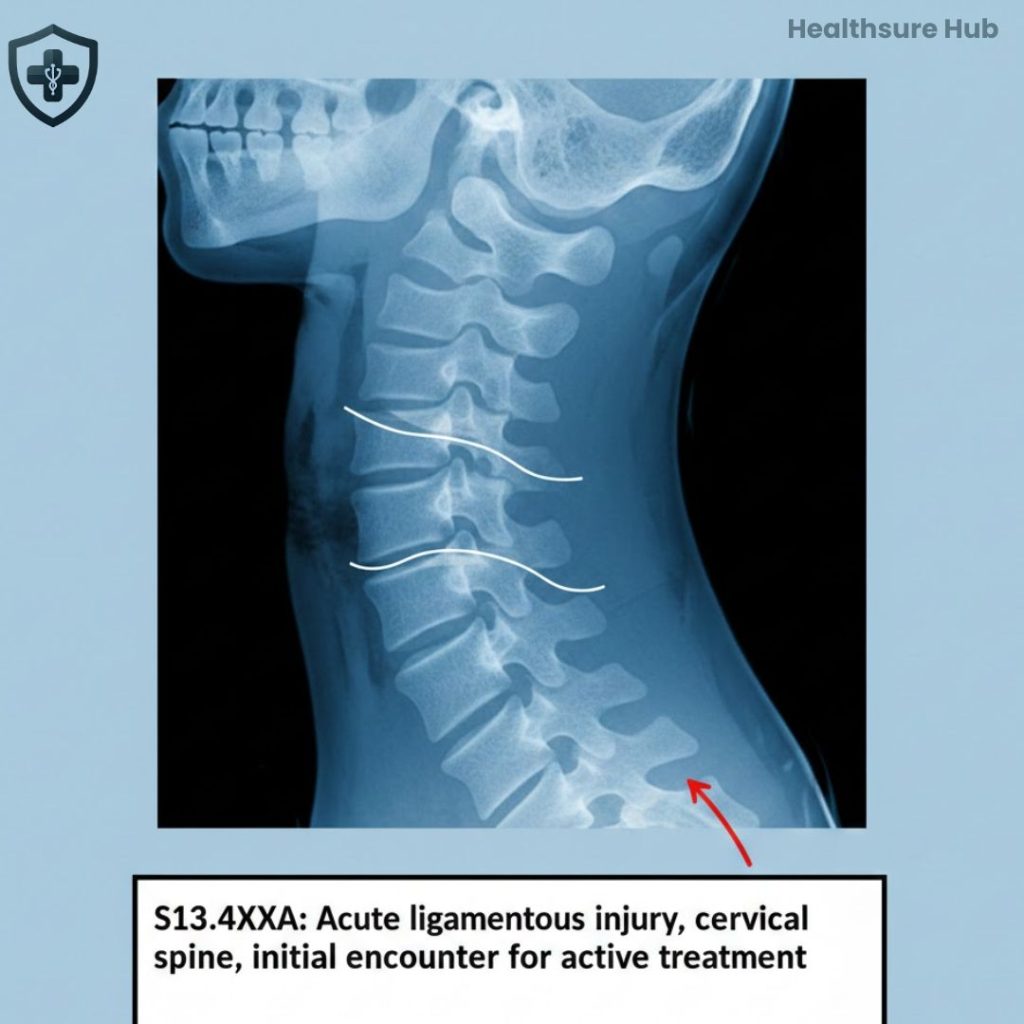
One ICD-10 code commonly used in these situations is S13.4XXA, which represents a sprain of the ligaments of the cervical spine during the initial encounter. At HealthSure Hub, we break down what this code means, when it should be used, and where documentation errors commonly occur.
Overview of the ICD-10 Code S13.4XXA
This code is used to report an acute ligamentous injury affecting the cervical spine when the patient is receiving active treatment for the condition. A cervical ligament sprain occurs when the ligaments that support and stabilize the neck are overstretched or torn due to trauma.
The code applies specifically to ligament injuries, not fractures, dislocations, or disc pathology. It is most often associated with soft-tissue neck injuries such as whiplash.
Breaking Down the Code Structure
Understanding the structure of the code helps prevent coding errors:
- S13.4 – Sprain of ligaments of the cervical spine
- XX – Placeholder characters required for code completeness
- A – Initial encounter (active treatment)
The placeholder “X” characters are mandatory. Removing them renders the code invalid and frequently results in claim denials.
Clinical Use of S13.4XXA
In clinical practice, the ICD-10 code for sprain of the ligaments of the cervical spine during the initial encounter is commonly used during early evaluation of neck trauma, particularly when ligament damage is suspected based on symptoms and physical examination. Imaging studies may rule out fractures while confirming soft-tissue injury, making this code appropriate during the initial phase of care.
This diagnosis is frequently seen in emergency departments, urgent care centers, and primary care settings following acute trauma.
Real-Life Clinical Example
A 35-year-old patient presents to urgent care after being rear-ended at low speed. They report neck stiffness and pain that began several hours after the accident. Physical examination reveals tenderness and reduced range of motion, but imaging shows no fractures or dislocations. The provider diagnoses a cervical ligament sprain and documents the code for the initial encounter.
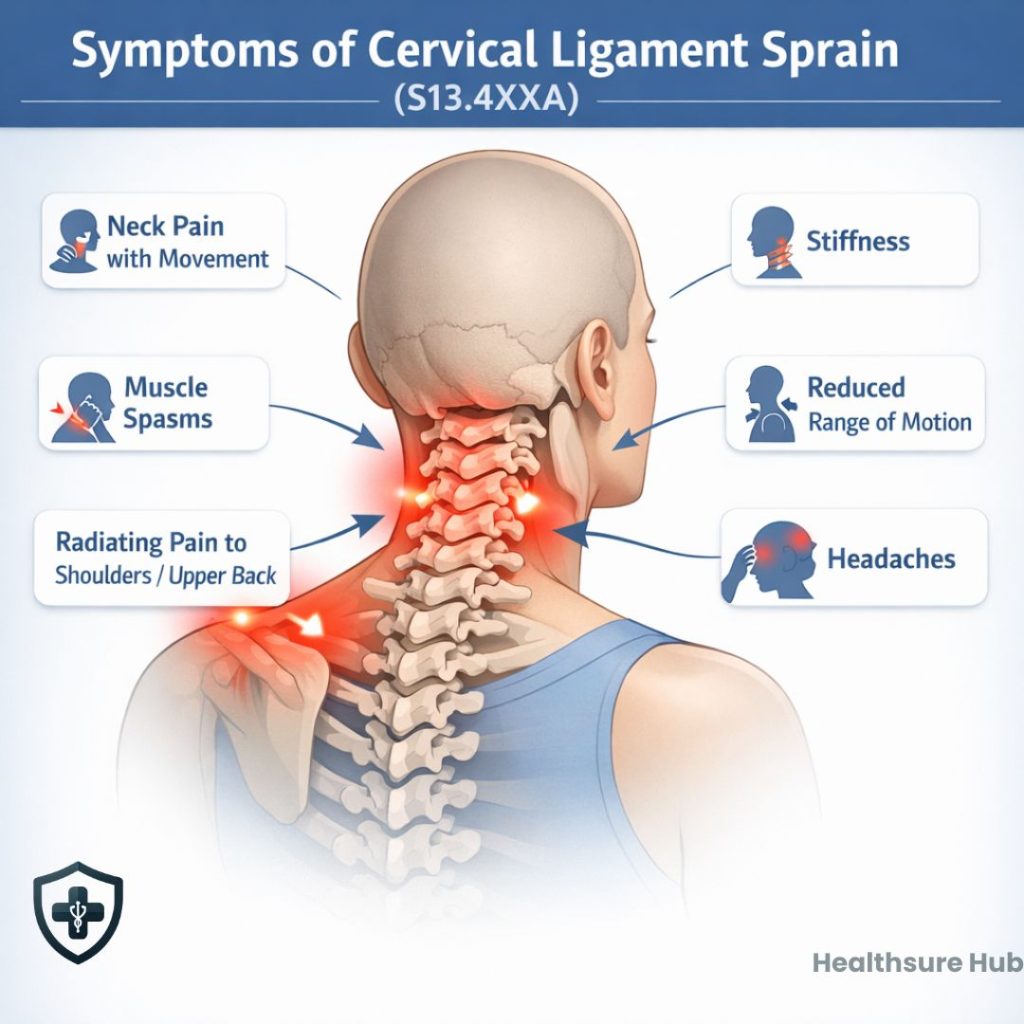
Symptoms Associated With S13.4XXA
Patients diagnosed with a cervical ligament sprain may report neck pain that:
- Worsens with movement
- Stiffness
- Muscle spasms
- Reduced range of motion
Pain may radiate to the shoulders or upper back, and headaches are also common. Unlike more severe cervical spine injuries, neurological deficits are typically absent, though symptoms may overlap early in evaluation.
When to Use ICD-10 Code S13.4XXA
This code is appropriate when:
- The injury involves cervical spine ligaments
- Trauma is the clear cause
- The patient is receiving active treatment
- The visit represents the initial encounter
- No fracture or dislocation is present
It is commonly used before transitioning to follow-up or recovery-phase coding.
When NOT to Use ICD-10 Code S13.4XXA
This ICD-10 code should not be used when:
- The encounter is a follow-up visit (use “D”)
- The condition is chronic or degenerative
- A cervical fracture or dislocation is diagnosed
- Neurological injury is the primary diagnosis
- A more specific ligament injury code is available
Improper use increases audit and increases the risk of denial.
Why Claims Are Denied for S13.4XXA
Common claim issues include insufficient documentation of trauma, failure to specify encounter type, continued use of the initial encounter code for follow-up visits, and inconsistencies between diagnosis and billed procedures.
Payers increasingly expect documentation to reflect injury progression and care stage.
Coding and Billing Best Practices
To reduce denials, providers should clearly document the mechanism of injury, confirm ligament involvement, and update encounter qualifiers appropriately. Coders should ensure placeholder characters are present and review documentation regularly for specificity.
Ongoing education on ICD-10 injury coding remains essential for compliance.
Conclusion
S13.4XXA accurately represents a sprain of the ligaments of the cervical spine during the initial encounter, making it a critical code in acute neck trauma care.
While appropriate early in treatment, it must be supported by clear documentation and updated as care progresses. Proper use improves reimbursement accuracy, compliance, and overall quality of care.
About the Author