Accurate medical coding is a cornerstone of modern healthcare, ensuring proper documentation, billing, and data reporting. The ICD-10-CM code S32.9XXA specifically refers to fractures of unspecified parts of the lumbosacral spine and pelvis during the initial encounter. Unlike specific fracture codes that identify exact vertebrae or pelvic bones, S32.9XXA is used when the precise location of the fracture is not detailed in the medical record.
Our team at HealthSure Hub explores S32.9XXA in depth, covering its definition, proper usage, documentation requirements, and clinical and administrative implications.
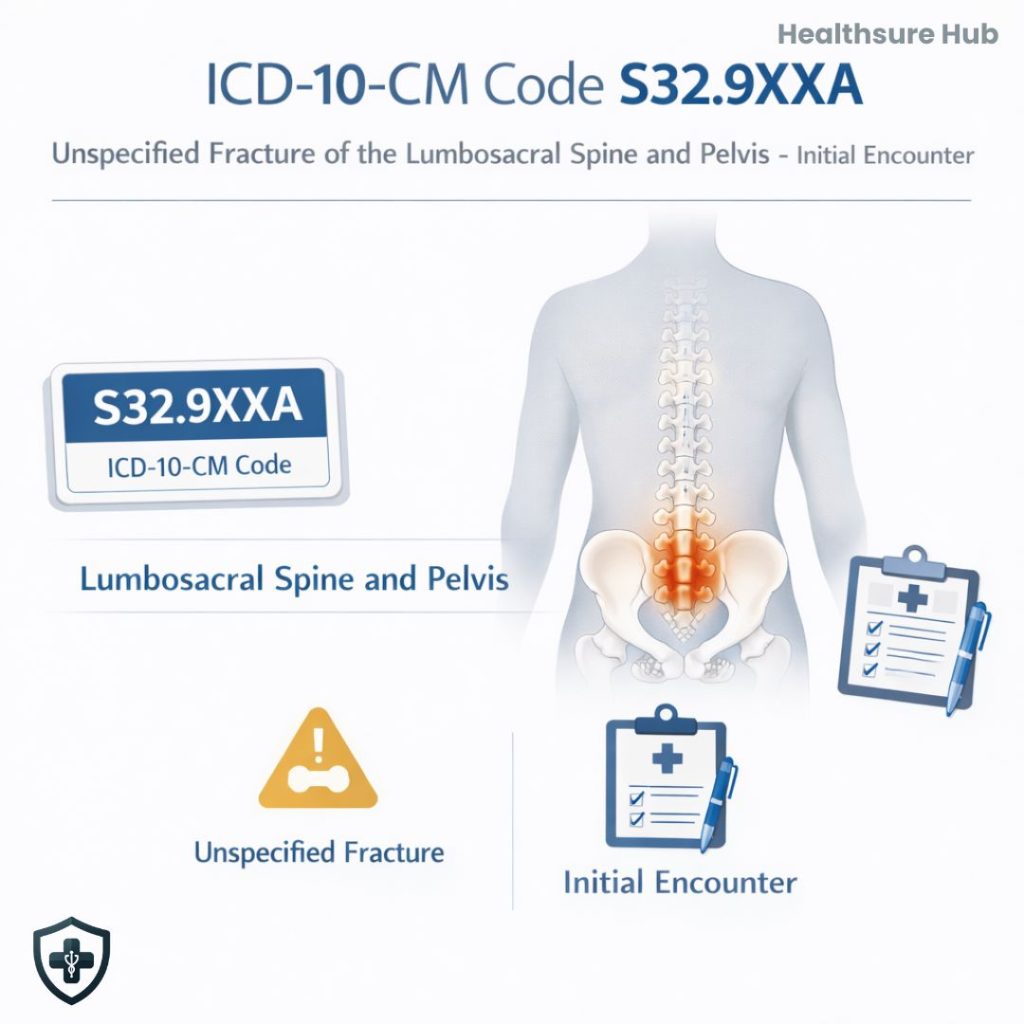
Definition and Code Breakdown
ICD-10 codes are structured to convey precise clinical information. S32.9XXA can be broken down as follows:
| Code Component | Meaning |
| S32 | Fracture of lumbar spine, sacrum, and pelvis |
| .9 | Unspecified part |
| XX | Placeholder for extensions (used in ICD-10 format) |
| A | Initial encounter for fracture |
This code applies when a fracture is confirmed in the lumbosacral spine or pelvis, but the exact vertebrae or pelvic bones are not identified. The “A” extension denotes the initial encounter, meaning the first time the patient receives treatment for this fracture.
National Statistics of Lumbosacral Fracture
Understanding the clinical frequency of injuries associated with S32-category codes further highlights why specificity matters. Lumbar vertebral fractures, for example, have shown a steady rise in incidence over recent years.
National emergency department data revealed that lumbar fracture rates increased from approximately 14.6 cases per 100,000 individuals to 22.5 per 100,000 within less than a decade, representing a growth of more than 50 percent.
During that same period, hundreds of thousands of lumbar fractures were documented nationwide, with women accounting for a majority of cases and the average patient age steadily increasing. This trend reflects demographic aging, higher detection rates, and improved imaging sensitivity, all of which contribute to greater diagnostic volume and, consequently, a greater need for precise coding.
While these figures reflect specialized populations rather than general trauma incidence, they demonstrate that fractures within the lumbosacral region are not rare in high-risk groups and must be documented precisely to support accurate coding and treatment planning. As spinal and pelvic fractures become more frequently diagnosed, especially among aging populations, the volume of related ICD-10 coding increases proportionally. When fracture locations are recorded imprecisely and coded as unspecified, the resulting data loses value for research, quality benchmarking, and public health surveillance.
Precise documentation doesn’t just help with billing and compliance, it also supports accurate healthcare data, research, and injury prevention efforts. In short, detailed coding protects both a provider’s finances and the overall reliability of medical records.
When to Use S32.9XXA
Code S32.9XXA should be assigned only when clinical documentation confirms the presence of a fracture within the lumbosacral spine or pelvic region but does not specify the exact anatomical structure involved. This situation commonly occurs when imaging identifies a fracture yet the radiology report does not clearly state which vertebra or pelvic bone is affected, or when complete diagnostic detail is not available at the time of evaluation. The code is also appropriate only during the initial encounter phase, meaning the patient is receiving active treatment for the injury, such as emergency care, hospital admission, or the first outpatient management visit.
It is important to distinguish this initial-encounter designation from later stages of care. Once treatment has begun and the patient returns for follow-up, rehabilitation, or monitoring, a different extension must be used to reflect the appropriate phase. For example, subsequent care would require the extension “D,” while conditions related to long-term complications or residual effects of the fracture would be reported with the “S” extension for sequela. Using S32.9XXA outside of the initial treatment context or when more specific anatomical information is available can lead to coding inaccuracies, reimbursement issues, and compliance concerns, making careful documentation review essential before assigning the code.
Documentation Requirements for Accurate Coding
Proper documentation is essential to support S32.9XXA. Incomplete or ambiguous records can lead to inappropriate coding and potential compliance issues. Healthcare providers need to lis the:
- Location confirmation: Lumbosacral spine or pelvis fracture.
- Unknown specifics: Exact vertebra or pelvic bone cannot be determined.
- Encounter type: Clearly indicate that it is the initial treatment.
- Mechanism of injury: Optional but strengthens the record.
Related Codes and Differentiation
Particular ICD-10 code belongs to the group of several codes for fractures in the lumbosacral spine and pelvis. Understanding the difference ensures accurate coding.
| Code | Description | Use Case |
| S32.0XXA | Fracture of lumbar vertebra | When exact vertebra is identified |
| S32.4XXA | Fracture of sacrum | When sacral fracture location is known |
| S32.8XXA | Fracture of other parts of pelvis | When pelvic fracture is specified |
| S32.9XXA | Fracture of unspecified parts of lumbosacral spine and pelvis | When location is unknown or not documented |
Clinical and Administrative Implications
Accurate coding of fractures, especially unspecified ones like S32.9XXA, has far-reaching implications beyond simply documenting a diagnosis. Misuse or overuse of unspecified codes can impact billing, compliance, clinical decision-making, and even public health research.
Impact on Billing and Reimbursement
Using unspecified codes such as this one can directly affect insurance claims and reimbursement in several ways:
- Potential Lower Reimbursement: Many payers, including Medicare and private insurers, may reimburse at a lower rate for unspecified codes because the lack of specificity can indicate incomplete documentation. For example, a pelvic fracture coded as the ICD-10 code for fractures of unspecified parts of the lumbosacral spine and pelvis may be reimbursed at a lower level than a specific pelvic fracture code like S32.8XXA, which identifies the exact bone.
- Increased Audit Risk: Overuse of unspecified codes can trigger coding audits. Auditors may question why the provider did not specify the fracture location, leading to claim denials or the need for additional documentation.
- Compliance with CMS Guidelines: The Centers for Medicare & Medicaid Services (CMS) and other regulatory bodies emphasize coding specificity. Using the code correctly, only when the fracture location is genuinely unknown, is crucial to meet compliance standards and avoid penalties.
- Documentation Best Practices: Providers should document the fracture location whenever possible, even if it is an estimated area. Coders can then select a more specific ICD-10 code, which supports accurate billing and minimizes potential disputes.
Industry analyses consistently demonstrate that coding errors and insufficient documentation contribute to approximately 12% of medical claim denials, with private insurers rejecting 1 in 7 medical billing claims, making diagnostic precision one of the most significant factors in revenue cycle stability.
Conclusion
ICD-10 S32.9XXA is an essential code for documenting unspecified fractures of the lumbosacral spine and pelvis during the initial encounter. While its use reflects incomplete information, proper documentation and careful coding are critical for accurate billing, compliance, and research. Coders and clinicians should work together to ensure that unspecified codes are used only when necessary, reinforcing the accuracy and reliability of healthcare records.
By understanding this code, medical professionals can ensure precise communication, optimize reimbursement, and maintain high-quality data standards for both clinical and administrative purposes.
About the Author