Accurate medical coding is essential for proper patient care documentation, insurance reimbursement, and healthcare data analysis. One frequently used code in the ICD-10-CM system is S33.5XXA, which represents a sprain of the ligaments of the lumbar spine during an initial encounter. Our team at HealthSure Hub explains this code, its proper application, and associated documentation requirements is crucial for coders, clinicians, and healthcare administrators.
What is S33.5XXA?
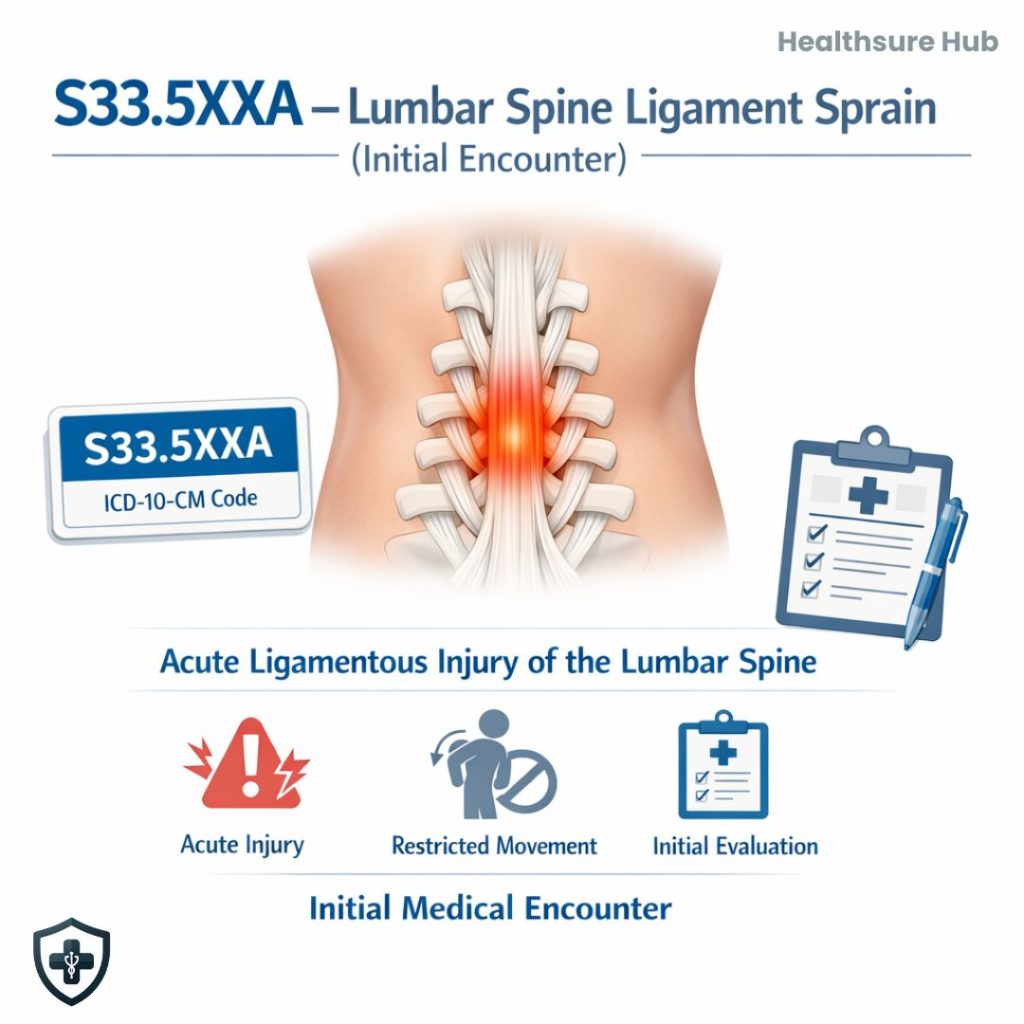
S33.5XXA is the ICD-10-CM code assigned to patients experiencing acute ligamentous injuries of the lumbar spine at the first medical encounter. This code applies specifically when:
- The injury is localized to the lumbar spine (L1–L5).
- There is a ligament sprain, not a muscle strain or vertebral fracture.
- The patient is being seen for initial treatment of the injury.
This code is part of the S33 category, which covers dislocations, sprains, and strains of joints and ligaments of the lumbar spine and pelvis. Using S33.5XXA ensures accurate clinical communication, billing, and reporting.
ICD-10 Code Structure Explained
Understanding each character in the code helps ensure proper usage:
| Character | Meaning | Explanation |
| S33 | Dislocation, sprain, and strain of lumbar spine and pelvic ligaments | Broad category encompassing lumbar ligament injuries |
| 5 | Specific to ligament sprains of the lumbar spine | Distinguishes from other types of lumbar injuries like fractures or dislocations |
| XX | Placeholder for unspecified details | Allows coding when exact ligament or side is not specified |
| A | Initial encounter | First medical visit for the sprain; subsequent visits use D (subsequent) or S (sequela) |
By breaking down the code, clinicians and coders can ensure accuracy and compliance with ICD-10-CM guidelines.
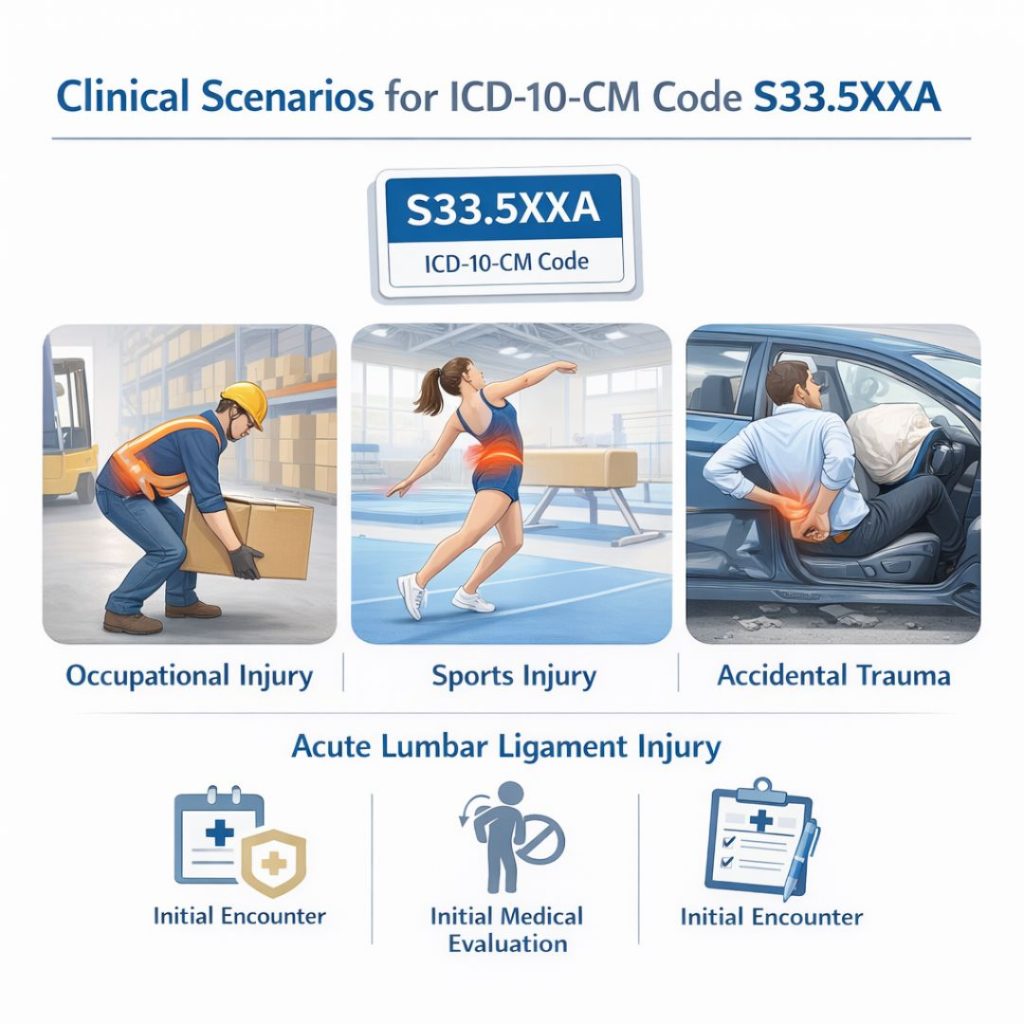
Clinical Scenarios for S33.5XXA
S33.5XXA is most commonly used in scenarios where the lumbar ligaments are acutely injured. Examples include:
- Occupational injuries: A warehouse worker lifts a heavy box incorrectly, experiencing sudden lower back pain, and seeks immediate medical care.
- Sports injuries: A gymnast falls during a routine, twisting the lower back, leading to ligament strain.
- Accidental trauma: A patient is involved in a minor car accident or slip-and-fall, resulting in acute lumbar ligament sprain without fracture.
This code is only used when the patient is being evaluated for the initial encounter of an acute lumbar ligament sprain.
Differentiating S33.5XXA from Related Codes
Correct coding requires knowing the differences between similar codes:
- S33.5XXD – For subsequent encounters after the initial treatment.
- S33.5XXS – For sequela, which refers to residual effects following healing.
- S32.0XXA – Lumbar vertebra fracture, initial encounter.
- M54.5 – Chronic low back pain, non-traumatic.
Using the wrong code can lead to insurance claim denials, inaccurate medical records, and potential compliance issues.
Documentation Requirements for S33.5XXA
Accurate documentation is critical to support the use of S33.5XXA. Essential elements include:
- Date and mechanism of injury – e.g., lifting, twisting, fall, or accident.
- Specific location – lumbar spine (L1–L5).
- Type of injury – ligament sprain, not strain, fracture, or chronic pain.
- Encounter type – explicitly initial; not subsequent or sequela.
- Optional supporting details – severity, imaging results, activity restrictions.
Clear documentation ensures compliance, proper reimbursement, and effective patient care tracking.
Conclusion
The ICD-10-CM code S33.5XXA plays a vital role in accurately documenting initial encounters of lumbar ligament sprains. Proper application of this code requires careful attention to the injury location (lumbar spine), the type of injury (acute ligament sprain), and the encounter type (initial visit). Accurate coding not only ensures correct insurance reimbursement but also supports comprehensive patient records, effective care management, and regulatory compliance.
For healthcare providers, coders, and medical administrators, a thorough understanding of S33.5XXA helps streamline clinical documentation, prevent coding errors, and facilitate continuity of care. Recognizing the precise use of this code ensures that patients with lumbar ligament injuries receive timely, appropriate treatment while maintaining high standards of coding accuracy and professional accountability.
About the Author