Traffic accidents remain a leading cause of injury worldwide, sending thousands of drivers to emergency departments each year. In many cases, the specific details of the collision or the full extent of injuries are not immediately clear. Healthcare providers need a standardized way to document these incidents accurately, even when complete diagnostic information is pending.
This is where ICD-10-CM code V43.52XA comes into play. At Healthsure Hub, we explain the purpose of this code, how it should be used, the importance of proper documentation, and best practices for claims submission in cases involving car drivers injured in collisions with other vehicles.
Understanding ICD-10 Code V43.52XA
What Does V43.52XA Mean?
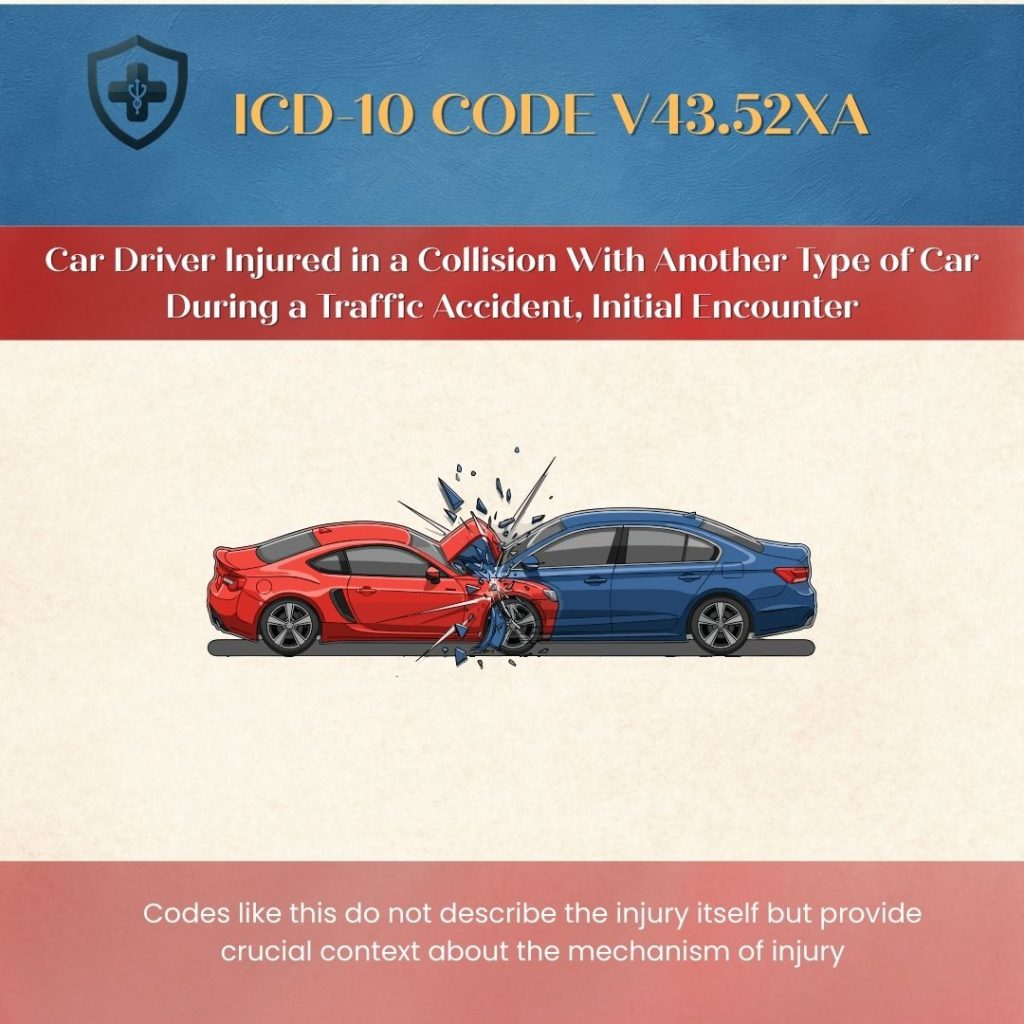
ICD-10-CM code V43.52XA stands for a car driver injured in a collision with another type of car during a traffic accident, initial encounter. External cause codes like this do not describe the injury itself but provide crucial context about the mechanism of injury, which complements primary diagnosis codes such as fractures, contusions, or soft tissue injuries.
This code is particularly useful in situations where:
- The full scope of injuries is not yet assessed
- Imaging or diagnostic tests are pending
- Early treatment or evaluation is required before the exact diagnosis is confirmed
Proper use ensures accuracy in medical records, supports public health data collection, and maintains compliance for insurance and billing purposes.
Breaking Down the Code Structure
Understanding the structure of the specific ICD-10 code ensures correct application:
- V43 – Car occupant injured in a collision with a car, pick-up truck, or van
- .5 – Specifies the patient’s role as the driver in the accident
- .52 – Indicates the collision involved another type of car (not SUV, van, or pick-up truck)
- X – Placeholder required for the 7-character structure
- A – Initial encounter for treatment
The seventh character “A” is critical, as it signals that the patient is receiving active care, such as evaluation, diagnostic workup, or acute treatment.
Common Clinical Scenarios for V43.52XA
This code is frequently used in real-world settings, especially when patients present shortly after an accident. Typical examples include:
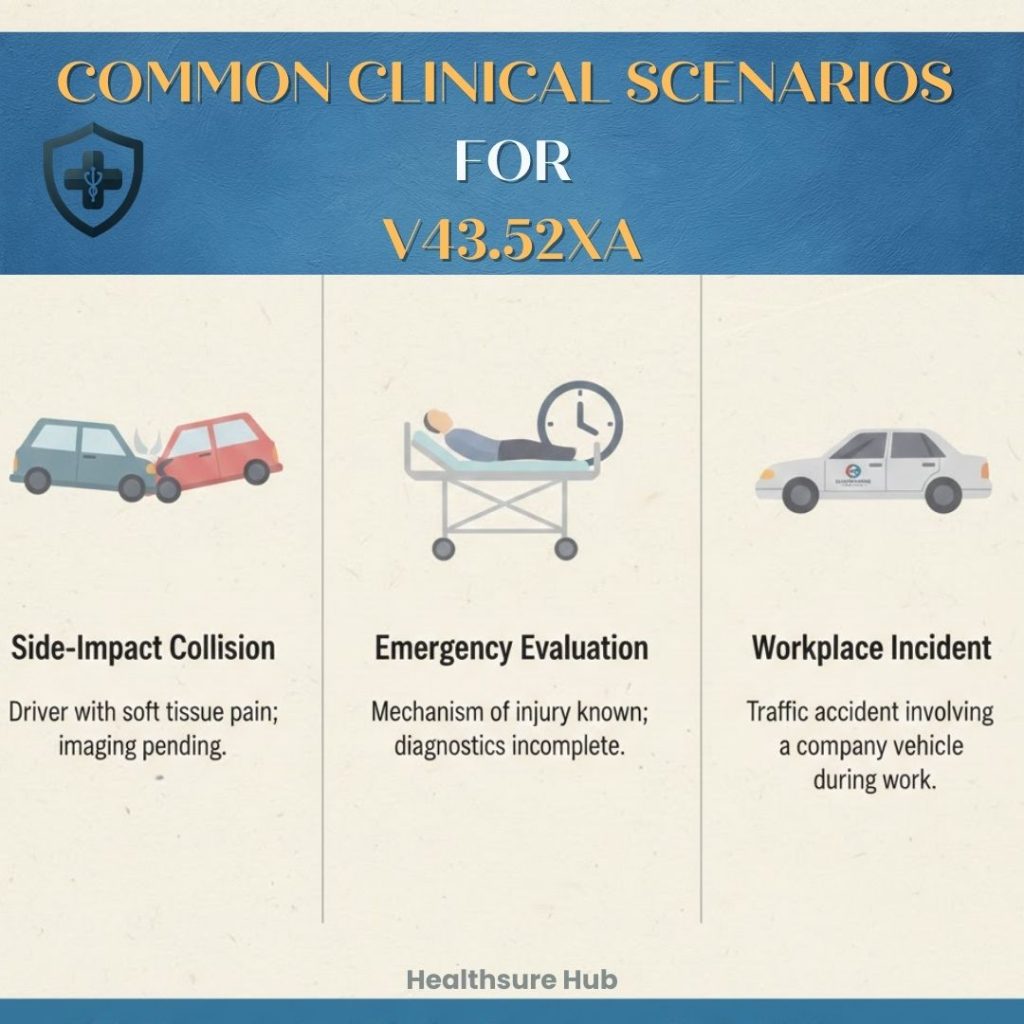
- A driver involved in a side-impact collision with another car, presenting with soft tissue injuries and pain, but imaging is pending
- Emergency visits where the mechanism of injury is known, but full diagnostics have not been completed
- Workplace-related traffic incidents involving company cars
- First evaluation in hospital or urgent care settings after a collision
Using the code allows providers to document the injury accurately without prematurely assigning a more specific code, ensuring both clinical accuracy and compliance.
Signs and Symptoms Associated With Car Collision Injuries
Drivers coded with V43.52XA often present with a combination of symptoms, including:
- Pain and tenderness at the site of impact
- Swelling or bruising
- Limited mobility due to discomfort
- Minor abrasions or contusions
- Headache, dizziness, or soft tissue strain
These signs may vary depending on the nature of the collision and the patient’s physical response, reinforcing the need for ongoing evaluation and documentation.
When to Use and When Not To Use V43.52XA
Appropriate Use:
- Acute injury involving a driver in a traffic collision with another type of car
- Initial encounter for treatment, evaluation, or diagnostic workup
- Documentation supports the occurrence of a traffic accident
When Not to Use:
- Injuries where the type or severity is already specified (e.g., fracture, dislocation)
- Follow-up visits or sequela (late effect) encounters
- Chronic injuries or non-acute conditions
- Documentation allows for a more specific ICD-10 external cause code
Overuse of unspecified codes when specificity is available can lead to compliance risks and claim denials.
Diagnostic Evaluation and Clinical Workup
Evaluation typically begins with a thorough physical examination, focusing on pain location, swelling, deformity, neurovascular status, and range of motion. Diagnostic imaging such as X-rays is commonly ordered to rule out fractures, while CT or MRI may be used for more complex cases involving internal injuries.
Once the specific injury is identified, primary diagnosis codes should be updated to reflect the condition accurately, while the code documents the external cause of the incident.
Documentation Best Practices
Strong documentation ensures proper coding and compliance. Providers should record:
- Patient role – driver vs passenger
- Mechanism of injury – collision with another vehicle
- Encounter type – initial vs subsequent
- Symptoms and severity – pain, swelling, bruising
- Timing and setting – emergency department, urgent care, or hospital admission
Clear documentation supports medical necessity, reduces claim denials, and improves the quality of public health data.
Common Claim Denials Associated With V43.52XA
Claims may be denied if:
- The seventh character “A” is incorrectly used
- Laterality or patient role is not documented
- The code continues to be used after the diagnosis is clarified
- Documentation conflicts with injury specificity
Timely updates and precise coding are essential for avoiding denials and ensuring accurate reimbursement.
Conclusion
ICD-10-CM code V43.52XA plays a critical role in documenting car driver injuries in collisions with other vehicles during the initial encounter. Used appropriately, it provides context for clinical care, supports public health reporting, and ensures proper claims processing.
Healthcare providers and coders should apply this code carefully, update it as more information becomes available, and maintain thorough documentation to strengthen compliance, improve data accuracy, and ensure continuity of care.
About the Author