Most people think serious injuries happen because of falls, accidents, or sudden trauma. In reality, many injuries begin with something far less dramatic: lifting a box the wrong way, pushing a heavy object, or repeating the same physical motion one too many times. Overexertion is one of the most common, and most underestimated, causes of musculoskeletal injuries in both workplace and everyday settings.
When an injury occurs due to excessive physical effort rather than impact or collision, ICD-10-CM code X50.0XXA becomes essential. Our team at Healthsure Hub breaks down the code, explains when and how to use it while ensuring medical records reflect the true mechanism of injury.
What Is ICD-10-CM Code X50.0XXA?
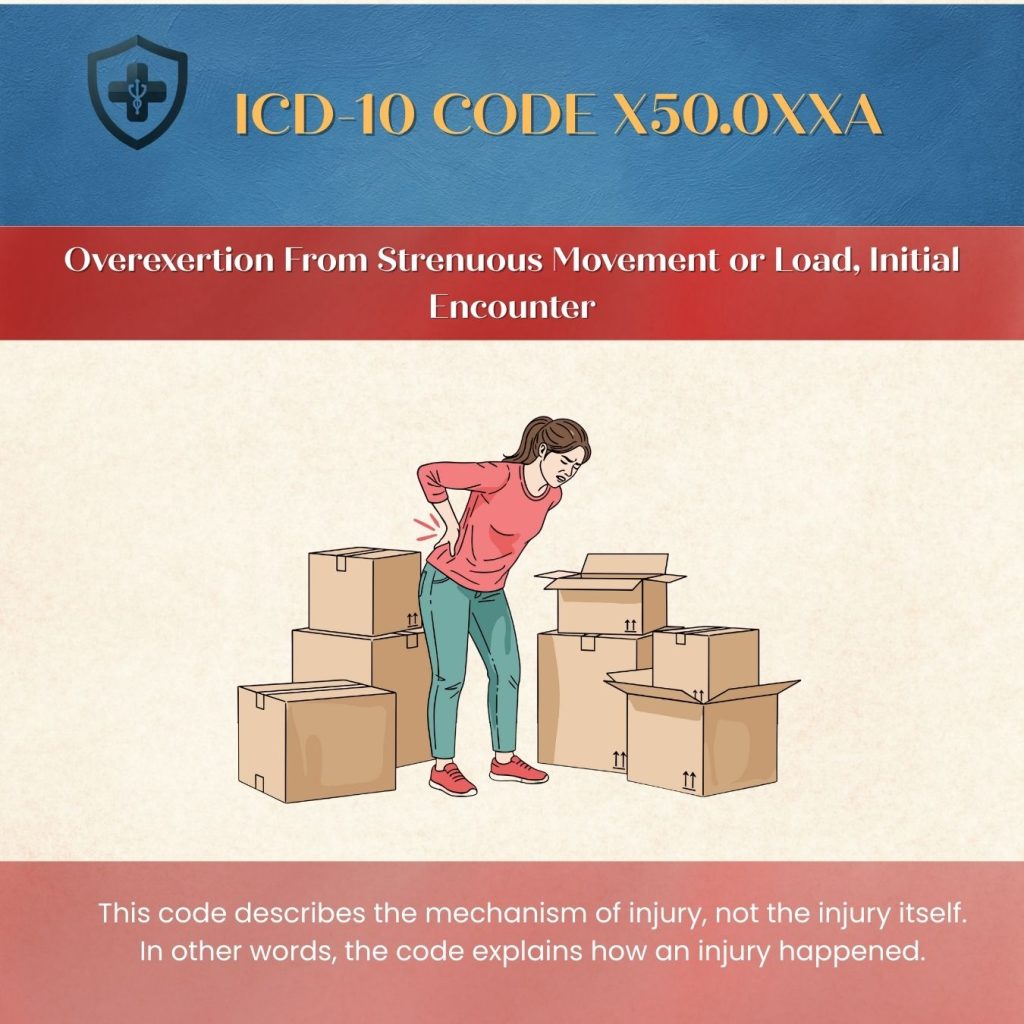
ICD-10-CM code X50.0XXA is a medical billing code for overexertion from strenuous movement or load, initial encounter. The code is classified under external causes of morbidity.
This code describes the mechanism of injury, not the injury itself. In other words, the code explains how an injury happened, due to excessive physical effort, but does not identify the affected body part or medical diagnosis.
Code breakdown:
- X50 – Overexertion
- 0XX – Placeholder characters required by ICD-10-CM formatting
- A – Initial encounter (active treatment phase)
Because it is an external cause code, this code must always be reported in addition to a primary injury diagnosis, such as a muscle strain, ligament sprain, or joint pain code.
What Is Overexertion?
Overexertion refers to injuries caused by excessive physical effort. Unlike injuries from a sudden fall, car accident, or collision, overexertion develops when the body is pushed beyond its natural capacity. This can happen during:
- Lifting, carrying, or moving heavy objects
- Repetitive movements, such as typing or assembly-line work
- Sudden strenuous actions during sports or exercise
- Occupational activities that involve repeated physical effort
Overexertion often affects muscles, ligaments, and tendons. Common symptoms include pain, swelling, stiffness, and decreased range of motion, and without proper rest or treatment, minor overexertion can lead to chronic musculoskeletal problems.
Understanding “Initial Encounter”
The seventh character “A” indicates an initial encounter, which refers to the period when the patient is receiving active treatment for the injury. Active treatment may include:
- Emergency department care
- Diagnostic evaluation
- Imaging studies
- Immobilization or splinting
- Medication management
- Initial physical therapy interventions
Importantly, “initial encounter” does not necessarily mean the first visit. It applies for as long as active treatment is ongoing. Once treatment transitions to routine healing or follow-up care, a subsequent encounter code would be used instead.
When Should X50.0XXA Be Used?
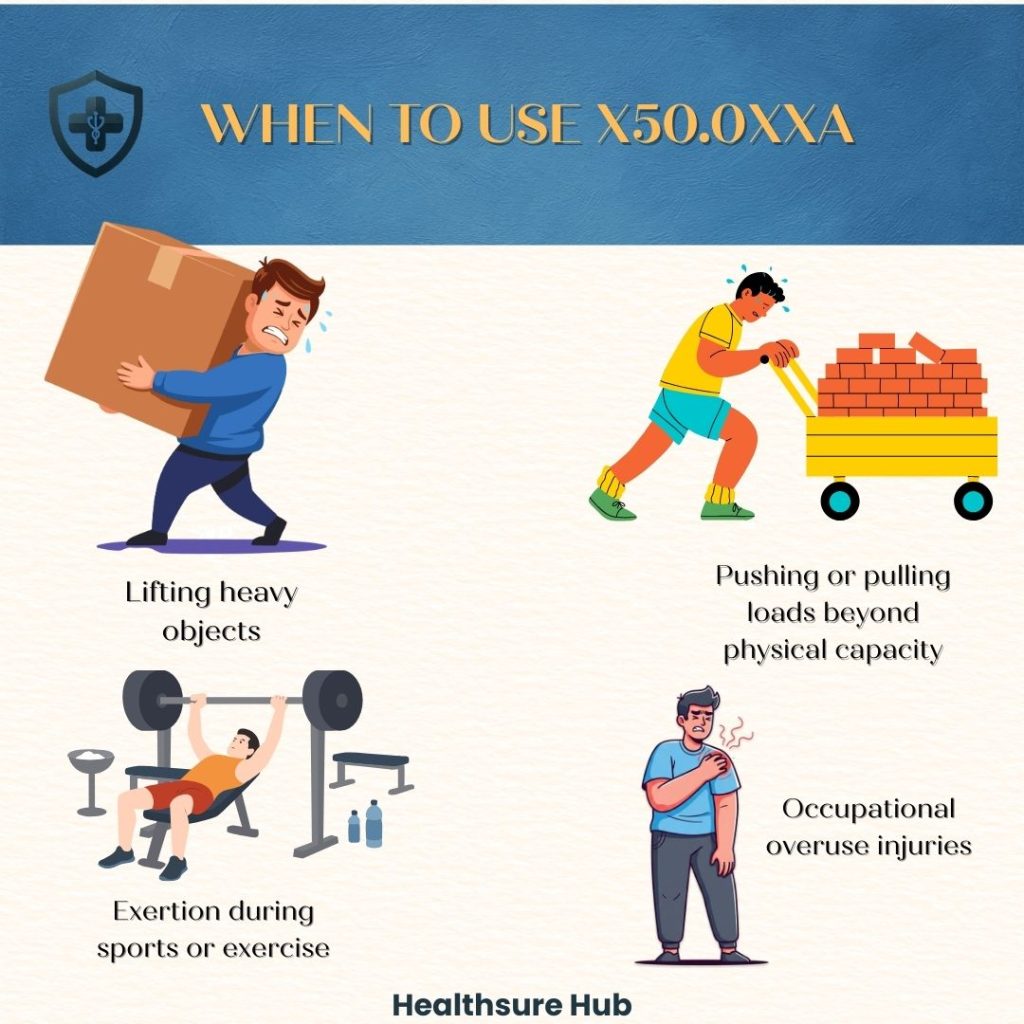
The ICD-10 code for overexertion from strenuous movement or load, initial encounter is used when an injury results from excessive physical effort, rather than trauma from a fall, collision, or external force. Common scenarios include:
- Lifting or carrying heavy objects
- Pushing or pulling loads beyond physical capacity
- Repetitive forceful movements
- Sudden exertion during sports or exercise
- Occupational overuse injuries
This code is appropriate when the documentation clearly supports that the injury was caused by strain or overuse, without an associated fall or impact. If a fall occurs, a fall-related external cause code would generally be more appropriate.
Common Injuries Associated With Overexertion
Although X50.0XXA does not specify an injury type, it is frequently used alongside diagnoses such as:
- Muscle strains and tears
- Ligament sprains
- Tendon injuries
- Acute low back strain
- Shoulder, wrist, knee, or hip pain
- Repetitive stress injuries
The Real Impact of Overexertion in the Workplace
Overexertion is one of the leading causes of workplace injuries, particularly in industries that involve manual labor or repetitive physical tasks. Understanding the scope of these injuries helps employers, healthcare providers, and workers take preventive action. Statistics show the following:
- Most affected industries – Service and manual labor sectors report the highest rates of overexertion injuries, often resulting in sprains, strains, and tears.
- Declining trends – Overall, workplace overexertion injuries have been gradually decreasing since 2011, reflecting improved safety protocols and awareness programs.
- Recovery time– On average, employees require about 12 days off work to recover from overexertion injuries, which is roughly 50% longer than the average for other types of workplace injuries.
- Back injuries dominate– Nearly half of all overexertion injuries involve the back, highlighting the need for proper lifting techniques and ergonomics.
- Economic impact– The financial burden of workplace overexertion is significant, with estimated costs exceeding $9 billion annually due to lost productivity, medical expenses, and workers’ compensation.
Using codes like X50.0XXA not only helps in documenting the injury mechanism accurately but also supports better reporting of workplace injury trends and associated costs.
Documentation Requirements for Accurate Coding
Clear, detailed documentation is essential for correct use of the ICD-10 code for overexertion from strenuous movement or load, initial encounter. Providers should document:
- The specific activity causing overexertion
- Whether the exertion involved lifting, pushing, pulling, or repetitive motion
- The context of the activity (work-related, sports-related, daily activity)
- The resulting injury and affected body part
Accurate documentation ensures that the external cause code aligns with the primary diagnosis and supports medical necessity, billing accuracy, and compliance with reporting standards.
Common Coding and Billing Errors
Several mistakes commonly lead to claim denials or audits when using X50.0XXA:
- Reporting the ICD-10 code for overexertion from strenuous movement or load, initial encounter as the only diagnosis
- Failing to include a specific injury code
- Using overexertion codes when a fall or collision is documented
- Incorrect encounter character selection
- Vague documentation that does not support overexertion as the cause
Avoiding these errors reduces denied claims and payer scrutiny.
How X50.0XXA Supports Billing and Compliance
External cause codes like X50.0XXA may seem optional, but they play a critical role in healthcare compliance. They:
- Provide a clear mechanism of injury for medical records
- Strengthen claims by demonstrating the cause of injury
- Support insurance documentation requirements for overexertion-related claims
Improve long-term injury reporting and analysis.
Conclusion
ICD-10-CM code X50.0XXA is an essential external cause code used to document injuries resulting from overexertion due to strenuous movement or load during the active treatment phase. While it does not describe the injury itself, it provides critical context that supports accurate billing, compliance, and injury reporting.
When paired with precise documentation and appropriate diagnosis codes, X50.0XXA enhances clinical clarity, strengthens claims, and contributes to long-term medical data integrity.
About the Author