A patient’s past doesn’t disappear just because a condition has been resolved. In healthcare, medical history often shapes today’s decisions, influencing everything from preventive screenings to procedural risk assessments. This is especially true for circulatory system conditions, where prior disease, even when no longer active, can carry long-term clinical relevance.
That’s where ICD-10 code Z86.79 plays a critical role. At Healthsure Hub, we break down the code, explain its meaning and point out the importance for accurate billing.
What Is ICD-10 Code Z86.79?
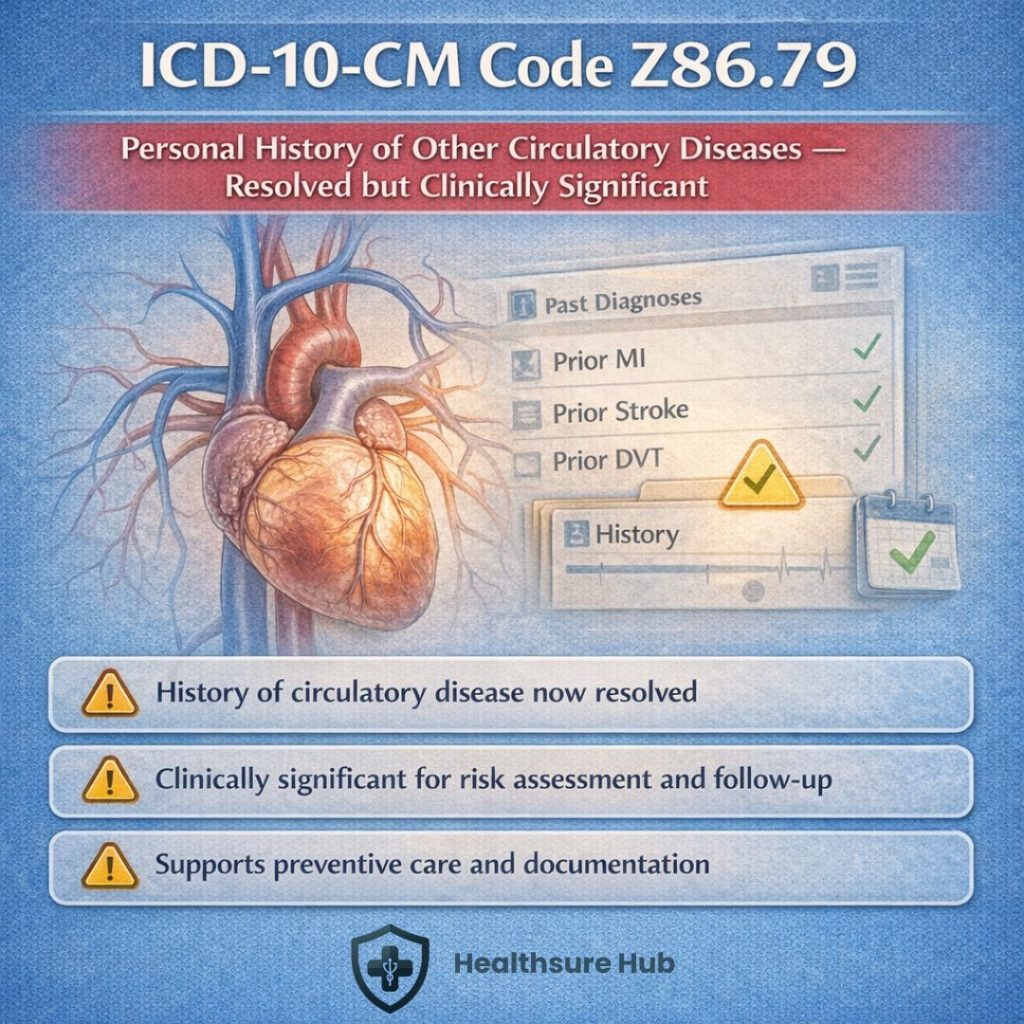
ICD-10-CM code Z86.79 is used to document a patient’s personal history of other diseases of the circulatory system that are no longer active but remain clinically significant. In simple terms, this code tells the story of a past circulatory condition that has resolved, but one that providers still need to be aware of when evaluating, treating, or monitoring the patient.
Simplified Explanation for Medical Billing
This ICD-10 code is a history code, not a diagnosis code. It is used in medical billing to:
- Capture relevant past circulatory conditions
- Provide clinical context for current encounters
- Support medical necessity for services, testing, or preventive care
Importantly, this specific ICD-10 code does not describe an active disease and cannot replace an ICD-10 diagnosis code when a circulatory condition is ongoing, similar to how resolved risk factors such as personal history of nicotine dependence must be clearly distinguished from active conditions.
Why Z86.79 Matters in Medical Billing and Coding
Although this code does not represent current illness, it carries significant weight in documentation and claims accuracy. This code helps:
- Explain why certain tests or follow-ups are ordered
- Support preventive services during wellness visits
- Provide historical context for treatment decisions
- Reduce claim denials related to insufficient documentation
From a compliance standpoint, this code ensures the medical record accurately reflects the patient’s risk profile, particularly when combined with other risk-influencing conditions such as prediabetes which is known to increase long-term cardiovascular risk.
Conditions Commonly Captured
Z86.79 applies to resolved circulatory system diseases when:
- The condition is no longer active
- No more specific personal history code exists
- The history remains relevant to care planning
Examples may include prior circulatory disorders that:
- Required treatment in the past
- Have resolved without ongoing management
- Do not meet criteria for other defined Z86 personal history codes
This code functions as a broad, catch-all history code within the circulatory system category, making accurate provider documentation essential.
Z86.79 vs. Active Circulatory Disease Codes
The importance of capturing circulatory history is underscored by scale alone. According to research, nearly half of U.S. adults are affected by some form of cardiovascular disease, making precise documentation of past circulatory conditions increasingly essential in modern healthcare.
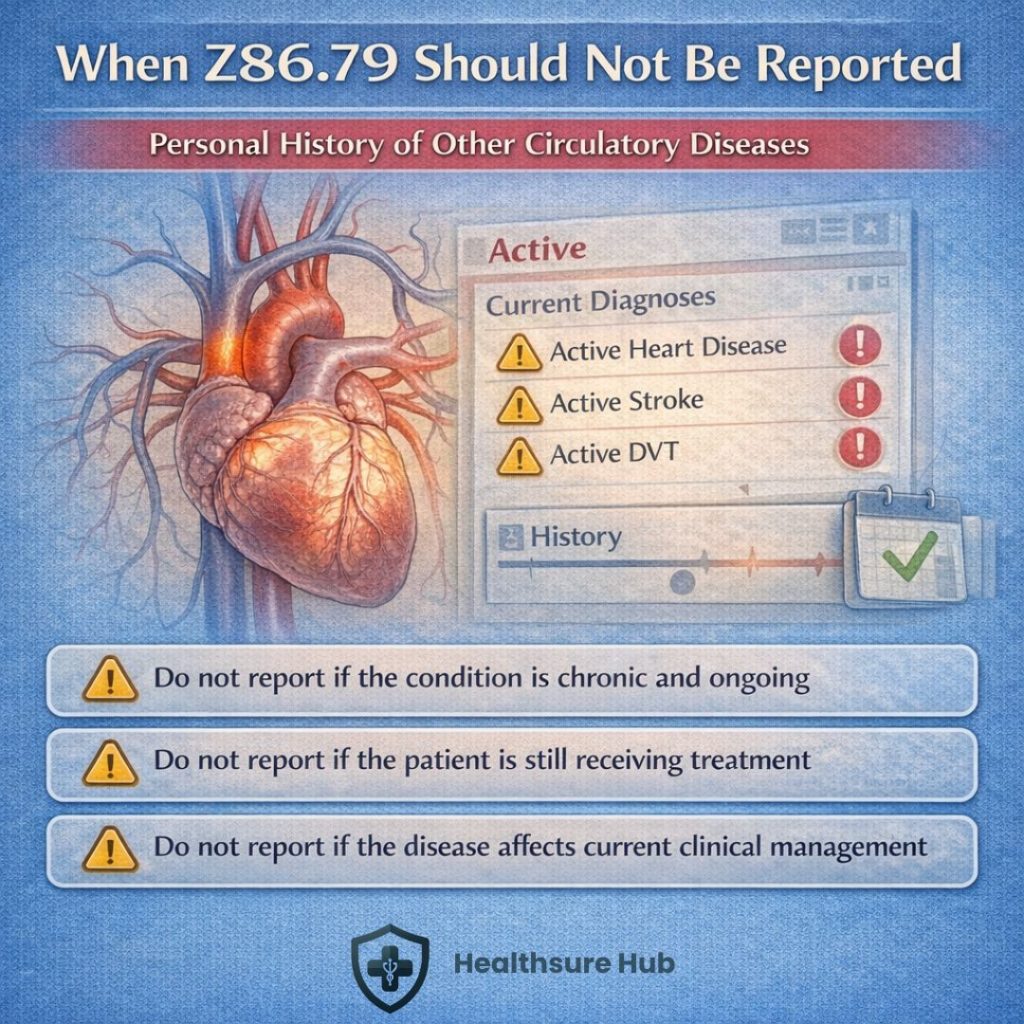
One of the most common coding errors involves confusing history codes with active disease codes. Key distinctions:
- Active circulatory diseases are coded using I00–I99
- Resolved or historical conditions are coded using Z86.79
This code should never be reported if:
- The condition is chronic and ongoing
- The patient is still receiving treatment
- The disease affects current clinical management as an active diagnosis
Correct differentiation protects against audits and ensures coding integrity.
Clinical Scenarios Where Z86.79 Is Commonly Used
This code frequently appears in documentation for:
- Annual wellness exams
- Preventive care visits
- Pre-operative evaluations
- Specialty consultations unrelated to circulatory disease
- Risk assessments prior to prescribing medications
In these scenarios, the code provides background context without overstating disease severity. For example, a patient evaluated for other chest pain (R07.89) may not have active heart disease, but a documented history of circulatory disease can justify further diagnostic evaluation.
Documentation Requirements
With circulatory system diseases remaining the leading cause of death globally, strong documentation is essential for compliant use of this code. Providers should clearly indicate:
- The condition is part of the patient’s past medical history
- The circulatory disease is resolved or inactive
- There is no current treatment or management
Common supporting phrases include:
- “Personal history of…”
- “Previously diagnosed, now resolved”
- “No active disease at this time”
Accurate documentation ensures coders can confidently assign this specific ICD-10 code without ambiguity.
Why Accurate Use of Z86.79 Supports Better Care and Compliance
Accurate reporting of this code benefits more than billing. It:
- Enhances continuity of care
- Supports long-term risk assessment
- Improves clinical decision-making
- Strengthens data used for population health and quality reporting
In value-based care environments, capturing relevant medical history is no longer optional—it’s essential.
Conclusion
ICD-10 code Z86.79 serves as a critical bridge between a patient’s past and present. While it doesn’t describe active disease, it ensures that resolved circulatory conditions remain visible, relevant, and properly documented.
When used correctly, this code supports cleaner claims, stronger compliance, and more informed clinical care, making it an essential tool in accurate medical coding and documentation.
About the Author