Pain in the ankle and foot is one of the most common musculoskeletal complaints seen in primary care, urgent care, orthopedics, and podiatry. Whether triggered by overuse, minor trauma, or an evolving underlying condition, ankle and foot joint pain can significantly affect mobility and daily functioning.
ICD-10-CM code M25.571 plays a key role in accurately documenting these symptoms when a definitive diagnosis has not yet been established, while still maintaining clinical and billing precision. Our team at HealthSure Hub breaks down the code along with the most common clinical scenarios while providing insight for proper billing and coding.
What Is ICD-10 Code M25.571?
M25.571 is an ICD-10 diagnosis code defined as pain in right ankle and joints of right foot. It belongs to the broader category M25 – Other joint disorders, not elsewhere classified, within the chapter covering diseases of the musculoskeletal system and connective tissue (M00–M99).
This code is symptom-based, meaning it is used to describe a patient’s reported pain rather than a confirmed pathological condition. It is most appropriate during early clinical evaluation, when symptoms are present but imaging, laboratory testing, or specialist assessment has not yet identified a specific cause.
Laterality is a critical component of ICD-10-CM, and M25.571 specifically applies to right-sided ankle and foot joint pain. Proper laterality improves:
- Clinical clarity and continuity of care
- Medical necessity justification
- Payer confidence and audit readiness
When laterality is documented, using unspecified pain codes may be viewed as incomplete or inaccurate coding.
Anatomical Scope of the Right Ankle and Foot Joints
M25.571 applies to pain affecting the right-sided ankle and multiple joints of the right foot, including:
- The ankle (talocrural) joint
- The subtalar joint
- Midfoot joints such as intertarsal and tarsometatarsal joints
- Metatarsophalangeal joints
Because these structures work together during walking, standing, and weight-bearing, patients often experience diffuse or poorly localized pain. This makes symptom-based coding both clinically appropriate and necessary during initial encounters.
Common Clinical Scenarios for M25.571
M25.571 is frequently documented across a variety of care settings, including:
- Primary care visits for new or unexplained right ankle or foot pain
- Urgent care or emergency department encounters following minor trauma or twisting injuries
- Orthopedic or podiatry consultations prior to definitive imaging
- Pain following increased activity, prolonged standing, or repetitive motion
- Follow-up visits when pain persists but remains diagnostically unclear
In each of these scenarios, the ICD-10 code for pain in right ankle and joints of right foot allows providers to document symptoms accurately while continuing the diagnostic workup.

Conditions Commonly Associated With Right Ankle and Foot Joint Pain
Although the code does not describe a specific diagnosis, it is commonly associated with conditions such as:
- Mild ankle sprains or ligament irritation
- Overuse injuries from walking, running, or occupational strain
- Early inflammatory or degenerative joint processes
- Tendon or soft tissue irritation
- Post-traumatic joint pain without radiographic confirmation
Once a specific condition is identified, the symptom code should be replaced with a more definitive diagnosis code.
Other Relevant Codes for Ankle and Foot Pain
The ICD-10 code for pain in right ankle and joints of right foot often appears alongside or transitions to more specific codes, such as:
- Joint pain in other locations ( knee or hip)
- Injury-related ankle codes, including ligament sprains or ankle injuries
- Overuse conditions such as Achilles tendinitis, right leg
- External cause codes when the mechanism of injury is documented
When M25.571 Should Not Be Used
The ICD-10 code for pain in right ankle and joints of right foot should be avoided when a clear diagnosis has already been established. Examples include:
- Confirmed fractures, dislocations, or arthritis
- Gout, infection, or inflammatory arthropathies
- Postoperative pain with a documented surgical procedure
- Neuropathic pain with identified nerve involvement
- Pain affecting the left ankle or bilateral joints
Accurate code selection ensures compliance and reduces the risk of claim denials.
Documentation Best Practices
To support the use of the ICD-10 code for pain in right ankle and joints of right foot, provider documentation should clearly include:
- Exact location of pain involving the right ankle or foot joints
- Confirmation of right-sided involvement
- Onset, duration, and severity of symptoms
- Functional limitations such as difficulty walking or weight-bearing
- Relevant physical exam findings and clinical assessment
Strong documentation not only supports accurate coding but also strengthens the medical record for future care decisions.
Billing and Coding Considerations
From a billing perspective, this ICD-10 code is a billable diagnosis code when used appropriately. Symptom codes are acceptable when:
- A definitive diagnosis has not yet been confirmed
- The symptom itself is clinically significant
- Documentation supports medical necessity
However, payers expect symptom-based codes to be updated once diagnostic clarity is achieved. Prolonged use without progression may raise questions during audits.
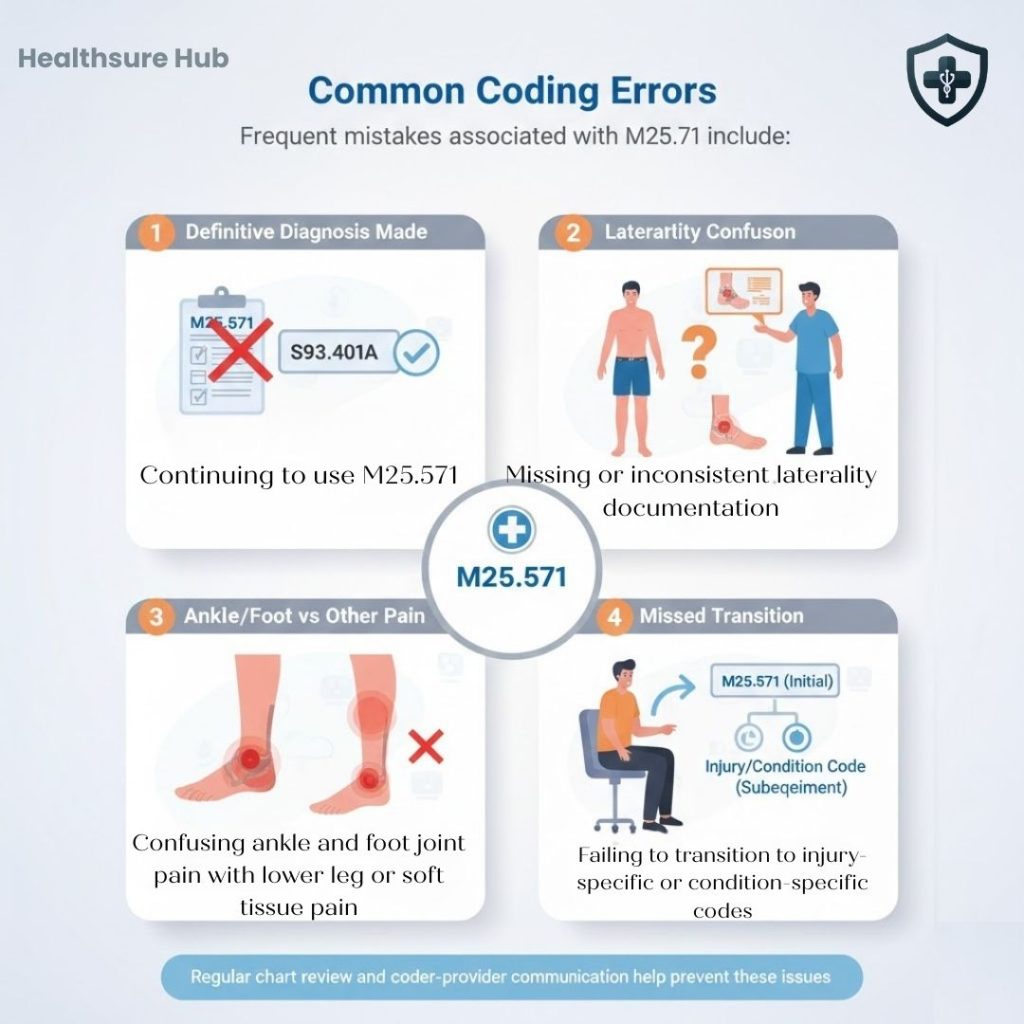
Common Coding Errors
Frequent mistakes associated with the code include:
- Continuing to use the code after a definitive diagnosis is established
- Missing or inconsistent laterality documentation
- Confusing ankle and foot joint pain with lower leg or soft tissue pain
- Failing to transition to injury-specific or condition-specific codes
Regular chart review and coder-provider communication help prevent these issues.
Conclusion
ICD-10-CM code M25.571 serves as an essential tool for documenting right ankle and foot joint pain when a definitive diagnosis is not yet available. When used correctly, it supports accurate clinical communication, compliant billing, and appropriate care planning. Clear documentation, correct laterality, and timely transition to specific diagnosis codes ensure that the code remains a valuable part of a comprehensive musculoskeletal coding strategy.
About the Author