Patient responsibility in medical billing has become one of the most influential forces shaping today’s healthcare revenue cycle. As insurance design evolves and out-of-pocket costs continue to rise, a growing share of provider reimbursement now depends directly on patient payments. Understanding how patient responsibility works, how it is calculated, and how it impacts both patients and providers is no longer optional, it’s essential for financial sustainability and patient trust.
Our team at Healthsure Hub explains patient responsibility in medical billing from a practical, real-world perspective. It breaks down definitions, components, contributing factors, and best practices using clear language, accurate data, and billing-specific insight.

What Patient Responsibility in Medical Billing Really Means
Patient responsibility in medical billing refers to the portion of a medical bill that a patient is legally obligated to pay out of pocket after insurance processing. Even when a patient is insured, insurance rarely covers 100% of medical expenses. The amount paid is determined based on the patient’s insurance plan. Uninsured patients are legally obliged to pay 100% of their medical bill, while patients with high-deductible health plans (HDHPs) are expected to pay for their medical bill out-of-pocket just until the deductibles are met. Patient responsibility may include:
- Deductibles not yet met
- Copayments due at the time of service
- Coinsurance after deductible fulfillment
- Charges for non-covered services
- Out-of-network cost differences
- Full balances for uninsured or self-pay patients
The correlation here is shared between patients who received the medical treatment, the insurance provider and the government payers such as Medicare and Medicaid. Accurate calculation of patient responsibility is critical. Errors in deductibles, coinsurance, or copayments can lead to overpayments or underpayments, which must be reconciled to maintain billing accuracy.
In modern healthcare billing, patient responsibility represents a primary revenue source, not a secondary one. As payer reimbursement tightens, providers increasingly rely on accurate patient billing and timely collections to maintain cash flow.
Why Patient Responsibility Balances Is Increasing Every Year
Patient responsibility in medical billing continues to rise due to structural changes in health insurance and healthcare economics.
Several forces are driving this shift:
- Widespread adoption of high-deductible health plans (HDHPs) – While recent studies show a decline in HDHP enrollment, still just under 50% of Americans are part of the HDHPs plans, which offers lower monthly premium but includes higher deductibles. This means that patients are currently taking on more financial responsibility for their medical bills.
- Shift in cost-sharing structure – Insurance plans have experienced a greater shift in the past decade, putting more financial responsibility onto patients by increasing out-of-pocket payments.
- Rise in healthcare costs – Since the cost of medical services only continues to increase, the deductibles/coinsurance of patients linearly increases.
- Regulatory changes and economic pressures – Inflation took its toll even in healthcare. Inflation plus Medicare/Medicaid reimbursement cuts leads insurance providers to seek more revenue from patients.
Over the past decade, deductibles for both individual and family plans have increased significantly. This trend means patients are responsible for a larger share of costs before insurance coverage begins, placing more financial responsibility directly on patients and, by extension, on provider billing operations. The rise of healthcare costs, increase in copayments, and higher co-insurance leads to patient bearing a larger financial burden than expected.
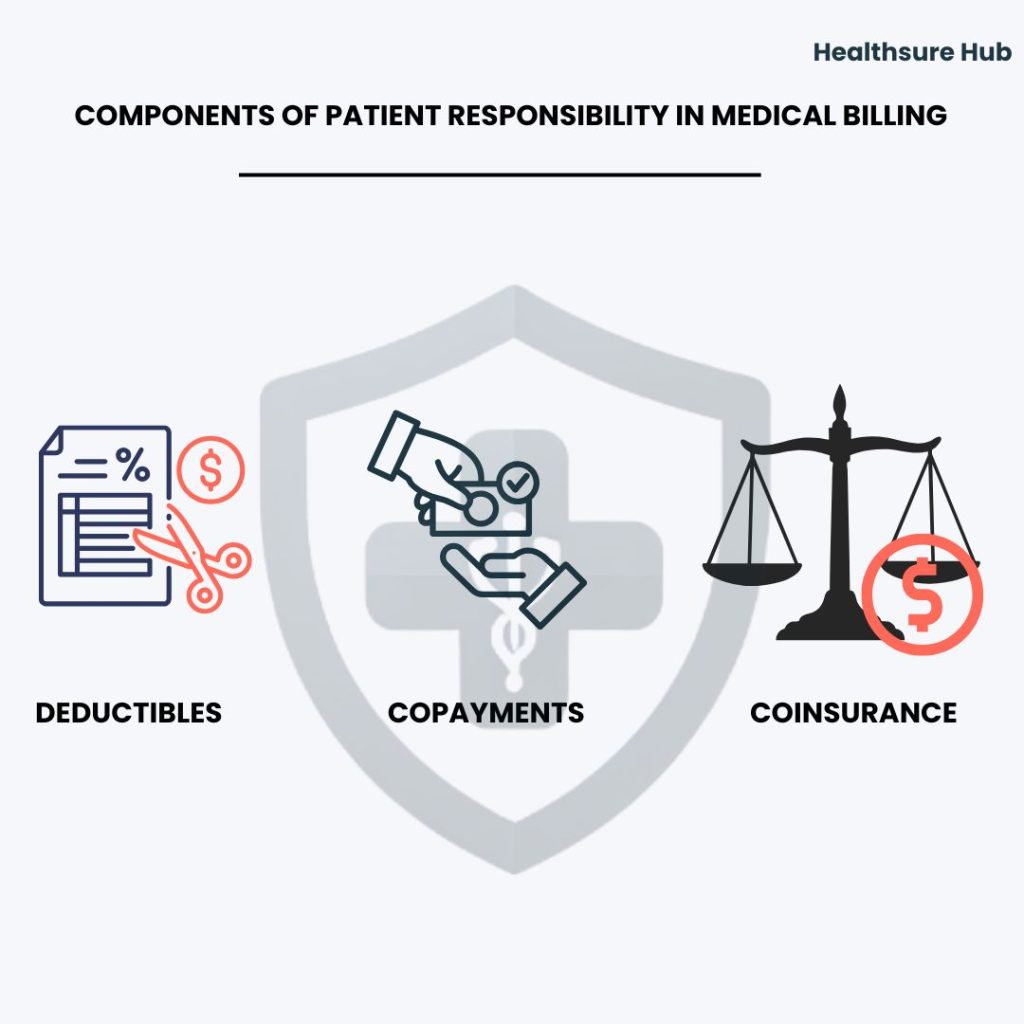
Components of Patient Responsibility in Medical Billing
Patient responsibility in medical billing is not a single charge. It is a combination of cost-sharing elements defined by the patient’s insurance plan.
Co-payments
Co-payments are fixed-dollar amounts patients pay at the time of service, such as a $30 primary care visit or a $50 specialist appointment. Co-pays do not vary based on the total cost of care.
Accurate copayment collection is essential because:
- Copays are contractually required
- Missed copays lead to downstream billing and refunds
- Incorrect copay data causes patient dissatisfaction
Deductibles
Deductibles represent the amount a patient must pay annually before insurance begins covering services. High deductibles significantly increase patient responsibility in medical billing, especially early in the plan year.
Key deductible characteristics:
- Reset annually
- Vary by plan tier
- Apply before coinsurance begins
- Are a major driver of unpaid balances
Coinsurance
Coinsurance is the percentage of allowed charges a patient pays after meeting their deductible. For example, 20% coinsurance means the patient pays 20% while insurance covers 80% even after the deductible is paid.
Coinsurance ensures ongoing patient responsibility even after deductible satisfaction, making accurate calculation critical to billing accuracy.
How Patient Responsibility in Medical Billing Is Determined
Patient responsibility in medical billing is calculated through a structured, multi-step process. It begins before care is delivered and is finalized only after the insurance claim is processed. Each step contributes directly to how much a patient ultimately owes.
Errors at any point can shift costs incorrectly, leading to higher balances, billing disputes, or delayed payments.
Patient Registration and Insurance Collection
Patient responsibility in medical billing starts at registration. At this stage, providers collect:
- Patient demographics
- Insurance carrier and plan details
- Policy and group numbers
- Subscriber information
- Coordination of benefits, if applicable
Insurance systems rely entirely on this data. If information is missing or inaccurate, claims may fail, and charges may incorrectly default to patient responsibility—even when coverage exists.
Eligibility and Benefits Verification
Eligibility verification confirms what the insurance plan covers for the date of service.
This step determines:
- Active coverage status
- Remaining deductible
- Required copayments
- Coinsurance percentages
- Out-of-pocket maximum status
Because benefit designs vary widely, eligibility verification defines the framework for patient responsibility in medical billing. Without it, estimates are unreliable and corrections become inevitable.
Provider Network Status Review
Network status directly affects patient financial responsibility.
- In-network care typically results in lower patient costs due to negotiated rates.
- Out-of-network care often leads to reduced insurance coverage or full patient liability.
This step is especially critical in multi-provider settings, where patients may unknowingly receive out-of-network services.
Authorization and Referral Validation
Some services require prior authorization or referrals for insurance payment. This step verifies:
- Whether authorization is required
- Whether payer rules were met
If authorization is missing, insurers may deny the claim, shifting costs to the patient depending on payer policy. Proper validation prevents avoidable increases in patient responsibility.
Pre-Service Cost Estimation
Pre-service estimates provide patients with an expected financial obligation before care is delivered. Estimates are based on:
- Remaining deductible
- Copays and coinsurance
- Non-covered services
Although not final, accurate estimates improve transparency, support compliance, and reduce billing disputes by setting realistic expectations.
Claim Submission and Insurance Adjudication
After care is provided, the claim is submitted to the payer. During adjudication, the insurer:
- Applies contracted rates
- Calculates deductible, copay, and coinsurance
- Determines the official patient responsibility
This is where patient responsibility in medical billing is formally calculated based on payer rules, not estimates.
Explanation of Benefits (EOB)
The payer then issues an Explanation of Benefits (EOB). The EOB details:
- Total charges
- Allowed amount
- Insurance payment
- Adjustments
- Final patient responsibility
An EOB is not a bill. It explains how the insurer calculated the patient’s portion of the costs.
Patient Billing and Balance Posting
The final step is patient billing.At this stage, the provider:
- Posts insurance payments and adjustments
- Generates an itemized statement
- Bills the remaining patient responsibility
Clear billing ensures patients understand what they owe, why they owe it, and how insurance contributed, supporting faster payments and fewer disputes.
Factors Affecting Patient Responsibility in Medical Billing
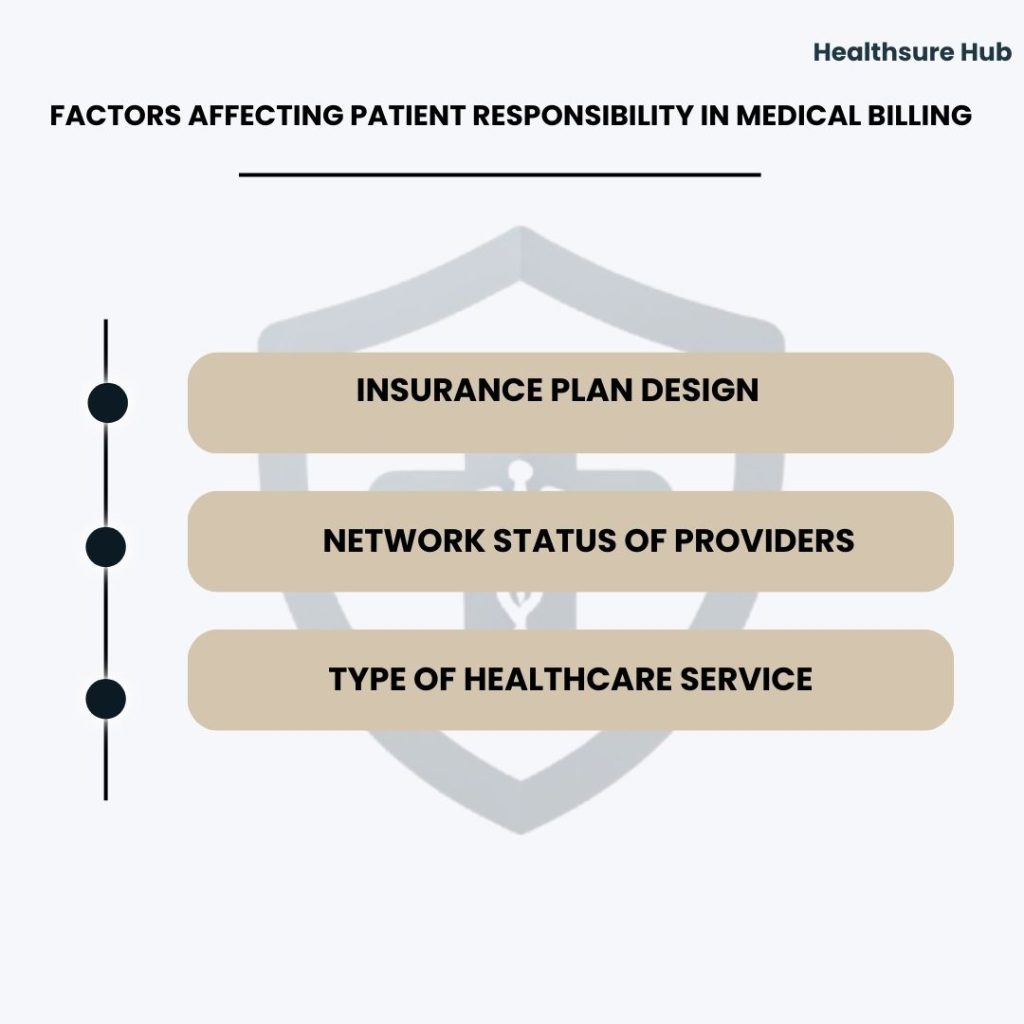
Patient responsibility in medical billing can vary widely depending on several key factors. Understanding these helps providers anticipate patient balances and educate patients effectively.
Insurance Plan Design
The type of insurance plan directly impacts patient financial obligations:
- High Deductible Health Plans (HDHPs) – Lower monthly premiums, higher out-of-pocket costs. Patients may pay 100% of expenses until the deductible is met.
- Low-Deductible or Platinum Plans – Higher premiums, lower patient responsibility. Insurance covers more costs upfront.
Different plans also dictate copayments, coinsurance, and out-of-pocket maximums, shaping the final patient responsibility.
Network Status of Providers
Whether a healthcare provider is in-network or out-of-network significantly affects patient responsibility:
- In-Network Providers – Lower negotiated rates and higher insurance coverage reduce out-of-pocket costs.
- Out-of-Network Providers – Patients may face higher balances or full responsibility if coverage is limited.
Patients may unknowingly receive services from out-of-network specialists or facilities, increasing their financial obligations.
Type of Healthcare Service
Patient responsibility can also depend on the type of service received:
- Preventive and Routine Care – Often fully covered or subject to minimal copays.
- Specialized or Elective Procedures – Typically higher out-of-pocket costs, especially if out-of-network.
- Emergency Care – May result in higher responsibility due to limited coverage or lack of in-network providers.
Conclusion
Patient responsibility in medical billing is a central component of today’s healthcare revenue cycle, reflecting the growing financial role patients play in covering their care. It encompasses deductibles, copayments, coinsurance, and charges for non-covered or out-of-network services, all shaped by insurance plan design, provider network status, and the type of care received.
As healthcare costs rise and cost-sharing shifts increasingly onto patients, understanding and managing patient responsibility is no longer optional, it is a critical part of efficient billing, financial sustainability, and positive patient experiences.
About the Author