Chest pain is one of the most concerning symptoms encountered in clinical practice, accounting for millions of emergency department and outpatient visits each year. Because chest pain can signal anything from a benign musculoskeletal strain to a life-threatening cardiac event, accurate documentation and ICD-10 coding are essential. One diagnosis code that frequently appears in medical records is R07.89, which represents other chest pain.
Understanding when and how to use this code is critical for clinical accuracy, billing compliance, and patient safety.
ICD-10 Code R07.89 Overview
ICD-10-CM code for other chest pain is classified under the broader category of R07 – Pain in throat and chest, which falls within the ICD-10 chapter for Symptoms, signs, and abnormal clinical and laboratory findings, not elsewhere classified (R00–R99). Chest pain is one of the most concerning symptoms in healthcare, accounting for ~6 million emergency department visits annually in the U.S. Only 10–20% of these visits are due to heart attacks, highlighting the need for accurate ICD-10 coding.
Code Breakdown
| ICD-10 Code | Description | Typical Use |
| R00–R99 | Symptoms, signs, abnormal findings | General symptom codes |
| R07 | Pain in throat and chest | Chest pain classification |
| R07.89 | Other chest pain | Atypical or non-specific chest pain pending evaluation |
This diagnosis code reflects what the patient is experiencing, not the underlying cause.
This code is particularly valuable because up to 50% of chest pain patients admitted to hospitals are ultimately diagnosed with non-cardiac causes, such as musculoskeletal pain or gastroesophageal reflux disease (GERD). Using this code ensures that early documentation accurately reflects the patient’s experience while supporting clinical decision-making and claim accuracy.
Clinical Interpretation of “Other Chest Pain”
We at Healthsure Hub we consider the term “other chest pain” to refer to atypical, non-specific chest discomfort that does not clearly align with cardiac, pulmonary, or gastrointestinal categories during initial assessment.
Why it’s used
- Early in evaluation, diagnostic testing may not yet reveal a specific cause.
- It allows clinicians to document uncertainty while investigations are ongoing.
- It prevents inappropriate assignment of more specific codes that may not yet be justified.
An example scenario would be:
A patient presents with mid-thoracic, dull chest pain with no ECG changes or cardiac enzyme elevation. Until cardiac causes are ruled out, this diagnosis code accurately documents the symptom while avoiding misclassification.
Common Causes Associated With Other Chest Pain
Common clinical associations during evaluation may include chest pain presentations that later prove to be non-cardiac in origin. In these cases, the ICD-10 code for other chest pain is used to document the symptoms of chest pain before a definitive diagnosis is established.
Examples of conditions that may initially present with chest pain coded as the code include:
- Musculoskeletal chest wall discomfort, such as strain or inflammation, prior to confirmation
- Costochondral or rib-related pain before a specific musculoskeletal diagnosis is documented
- Esophageal irritation or spasm during early assessment
- Gastroesophageal reflux disease (GERD)
- Anxiety- or stress-related chest discomfort when no formal mental health diagnosis is assigned
- Non-specific thoracic pain without identifiable pathology
Once the underlying cause is confirmed, coding should transition from this code to the appropriate condition-specific ICD-10 code. These presentations frequently lack classic cardiac features, making this ICD-10 code appropriate during initial evaluation or rule-out scenarios.
When to Use ICD-10 Code R07.89
This diagnosis code is most appropriate when chest pain is clearly documented but cannot yet be categorized more precisely.
Typical use cases include:
- Emergency department visits with atypical chest pain
- Urgent care evaluations pending further testing
- Outpatient encounters where serious causes are ruled out
- Initial assessments prior to diagnostic confirmation
In many cases, this diagnosis code functions as a temporary or rule-out diagnosis.
When NOT to Use
This code should not be assigned when clinical findings support a more definitive diagnosis.
Avoid using the code when documentation confirms:
- Angina pectoris or myocardial infarction
- Pleuritic chest pain related to respiratory conditions
- Traumatic chest injuries
- Pulmonary embolism or pneumothorax
Incorrect use may trigger billing errors, claim denials, or compliance issues. Once the underlying cause is identified, update the code promptly.
Documentation Requirements
Thorough documentation is essential when using symptom-based codes. Medical records should clearly support why a more specific diagnosis is not yet available.
Strong documentation includes:
- Location and character of chest pain
- Onset, duration, and severity
- Aggravating or relieving factors
- Associated symptoms such as dyspnea or nausea
- Diagnostic testing performed or ordered
- Relevant negative findings ruling out cardiac causes
This level of detail improves claim defensibility.
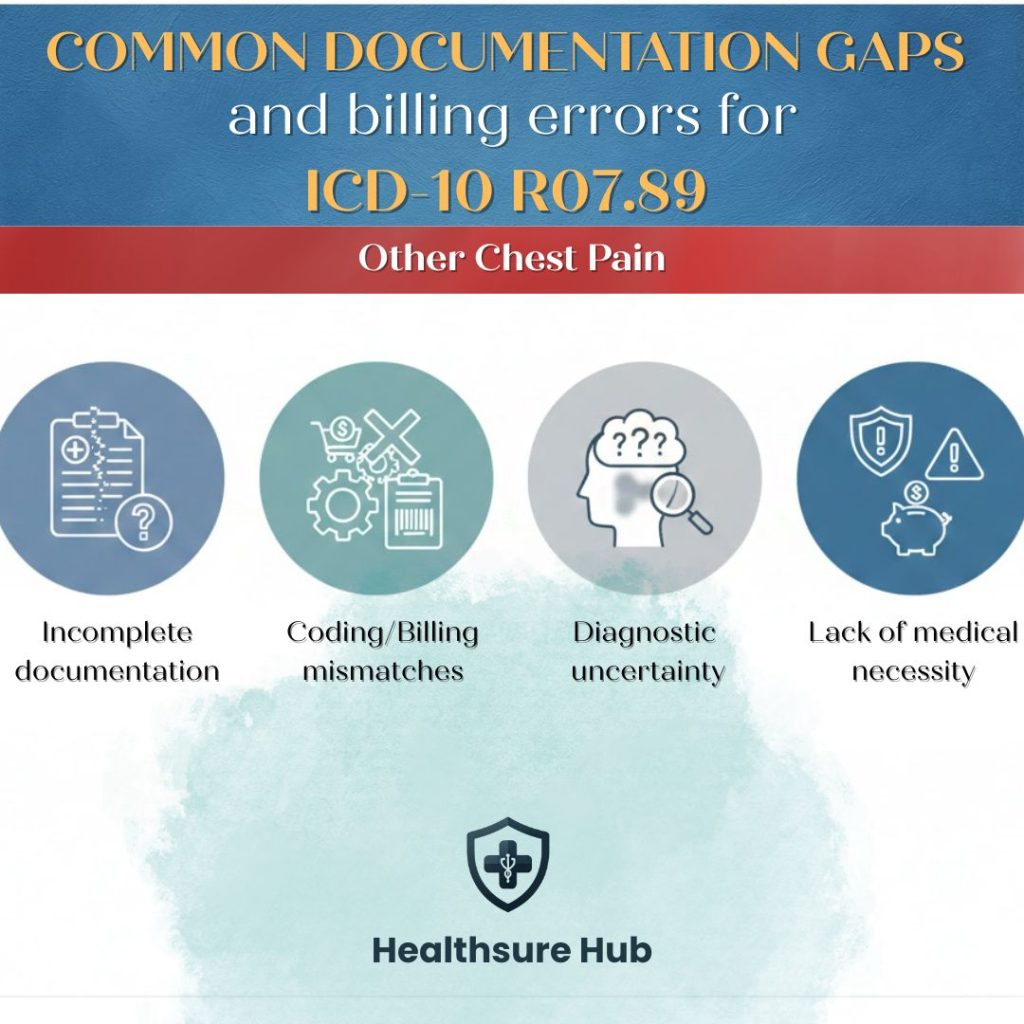
Common Documentation Gaps and Coding Errors
Coding issues with the ICD-10 code for other chest pain often stem from insufficient clinical detail or failure to update the diagnosis.
Common pitfalls include:
- Overusing of the diagnosis after a diagnosis is confirmed – always update the code when a specific condition is identified.
- Vague documentation – simply stating “chest pain” without details on onset, location, severity, or associated symptoms is insufficient.
- Coding conflicts – using the code alongside confirmed cardiac or respiratory diagnoses without justification can create claim discrepancies.
- Ignoring diagnostic testing – failing to document ECG, imaging, or lab results may weaken coding defensibility
Using the ICD-10 code alongside codes for confirmed cardiac conditions without clear justification can also create conflicts in claims data.
Differential Diagnoses to Consider
When assigning R07.89, it’s important to distinguish other chest pain from conditions with more specific ICD-10 codes. Differential diagnoses may include:
- Angina pectoris or myocardial infarction – typically presents with pressure-like chest pain, radiation to arm/jaw, and abnormal ECG or cardiac markers.
- Pleuritic chest pain – sharp pain that worsens with breathing, coughing, or movement, often linked to respiratory conditions.
- Chest pain due to trauma – identifiable injury history with localized tenderness or imaging findings.
- Gastrointestinal causes – may present with burning sensation, reflux, or dysphagia.
- Musculoskeletal causes – costochondritis or strain, often reproducible on palpation
| Scenario | Recommended Coding |
| Atypical chest pain in ED | R07.89 |
| Pain confirmed as angina | R07.0 or relevant cardiac code |
| Pain confirmed as pleuritic | R07.1 |
| Pain due to trauma | S or T injury code |
| Non-specific, ongoing evaluation | R07.89 |
The code should only be used when the chest pain is non-specific or atypical and none of the above conditions are confirmed, ensuring accurate documentation and proper coding.
Conclusion
ICD-10-CM code R07.89 (Other Chest Pain) is a vital tool for documenting atypical or non-specific chest pain during early or inconclusive evaluations. Given that most chest pain cases in outpatient and ED settings are non-cardiac, proper use ensures accurate clinical documentation, supports billing compliance, and reduces the risk of claim denials.
When supported by detailed documentation and used appropriately, it bridges the gap between symptom presentation and diagnostic certainty. Always update the code once the underlying cause is confirmed to maintain both accuracy and regulatory compliance.
This article is for informational purposes only and does not substitute professional medical or coding advice.
About the Author