Knee injuries are among the most common musculoskeletal issues, affecting athletes, active adults, and the elderly alike. Accurate diagnosis, treatment, and coding are critical—not only for patient care but also for medical documentation, insurance billing, and healthcare analytics. One frequently used ICD-10 code for knee injuries is S83.92XA, which represents an unspecified injury of the left knee during the initial encounter. Understanding the nuances of this code helps clinicians and coders document injuries accurately and ensure appropriate treatment and reimbursement.
Overview of ICD-10 Code S83.92XA
S83.92XA falls under the “S” chapter of ICD-10, which covers injuries to specific body regions. This code is used when the left knee is injured, but the exact type of injury—whether a ligament tear, meniscus injury, or contusion—is not yet identified.
The “A” at the end designates an initial encounter, meaning this is the first visit where the patient is actively being treated for the injury.
Breaking Down the Code
Every ICD-10 code communicates important information about the injury. While ICD-10 codes can appear complex, each component has a specific meaning. Here’s a clear breakdown for S83.92XA:
| Code Segment | Meaning | Explanation |
| S83 | Injury of knee and lower leg | Refers to the general body region. |
| .92 | Unspecified injury | Indicates the exact type of knee injury is not specified. |
| X | Placeholder | Required to complete the 7-character ICD-10 format. |
| A | Initial encounter | Signifies the first encounter for treatment. |
The ICD-10 system provides specific codes for injuries once the structure is identified:
- Right knee: S83.91XA
- Left knee: S83.92XA
- Unspecified knee: S83.90XA
This structure ensures consistent, accurate medical records, insurance claims, and national injury statistics.
What “Unspecified Injury” Means
The term “unspecified injury” does not imply uncertainty about whether the knee is injured. Rather, it means that the exact nature of the injury is not fully documented at the time of coding.
Common characteristics of unspecified knee injuries include:
- The patient may have swelling, pain, or limited mobility.
- The specific ligament, cartilage, or meniscus involved may not be determined yet.
- In fast-paced environments like emergency rooms or urgent care, immediate stabilization takes priority over detailed anatomical documentation.
In fast-paced environments, such as emergency departments or urgent care settings, immediate care often takes precedence over complete diagnostic clarity.
When the Initial Encounter Extension Applies
The “A” extension indicates that the patient is in the active treatment phase:
- First visit to the emergency department or urgent care for knee trauma
- Initial orthopedic evaluation
- Imaging referrals where the injury is suspected but not yet confirmed
Later encounters for the same injury would use D (subsequent encounter) or S (sequela) extensions, depending on the treatment stage.
Clinical Context and Types of Knee Injuries
While S83.92XA covers unspecified injuries, understanding the types of knee injuries that may initially be undocumented helps provide clinical context:
- Ligament injuries – ACL, MCL, LCL, or PCL tears
- Meniscus injuries – Tears, degeneration, or cartilage damage
- Contusions and soft tissue injuries – Bruising or minor trauma
- Dislocations or subluxations – Patellar or tibiofemoral dislocations
These injuries can be challenging to identify immediately due to swelling, pain, or limited range of motion, making unspecified coding necessary in early encounters.
Knee Injury Statistics and Trends
Including statistics strengthens both the credibility and SEO value of the article. According to recent studies:
- Knee injuries account for over 15% to 40% of all musculoskeletal injuries in the U.S.
- Sports-related knee injuries affect approximately 1 in 3 athletes annually, with women being two to eight times at a higher risk for ligament tears than their male counterparts.
- Emergency departments report that up to 25% of knee injuries are initially coded as unspecified, pending imaging or further evaluation.
- The estimated annual cost of knee injuries to the U.S. healthcare system exceeds $5 billion, including treatment, rehabilitation, and lost productivity.
These numbers highlight the importance of accurate coding for clinical, administrative, and financial purposes.
Documentation and Clinical Assessment
Accurate documentation is essential when using S83.92XA. Initial assessments may include:
- Pain evaluation – Using standardized scoring systems
- Swelling and mobility checks – Measuring range of motion and identifying effusion
- Imaging studies – X-ray, MRI, or ultrasound to assess internal structures
- Stability tests – Evaluating ligament integrity and joint stability
Documenting symptoms, initial findings, and treatment plans ensures that unspecified codes are used appropriately and updated once the exact injury is confirmed.
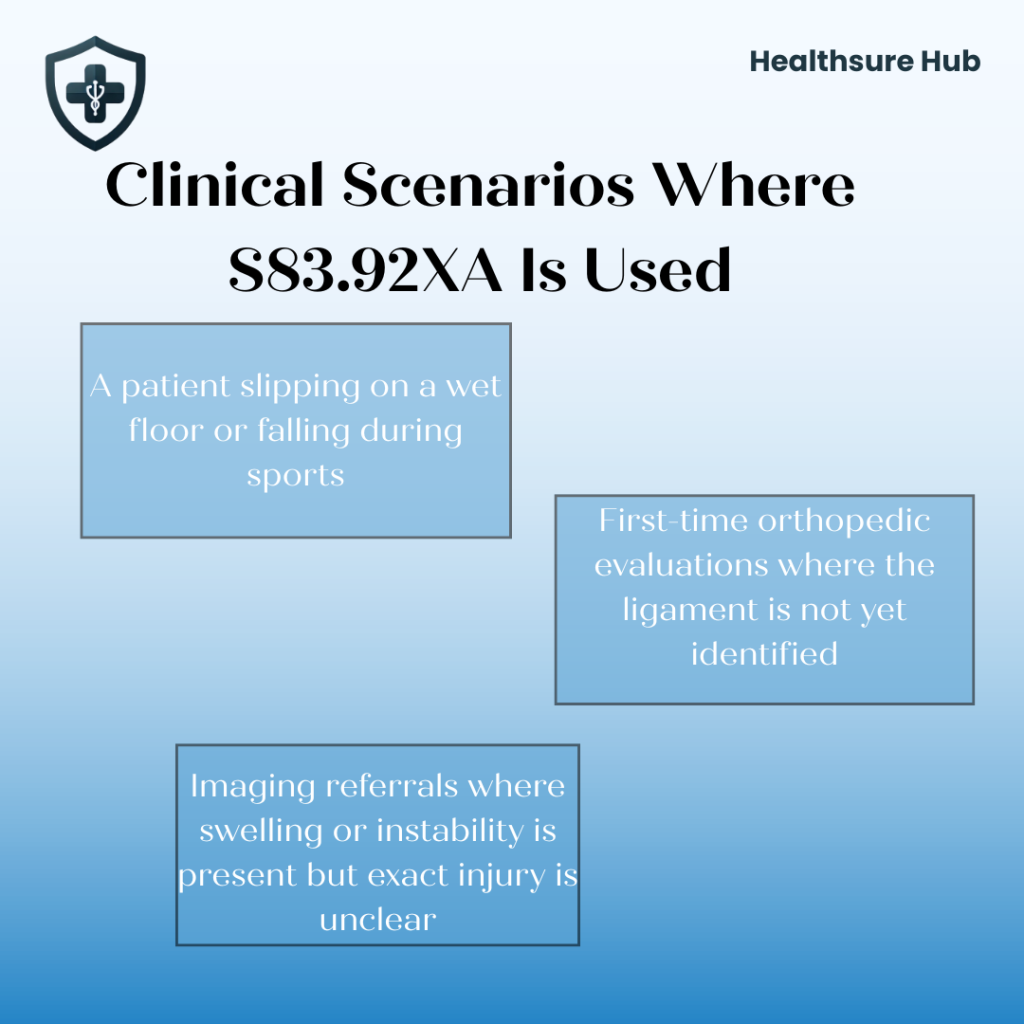
Clinical Scenarios Where S83.92XA Is Used
S83.92XA is often applied in real-world clinical settings, including:
- A patient slipping on a wet floor or falling during sports
- First-time orthopedic evaluations where the ligament is not yet identified
- Imaging referrals where swelling or instability is present but exact injury is unclear
In these cases, documentation focuses on symptoms, stabilization, and initial management, rather than specifying the exact tissue involved.
Importance of Accurate Coding
Correct use of S83.92XA is crucial for multiple reasons:
- Insurance reimbursement – Accurate coding reduces claim denials and ensures providers are compensated properly.
- Healthcare analytics – Reliable coding provides data on injury trends, resource allocation, and cost analysis.
- Clinical communication – Detailed and consistent documentation supports smooth care coordination, referrals, and follow-ups.
Overall, accurate coding enhances patient care while supporting administrative efficiency and compliance.
Common Documentation Gaps That Lead to S83.92XA
This code is often selected due to practical realities in clinical practice:
- Initial evaluations may omit ligament or meniscus details
- Clinicians may use general terms like “left knee injury”
- Imaging may confirm an injury but not specify the structure involved
These gaps reflect real-world workflows, not poor medical care.
Insurance and Billing Implications
Using S83.92XA appropriately has direct implications for insurance and billing:
- Initial coding- Enables providers to file timely claims even when the exact injury is unknown
- Claim updates – Once the injury is fully diagnosed, codes should be updated to reflect the specific structure involved
- Revenue cycle management – Proper documentation reduces the risk of denied claims and ensures accurate reimbursement
Medical coders play a critical role in reviewing unspecified codes and updating them as more information becomes available.
Prevention and Patient Education
While coding is essential, preventing knee injuries is equally important. Patients and healthcare providers can focus on:
- Strengthening exercises – Targeting quadriceps, hamstrings, and stabilizing muscles
- Proper warm-up routines – Reducing the risk of ligament or meniscus injuries
- Protective gear – Especially in high-risk sports or physically demanding activities
Educating patients on preventive strategies supports recovery and reduces the likelihood of future injuries.
Conclusion
ICD-10 code S83.92XA standardizes documentation for unspecified left knee injuries during the initial encounter. By encoding laterality, injury type, and treatment phase in one designation, it helps clinicians, coders, and insurers maintain accurate records.
Understanding this code improves transparency in medical documentation, supports proper insurance claims, and ensures patients receive timely and appropriate care. Accurate coding, thorough assessment, and preventive measures collectively enhance patient outcomes while optimizing healthcare efficiency.
About the Author