A simple slip on a wet floor. A momentary trip on uneven pavement. A brief loss of balance while walking. These everyday incidents may seem minor, yet they account for millions of injury-related medical visits each year. In medical records, these seemingly routine events are not left to narrative description alone, they are captured using precise ICD-10 external cause codes.
One such code, ICD-10 W01.0XX. Stay as we explain how the correct use of W01.0XXA supports compliant billing, strengthens injury data reporting, and contributes to broader patient safety and fall-prevention efforts across healthcare systems.
What Is ICD-10 Code W01.0XXA?
W01.0XXA is an ICD-10 code that describes a fall on the same level due to slipping, tripping, or stumbling without subsequently striking against an object, during initial encounter. It belongs to the External Causes of Morbidity Chapter.
This code does not describe the injury itself. Instead, it explains how the injury occurred, which is why it must always be reported in addition to a primary injury diagnosis code, such as a fracture, contusion, or joint pain.
Breaking Down the Code Structure
Each component of the code carries specific meaning:
- W01 – Indicates a same-level fall caused by slipping, tripping, or stumbling
- .0 – Specifies that the fall occurred without striking against an object
- XX – Placeholder characters required to maintain correct code length
- A – Initial encounter, meaning active treatment is being provided
The use of placeholders (“X”) is mandatory to ensure the correct placement of the 7th character. Omitting or misplacing these characters can result in claim rejections.
When Is W01.0XXA Used?
This code is appropriate when a patient experiences a same-level fall due to loss of balance or footing and does not hit another object, such as furniture, equipment, or structures, during the fall.
Common clinical scenarios include:
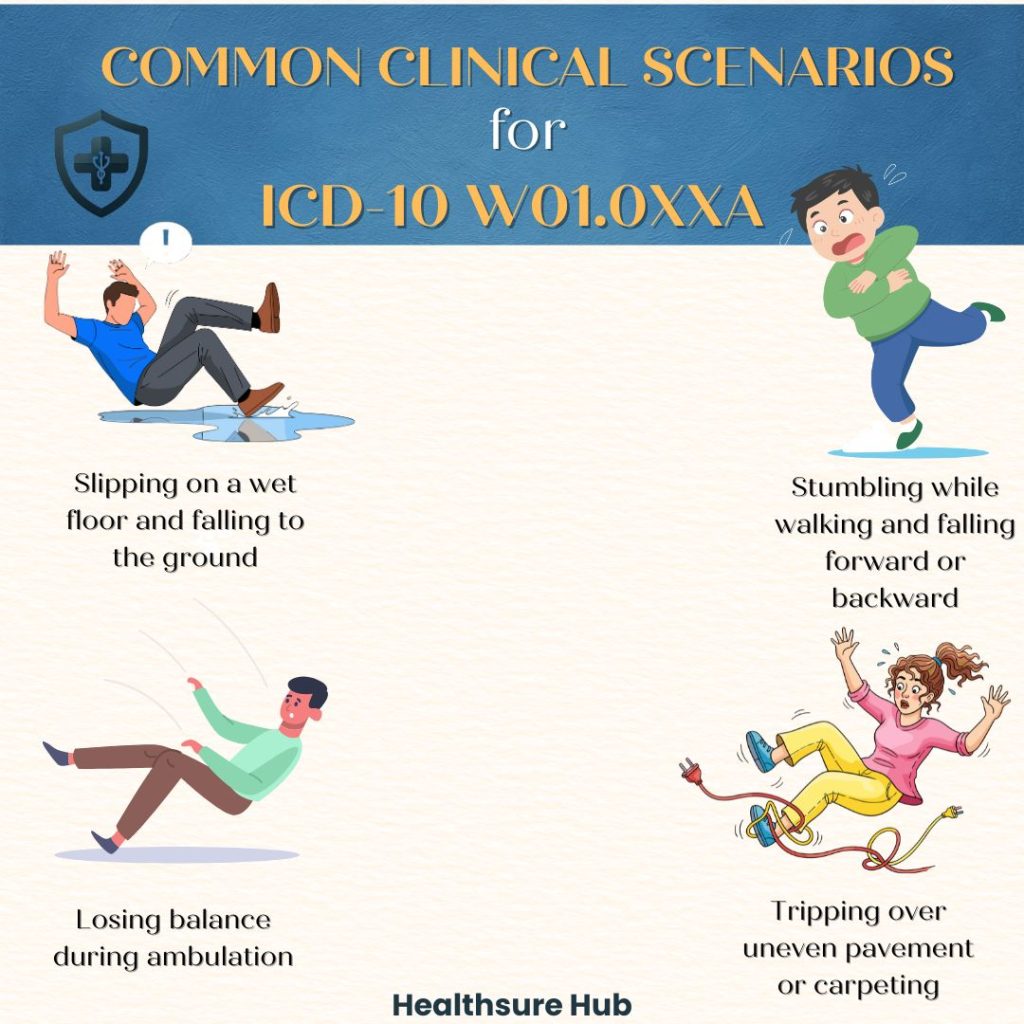
- Slipping on a wet floor and falling to the ground
- Tripping over uneven pavement or carpeting
- Stumbling while walking and falling forward or backward
- Losing balance during ambulation without external impact
This code is frequently used in emergency medicine, primary care, orthopedics, geriatrics, and rehabilitation settings.
The Scope of Same-Level Falls in Healthcare Data
Same-level falls resulting from slipping, tripping, or stumbling represent one of the most common mechanisms of injury documented across healthcare systems. Epidemiological data consistently show that ground-level falls account for more than half of all fall-related emergency department visits, particularly among older adults and individuals with mobility limitations.
Adults aged 65 and older experience the highest rates of injury from same-level falls, with wrist fractures, hip injuries, and knee trauma among the most frequently reported outcomes.
From a healthcare utilization perspective, same-level falls contribute significantly to diagnostic imaging use, orthopedic consultations, physical therapy referrals, and short-term disability claims. Unlike falls from heights or stairs, these incidents often occur in routine environments such as homes, workplaces, clinics, and retail settings.
Accurate reporting using external cause codes like W01.0XXA enables healthcare organizations and public health agencies to track patterns, identify environmental hazards, and prioritize fall-prevention strategies. Without consistent external cause coding, the true burden of same-level falls remains underrepresented in injury surveillance data.
Injuries Commonly Associated With W01.0XXA
Although W01.0XXA does not identify the injury itself, it is often paired with diagnosis codes related to the body part affected by the fall. Commonly associated conditions include wrist pain, knee injuries, hip pain, ankle sprains, and soft tissue trauma.
In more severe cases, same-level falls may result in sprains and strains, lower back contusions, or fractures caused by ground-level impact, all of which must be coded separately to accurately reflect medical necessity and injury severity.
Documentation Requirements for Accurate Coding
To support the appropriate use of W01.0XXA, medical documentation should clearly include:
- The mechanism of the fall (slipping, tripping, or stumbling)
- Confirmation that the fall occurred on the same level
- Explicit notation that the patient did not strike an object
- Detailed injury findings, including location, laterality, and severity
- Clear indication that the encounter is the initial encounter
Incomplete or vague documentation is one of the leading causes of external cause coding errors.
Coding Guidelines and Compliance Considerations
External cause codes like this particular ICD-10 code are not always required for reimbursement, but they are strongly encouraged and sometimes mandated by specific payers or reporting programs. They are essential for:
- Injury surveillance and public health reporting
- Quality measurement and risk adjustment
- Legal and occupational injury documentation
Consistency between provider notes and coded data is crucial for compliance and audit readiness.
Common Documentation Gaps and Coding Errors
Frequent issues associated with this ICD-10 code include:
- Failure to specify whether an object was struck
- Using the code without a related injury diagnosis
- Selecting the incorrect encounter character
- Applying W01.0XXA when the fall involved stairs or elevation
- Overreliance on unspecified injury codes
While this code captures same-level falls from slipping or tripping, W10.9XXA should be used when a patient falls on or from stairs and steps. Choosing the correct code ensures accurate reporting and prevents claim denials. Addressing these gaps improves data quality and reduces the risk of claim denials.

Why Accurate Use of W01.0XXA Matters Beyond Billing
While ICD-10 code W01.0XXA does not directly affect reimbursement in all cases, its accurate use has implications far beyond claims submission. External cause codes play a critical role in risk management, quality improvement initiatives, and patient safety programs. When same-level falls are consistently coded, healthcare systems can analyze trends related to environmental conditions, patient mobility challenges, and care settings associated with higher fall risk.
In institutional settings, this data supports targeted interventions such as improved flooring materials, enhanced housekeeping protocols, mobility assessments, and staff education. From a legal and compliance standpoint, detailed documentation of how an injury occurred may also be relevant in liability reviews, occupational injury claims, or workers’ compensation cases. Incomplete or inaccurate external cause coding limits an organization’s ability to demonstrate due diligence in fall prevention and may weaken internal safety reporting efforts.
Best Practices for Reporting Same-Level Falls
To ensure compliant and accurate reporting of same-level falls, healthcare organizations should follow established best practices when using ICD-10 code W01.0XXA. This code should always be reported in conjunction with a definitive injury diagnosis that reflects the patient’s clinical condition like M25.532 or S83.511A. Coders must confirm that the encounter character accurately represents the stage of care, whether initial, subsequent, or sequela.
Documentation should clearly describe the circumstances of the fall, including confirmation that it occurred on the same level and that no object was struck during the event. When details are missing or ambiguous, provider queries are essential to avoid assumptions that could compromise data accuracy. Regular education for clinical staff on the importance of documenting fall mechanisms can significantly improve external cause code quality. Consistent application of these practices supports audit readiness, strengthens compliance, and enhances the overall reliability of injury reporting.
Conclusion
ICD-10 code W01.0XXA is a vital external cause code used to describe same-level falls resulting from slipping, tripping, or stumbling during the initial encounter. While it does not represent a diagnosis, it provides essential context that enhances medical records, supports compliance, and strengthens injury data accuracy.
By ensuring thorough documentation and correct code selection, healthcare providers and coding professionals can reduce errors, improve claim outcomes, and contribute to more reliable health data across the care continuum.
About the Author