A routine drive can change in seconds. Whether it involves a minor roadway collision or a severe impact requiring emergency care, motor vehicle accidents generate complex clinical documentation, injury reporting, and coding challenges. Capturing the circumstances of these incidents accurately is essential for healthcare providers, insurers, and public health tracking.
At Healthsure Hub, we help simplify complex ICD-10 coding concepts such as V49.9XXA so providers, coders, and healthcare professionals can improve documentation accuracy and coding confidence.
Overview of ICD-10 Code V49.9XXA
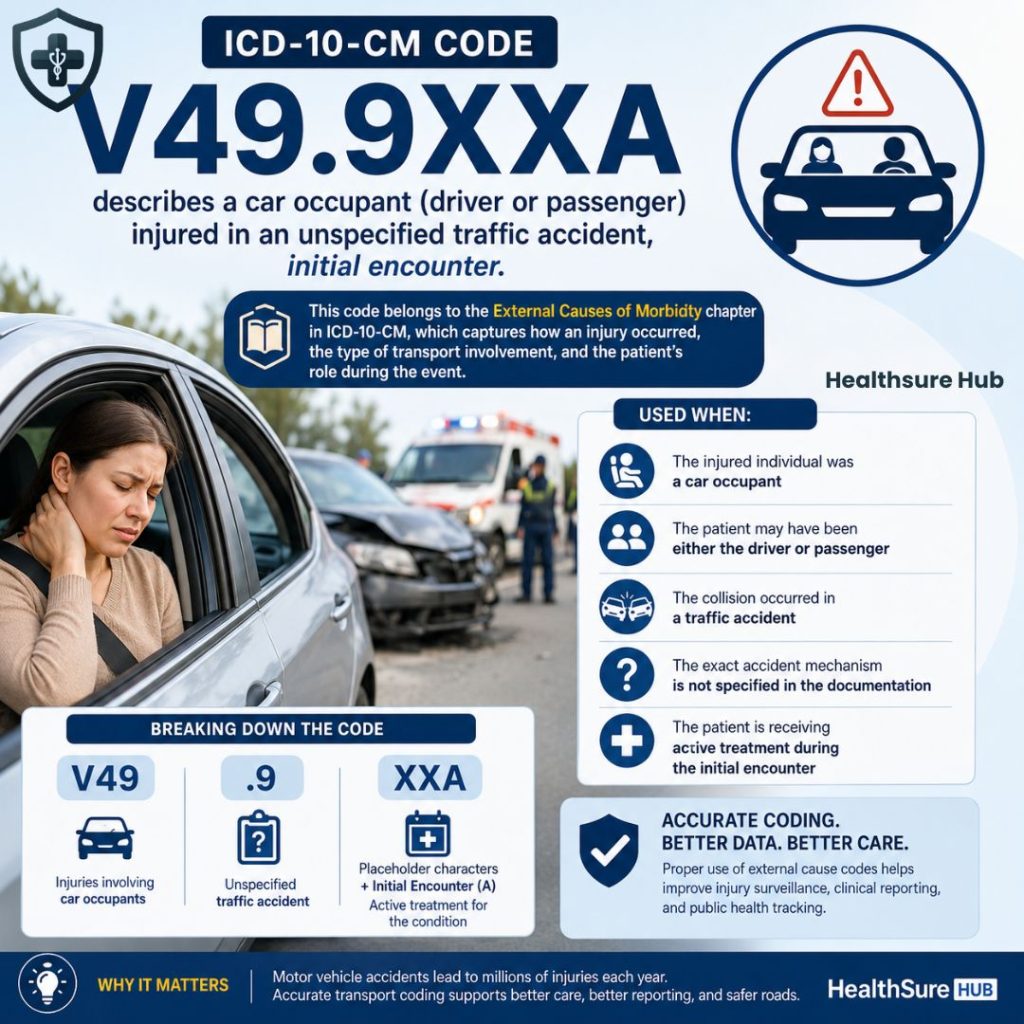
ICD-10-CM code V49.9XXA describes a car occupant (driver or passenger) injured in an unspecified traffic accident, initial encounter.
This code belongs to the External Causes of Morbidity chapter in ICD-10-CM, which captures how an injury occurred, the type of transport involvement, and the patient’s role during the event.
V49.9XXA is used when:
- The injured individual was a car occupant
- The patient may have been either the driver or passenger
- The collision occurred in a traffic accident
- The exact accident mechanism is not specified in the available documentation
- The patient is receiving active treatment during the initial encounter
Because transportation injuries remain a major healthcare concern, proper use of external cause codes helps improve injury surveillance and clinical reporting.
Motor vehicle accidents continue to represent a major public health issue. According to the National Highway Traffic Safety Administration (NHTSA), the United States experiences millions of police-reported crashes each year, leading to more than two million injuries among drivers, passengers, pedestrians, and other roadway users. This volume of injury data underscores why accurate transport coding matters across clinical, administrative, and public health settings.
Breaking Down Code the Structure
Understanding how the code is built can make its purpose easier to interpret.
The “V49” category identifies injuries involving car occupants. Within that category, the “.9” subclassification reflects an unspecified traffic accident, meaning the available documentation does not clearly identify the collision mechanism or precise transport circumstance.
The final portion, “XXA,” includes placeholder characters required for proper ICD-10 formatting and ends with the encounter designation “A,” which signals an initial encounter. In ICD-10-CM terminology, an initial encounter does not necessarily mean the patient’s first appointment overall. Rather, it indicates that the patient is receiving active treatment for the condition.
This stage of care may include emergency department management, trauma evaluation, surgical intervention, inpatient treatment, or physician-directed acute care.
Common Clinical Situations Where V49.9XXA May Apply
In everyday clinical practice, providers and coders rarely work with perfect information. Motor vehicle injury documentation often develops in stages, particularly in emergency medicine, trauma care, and acute hospital settings. ICD-10-CM code V49.9XXA becomes relevant when healthcare professionals can confirm that a patient was injured as a car occupant in a traffic accident, but the medical record does not yet provide enough detail to support a more specific transport injury code.
Emergency Department Encounters With Limited Accident Details
Emergency departments routinely evaluate patients following traffic collisions involving a wide range of injuries, from minor soft tissue trauma to serious orthopedic or neurological conditions. WHO reports that 20 and 50 million more people suffer non-fatal injuries. During these encounters, documentation may establish that the patient was inside a passenger vehicle at the time of the accident without fully describing the collision itself.
For example, a chart may note chest pain, cervical strain, or fractures after a roadway incident but fail to specify whether another vehicle was involved, whether the crash resulted from loss of vehicle control, or whether the patient occupied the driver or passenger seat. In situations where only limited external cause details are available, V49.9XXA may appropriately reflect the known circumstances during the patient’s initial treatment.
Trauma Care Before Complete Incident Information Is Available
Providers may know that injuries occurred during a traffic accident involving a car occupant, yet important contextual details—such as collision mechanism, roadway conditions, or vehicle dynamics—remain unavailable. Police reports, EMS documentation, or witness statements may still be pending review.
When the clinical record confirms vehicle involvement but lacks sufficient specificity, V49.9XXA provides a practical coding option that aligns with the information currently supported by documentation.
Early Documentation Before Investigative Findings Are Confirmed
Clinical documentation frequently begins long before official investigative findings become available. Healthcare providers often initiate diagnosis, treatment planning, and injury management while law enforcement reports or accident analyses are still in progress.
A patient’s record may confirm involvement in a traffic-related car accident but lack definitive information regarding crash type, contributing factors, or vehicle interactions. During this early documentation window, unspecified coding may be necessary to accurately represent the event without introducing unsupported assumptions into the medical record.
Used appropriately, V49.9XXA helps bridge that gap between immediate clinical documentation and later investigative clarification.
Why Accurate Coding Matters
External cause coding is sometimes viewed as secondary documentation, but its impact extends far beyond administrative recordkeeping.
Accurate coding supports a clearer understanding of injury patterns across healthcare systems. Hospitals rely on transport injury data for trauma registries, quality reporting, research initiatives, and population health analysis. Public health agencies use these datasets to evaluate roadway safety trends and develop prevention strategies.
On the operational side, complete coding improves record consistency, strengthens claims documentation, and contributes to reliable healthcare analytics.
Because motor vehicle injuries remain one of the leading causes of emergency care utilization worldwide, even small improvements in documentation precision can strengthen the quality of injury reporting on a much larger scale.
Documentation Elements That Support V49.9XXA
Strong clinical documentation is the foundation of correct code assignment.
For V49.9XXA, providers should clearly establish that the patient was a car occupant involved in a traffic accident and that the encounter represents active treatment. Supporting documentation may come from physician assessments, emergency department notes, trauma documentation, EMS reports, or hospital admission records.
When available, additional details strengthen coding accuracy significantly. Information about occupant role, collision circumstances, vehicle involvement, and accident setting can help coders determine whether a more specific external cause code from the V40–V49 series should be used instead of an unspecified option. Even when complete accident details are unavailable, documentation should still communicate the known clinical circumstances clearly and consistently.
Codes Commonly Reported With V49.9XXA
ICD-10-CM code V49.9XXA functions as an external cause code, meaning it explains the circumstances surrounding an injury rather than identifying the injury itself. Because of this, it is typically reported alongside diagnosis codes that describe the patient’s actual medical condition or trauma.
Injury Diagnosis Codes
V49.9XXA is frequently paired with Chapter 19 injury codes (S00–T88) that capture the physical injuries sustained during the accident.
Depending on the clinical presentation, associated diagnosis codes may include:
- S06.0X0A — Concussion without loss of consciousness, initial encounter
- S13.4XXA — Sprain of ligaments of cervical spine, initial encounter
- S22.39XA — Fracture of rib, initial encounter
- S42.90XA — Fracture of unspecified shoulder region, initial encounter
- S80.00XA — Contusion of knee, initial encounter
For example, a patient treated after a motor vehicle collision may receive an injury diagnosis code describing a rib fracture or cervical strain, while V49.9XXA provides the external cause information explaining how the injury occurred.
Common Documentation Gaps That Lead to Coding Challenges
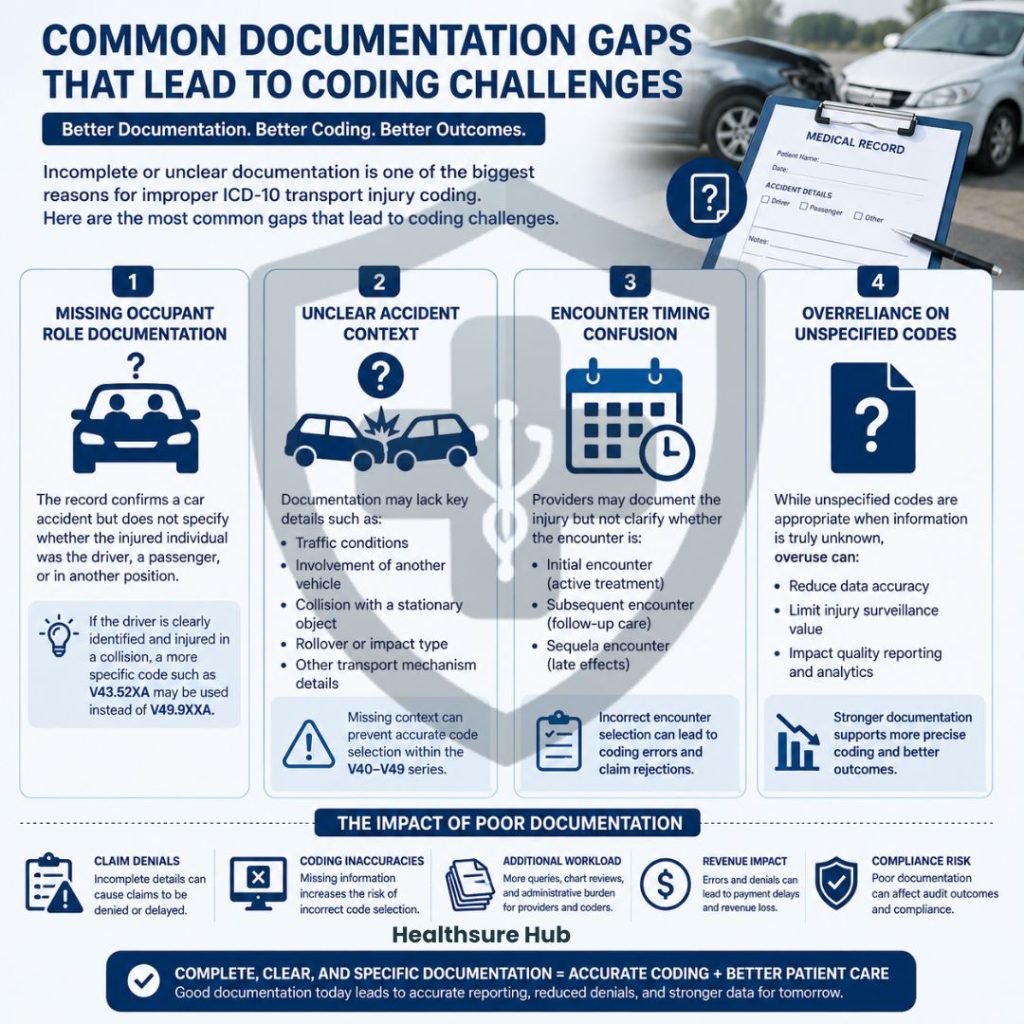
One of the most frequent challenges with transport injury coding is not incorrect coding itself, but incomplete documentation.
In many records, the patient’s role inside the vehicle is never identified. Documentation may confirm involvement in a car accident while failing to clarify whether the injured individual was driving, riding as a passenger, or occupying another position within the vehicle. If it’s for sure that the driver has been injured in a collision the code V43.52XA should be used instead.
Another common issue is missing accident context. Clinical notes sometimes omit whether the event occurred in traffic conditions, involved another moving vehicle, a stationary object, rollover dynamics, or another transport mechanism entirely.
Encounter timing can also create confusion. Providers may thoroughly document the injury itself but overlook whether care represents active treatment, follow-up management, or sequela care, details that directly influence ICD-10 encounter selection. Improper documentation can lead to claim denials, coding inaccuracies, and unnecessary administrative burden during the medical billing process.
While unspecified codes are appropriate when documentation genuinely lacks detail, overreliance on unspecified reporting can reduce data accuracy and limit the value of injury surveillance efforts. Stronger documentation practices help support more precise coding decisions whenever greater specificity is clinically supported.
Final Thoughts
ICD-10-CM code V49.9XXA plays an important role in documenting injuries involving car occupants treated after an unspecified traffic accident during the initial phase of care. Its purpose is not to replace detailed accident reporting, but to provide a clinically appropriate coding option when available documentation confirms the event without fully defining its circumstances.
As with many external cause codes, accurate application depends on thoughtful documentation, careful review of clinical records, and a commitment to coding specificity whenever the medical record supports it.
About the Author