Injuries affecting the wrist, hand, and fingers are frequently evaluated in emergency departments, urgent care centers, and occupational health settings. During the initial stages of treatment, healthcare providers may not always have enough information to identify the exact nature of an injury, particularly when diagnostic testing is still pending.
In these situations, accurate ICD-10 coding is essential for documenting the encounter, supporting medical necessity, and facilitating proper claim submission. Understanding how and when S69.92XA should be reported can help providers, coders, and billers maintain compliance while reducing the risk of medical billing errors.
What Does ICD-10 Code S69.92XA Mean?
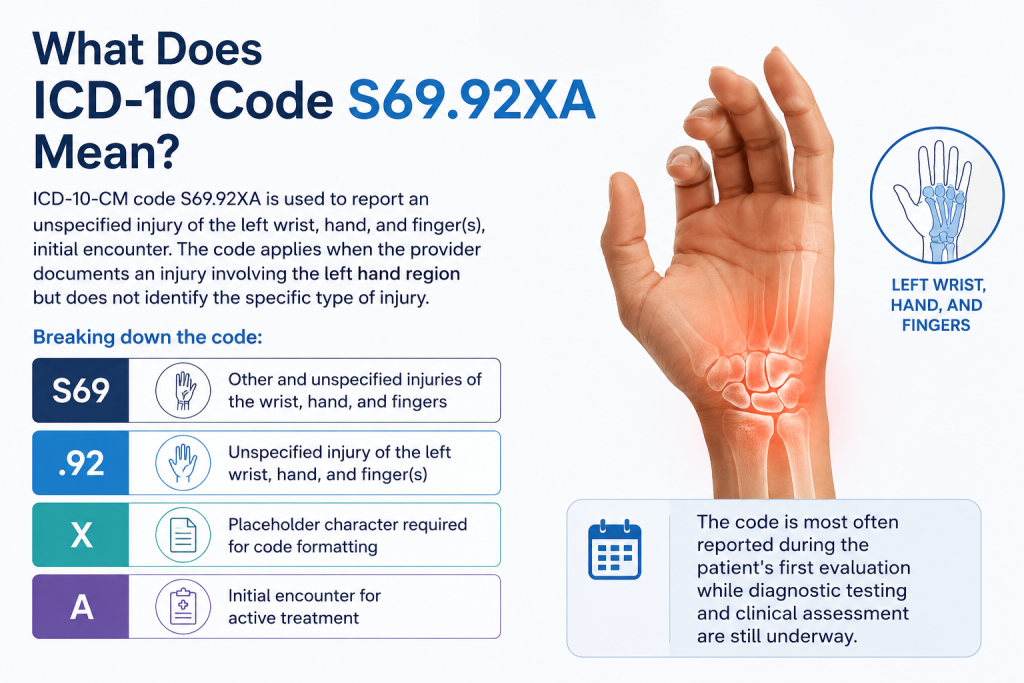
ICD-10-CM code S69.92XA is used to report an unspecified injury of the left wrist, hand, and finger(s), initial encounter. The code applies when the provider documents an injury involving the left hand region but does not identify the specific type of injury. Breaking down the code:
- S69 – Other and unspecified injuries of the wrist, hand, and fingers
- .92 – Unspecified injury of the left wrist, hand, and finger(s)
- X – Placeholder character required for code formatting
- A – Initial encounter for active treatment
The code is most often reported during the patient’s first evaluation while diagnostic testing and clinical assessment are still underway.
When Is S69.92XA Used?
S69.92XA may be appropriate when documentation confirms an injury affecting the left wrist, hand, thumb, or fingers, but the exact diagnosis has not yet been determined. Common examples include:
- A patient falls and lands on their left hand.
- A workplace accident causes pain and swelling in the left hand.
- A sports injury affects the left wrist or fingers.
- Initial evaluation reveals trauma but imaging results are pending.
In these situations, the injury may be documented as unspecified until additional information becomes available.
Diagnostic Evaluation
Because S69.92XA represents an unspecified injury, additional evaluation is often necessary before a more definitive diagnosis can be assigned. Providers may use a combination of clinical assessment and diagnostic testing to determine the nature and severity of the injury.
Physical Examination
The initial evaluation typically includes an assessment of pain, swelling, tenderness, range of motion, and overall hand function. These findings help guide further testing and treatment decisions.
Imaging Studies
Diagnostic imaging may be ordered when a fracture, dislocation, or other structural injury is suspected. Common imaging studies include X-rays, CT scans, and MRI examinations.
Follow-Up Assessment
As additional clinical information becomes available, providers may update the diagnosis to reflect a more specific injury. This can affect both treatment planning and code selection.
Insurance Claim Considerations
Although S69.92XA is a valid billable ICD-10-CM code, unspecified injury codes may receive additional scrutiny from payers when documentation supports greater specificity. To support successful claim processing, healthcare providers should ensure that medical records clearly document:
- The affected body region
- Confirmation of left-sided involvement
- Clinical findings
- Diagnostic testing results
- Treatment provided during the encounter
Accurate documentation and timely coding updates can help reduce reimbursement delays and minimize the risk of claim denials.
Documentation Requirements
Accurate documentation plays an important role in supporting the use of S69.92XA. Because this is an unspecified injury code, medical records should clearly establish the presence of an injury involving the left wrist, hand, or fingers while explaining why a more specific diagnosis is not yet available.
Thorough documentation also helps support medical necessity and can reduce coding and reimbursement issues. To support accurate coding, providers should document:
- The mechanism of injury
- Confirmation that the injury involves the left side
- Clinical signs and symptoms
- Diagnostic testing performed
- Treatment provided
- Encounter type
Clear documentation helps support medical necessity, reduces coding uncertainty, and allows coders to determine whether a more specific diagnosis code may be appropriate as additional clinical information becomes available.
Billing and Coding Considerations for S69.92XA
Accurate code selection is important when reporting S69.92XA, particularly because it is an unspecified injury code. Providers and coders should review documentation carefully to ensure the diagnosis accurately reflects the patient’s condition and stage of treatment. Even small coding inaccuracies can contribute to claim denials, payment delays, and other challenges that affect the healthcare organization’s overall revenue cycle.
Verify Laterality
S69.92XA specifically identifies an injury involving the left wrist, hand, or fingers. If documentation clearly indicates the affected side, coders should select a code that reflects this information rather than using a more general unspecified injury code.
Look for Greater Specificity
Unspecified injury codes are often used during the initial stages of evaluation when the exact diagnosis has not yet been determined. However, if documentation later confirms a fracture, sprain, dislocation, laceration, or another specific injury, a more detailed ICD-10 code should generally be reported.
Confirm Encounter Type
The seventh character “A” indicates that the patient is receiving active treatment during the initial encounter. Coders should verify that the encounter designation matches the clinical documentation, as follow-up visits may require a different seventh character.
Accurate documentation and timely coding updates can help support claim approval, reduce reimbursement delays, and improve overall coding accuracy.
Related ICD-10 Codes
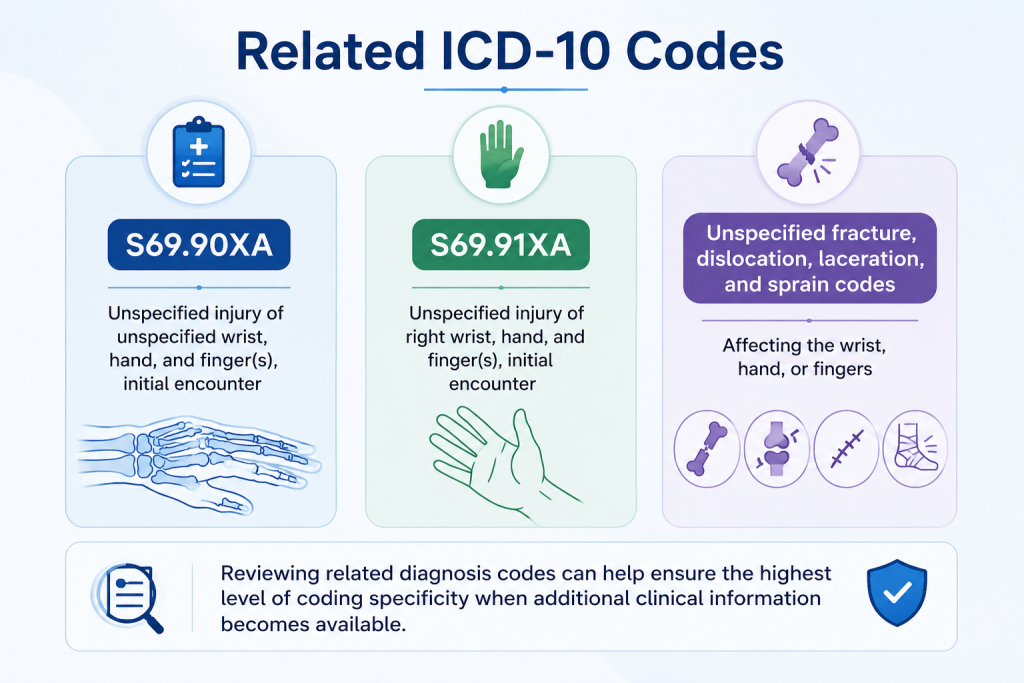
Several related ICD-10 codes may be considered depending on the level of documentation detail available and the specific nature of the injury. The following codes are commonly associated with injuries affecting the wrist, hand, and fingers:
- S69.90XA – Unspecified injury of unspecified wrist, hand, and finger(s), initial encounter
- S69.91XA – Unspecified injury of right wrist, hand, and finger(s), initial encounter
- Unspecified fracture, dislocation, laceration, and sprain codes affecting the wrist, hand, or fingers
Reviewing related diagnosis codes can help ensure the highest level of coding specificity when additional clinical information becomes available.
Final Thoughts
ICD-10 code S69.92XA is used to report an unspecified injury of the left wrist, hand, and finger(s) during an initial encounter. It is commonly assigned when the affected area is known but the exact injury has not yet been determined.
Accurate documentation, proper laterality reporting, and ongoing review of clinical findings can help ensure appropriate coding and smoother claims processing.
About the Author