Hand and finger injuries are among the most common reasons patients seek care in emergency departments, urgent care clinics, and primary care settings. In many cases, providers may identify an injury involving the wrist, hand, fingers, or thumb before determining the exact diagnosis. When documentation does not specify the precise nature of the injury, coders may assign an unspecified injury code during the initial encounter.
One such code is ICD-10-CM S69.90XA. Understanding when this code is appropriate, what documentation supports its use, and when a more specific diagnosis should be reported can help improve coding accuracy and reduce the risk of claim denials. In this guide, Healthsure Hub explains what ICD-10 code S69.90XA means, when it is commonly used, and important coding considerations for healthcare providers and medical billers.
What Does ICD-10 Code S69.90XA Mean?
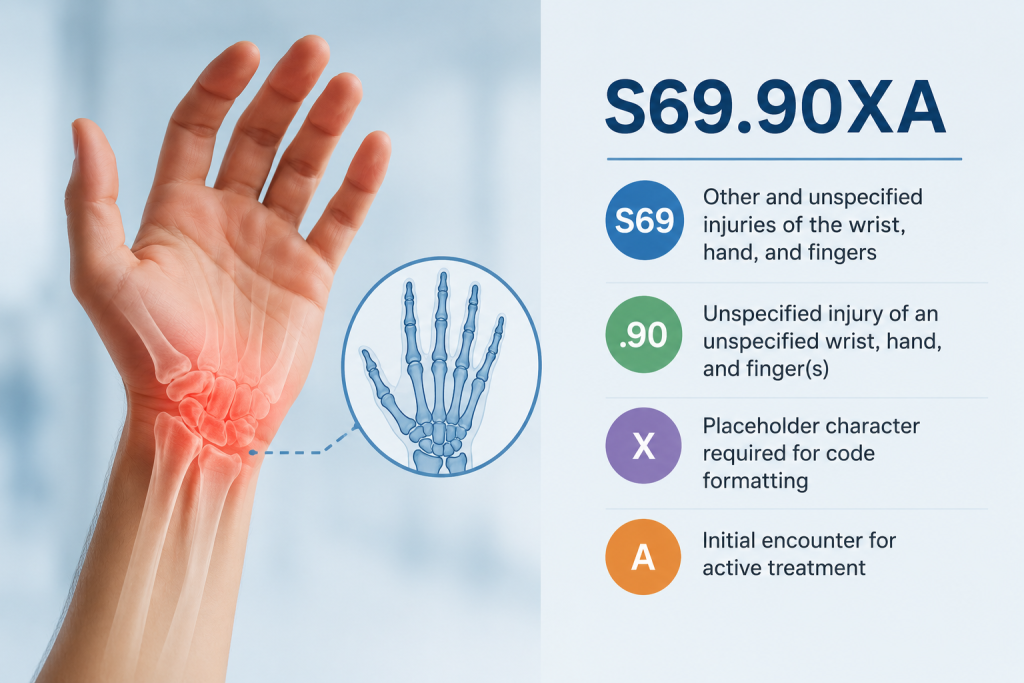
ICD-10-CM code S69.90XA is used to report an unspecified injury of an unspecified wrist, hand, and finger(s), initial encounter. The code is assigned when a patient presents with an injury involving the hand, wrist, thumb, or fingers, but the provider has not documented the specific type of injury or the exact anatomical location affected. Breaking down the code:
- S69 – Other and unspecified injuries of the wrist, hand, and fingers
- .90 – Unspecified injury of an unspecified wrist, hand, and finger(s)
- X – Placeholder character required for code formatting
- A – Initial encounter for active treatment
The code is generally used during the patient’s first visit when evaluation and treatment are being provided for the injury.
When Is S69.90XA Used?
S69.90XA may be reported when documentation confirms an injury to the wrist, hand, or fingers but lacks enough detail to assign a more specific ICD-10 code. Examples include:
- A patient presents after a fall and reports hand pain, but imaging results are still pending.
- An emergency department provider documents a hand injury without identifying the exact structure affected.
- A patient sustains trauma to the fingers during sports activity, but the injury type has not yet been determined.
- Initial clinical documentation describes swelling and pain of the hand following an accident but does not specify whether a fracture, sprain, strain, or contusion is present.
In these situations, S69.90XA may serve as a temporary diagnosis code until additional clinical information becomes available.
Common Scenarios Where S69.90XA May Apply
Several situations may lead to the assignment of this code during an initial encounter.
Workplace Injuries
Hand injuries are common in workplace settings, particularly among employees who operate machinery, handle tools, or perform repetitive manual tasks. According to the U.S. Bureau of Labor Statistics, private industry employers reported 2.5 million nonfatal workplace injuries and illnesses in 2024, highlighting the continued prevalence of occupational injuries across various industries. Employees who suffer hand, wrist, or finger injuries at work may initially receive an unspecified injury diagnosis until further evaluation, imaging, or specialist assessment is completed.
Sports-Related Trauma
Athletes frequently experience hand and finger injuries during activities such as basketball, football, baseball, volleyball, and martial arts. If the exact injury has not yet been identified, S69.90XA may be reported.
Falls
Patients who fall and land on an outstretched hand often present with pain, swelling, or reduced mobility before a definitive diagnosis is established.
Motor Vehicle Accidents
Drivers and passengers involved in collisions may experience trauma to the hands or fingers from impact with steering wheels, dashboards, or other objects. These injuries may occur alongside other conditions commonly reported after a motor vehicle accident. Initial documentation may support the use of S69.90XA until more detailed findings are available.
Crush Injuries
A hand caught in machinery, doors, or heavy equipment can result in significant trauma that requires additional diagnostic workup before a more specific injury code is assigned.
Documentation Requirements for S69.90XA
Although this is an unspecified injury code, adequate documentation is still necessary to support medical necessity and accurate coding. Providers should document:
- The mechanism of injury
- The date of injury when known
- Symptoms such as pain, swelling, bruising, numbness, or limited movement
- The anatomical area involved
- Diagnostic testing performed
- Treatment provided during the encounter
- Whether the encounter is initial, subsequent, or for sequela care
Clear documentation helps justify the code selection and may reduce payer requests for additional information.
Why Specificity Matters
ICD-10-CM emphasizes detailed clinical documentation whenever possible. While S69.90XA is a valid billable code, providers should use a more specific diagnosis when sufficient information is available. For example, a confirmed fracture, dislocation, contusion, laceration, or ligament injury should generally be reported using the corresponding specific ICD-10 code rather than an unspecified injury code. Using the highest level of specificity can:
- Improve claim acceptance rates
- Support accurate reimbursement
- Reduce coding audits
- Enhance clinical reporting
- Improve injury tracking and data collection
When diagnostic results become available, coders should review the record to determine whether a more specific code should replace S69.90XA.
Initial Encounter vs. Subsequent Encounter
The seventh character of an ICD-10 injury code indicates the type of encounter.
Initial Encounter (A)
The “A” designation is used while the patient is receiving active treatment. Examples include:
- Emergency department visits
- Urgent care evaluations
- Initial physician assessments
- Surgical treatment
- Fracture management
Subsequent Encounter (D)
A subsequent encounter is reported when the patient receives routine follow-up care during the healing or recovery phase.
Sequela (S)
The “S” designation is used for complications or conditions that develop as a result of a previous injury. Selecting the correct encounter type is essential for accurate claims submission.
Related ICD-10 Codes
Depending on clinical findings, a more specific code may be appropriate. Common alternatives include:
- Left wrist injury
- Right wrist injury
- Finger injury
- Thumb injury
- Hand contusion
- Hand laceration
- Hand fracture
- Hand sprain and ligament injury
Coders should always review provider documentation carefully before assigning an unspecified diagnosis code.
Common Coding Mistakes to Avoid
Several coding errors can occur when reporting S69.90XA, particularly when documentation is incomplete or updated findings are overlooked.
Using an Unspecified Code Too Long
S69.90XA may be appropriate during the initial evaluation, but coders should switch to a more specific diagnosis code once the exact injury has been identified and documented.
Missing Updated Findings
Imaging studies and follow-up evaluations may reveal additional details about the injury. Failing to review updated documentation can result in inaccurate code assignment.
Incorrect Encounter Type
The seventh character must match the patient’s stage of treatment. Using an incorrect encounter designation can lead to coding and billing issues.
Making Coding Assumptions
Pain, swelling, or limited movement do not automatically indicate a fracture, sprain, or other specific injury. Coders should only report diagnoses that are clearly documented by the provider.
Overlooking Documentation Gaps
Missing details about the injury location or type may affect code selection. When documentation is unclear, additional clarification may be needed before assigning a diagnosis code.
Can S69.90XA Be Used for Insurance Claims?
Yes. S69.90XA is a valid billable ICD-10-CM code that can be submitted on insurance claims when supported by provider documentation. However, some payers may scrutinize unspecified diagnosis codes more closely, particularly when medical records contain information that could support a more specific diagnosis. Accurate documentation and timely coding updates can help prevent reimbursement issues.

Final Thoughts
ICD-10 code S69.90XA is used to report an unspecified injury of an unspecified wrist, hand, or finger during an initial encounter. It commonly appears in emergency and urgent care settings when providers have not yet determined the precise nature of the injury.
Although the code is billable, healthcare providers and coders should strive for the highest level of diagnostic specificity possible. Thorough documentation, proper encounter designation, and ongoing review of clinical findings can help ensure accurate coding, smoother claims processing, and appropriate reimbursement.
About the Author