Buying a home is one of the biggest financial commitments most people will ever make. Protecting that investment is just as important as choosing the right property or securing a mortgage. Yet many homeowners still ask the same fundamental question: what is homeowners insurance and how does it work?
Understanding the answer is essential. Homeowners insurance is not just another monthly bill, it’s a financial safety net that protects your property, belongings, and personal liability if something unexpected happens. In fact, homeowners insurance claims data shows that weather-related damage and fire losses account for a significant percentage of filed claims each year. In this guide, we’ll break down exactly what homeowners insurance is, how it works, what it covers, and how to choose the right policy for your needs.
What Is Homeowners Insurance and How Does It Work?
Homeowners insurance is a financial protection policy that covers damage to your home, personal belongings, and liability for accidents, and it works by paying for covered losses in exchange for a monthly or annual premium.
If you’re wondering what it is and how it works in practical terms, here’s the simple version: you pay an insurance company a premium, and in return, the insurer agrees to cover specific risks outlined in your policy. If a covered event, such as a fire, storm, theft, or liability claim, occurs, you file a claim and the insurer helps pay for the damages, minus your deductible.
A standard homeowners insurance policy includes:
- Premium – The amount you pay (monthly or annually) to keep the policy active
- Deductible – The amount you pay out of pocket before coverage kicks in
- Policy limits – The maximum amount the insurer will pay for a covered loss
For example, if a covered storm causes $20,000 in damage and your deductible is $1,000, your insurer would typically pay $19,000. At its core, homeowners insurance spreads financial risk. Instead of bearing the full cost of a disaster alone, policyholders share risk through premiums collected by the insurance company.
Now that you understand what homeowners insurance is and how it works at a basic level, the next step is examining exactly what protections are included in a standard policy.
What Does Homeowners Insurance Typically Cover?
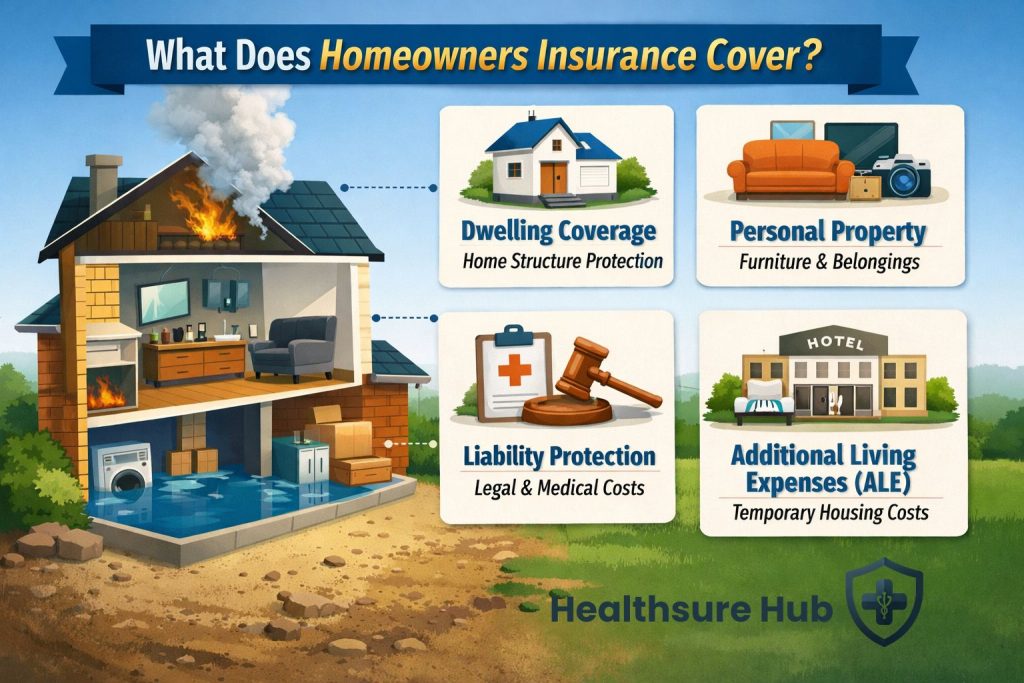
To fully understand what is homeowners insurance and how does it work, you need to know what it actually covers. Most standard policies provide protection in four main areas:
- Dwelling coverage – Protects the physical structure of your home (walls, roof, floors, built-in appliances)
- Personal property coverage – Covers belongings such as furniture, electronics, and clothing
- Liability protection – Pays for legal and medical costs if someone is injured on your property
- Additional living expenses (ALE) – Covers temporary housing and related costs if your home becomes uninhabitable due to a covered loss
For example, if a kitchen fire damages cabinets and appliances, dwelling coverage would pay for repairs. If smoke damages your furniture, personal property coverage applies. If a guest slips and sues you for medical expenses, liability coverage helps protect your assets.
These components work together to provide broad protection against common risks homeowners face. However, understanding coverage is only half the picture, it’s just as important to know what your policy does not include.
What Is Not Covered by Homeowners Insurance?
While homeowners insurance offers wide-ranging protection, it does not cover everything. Knowing the exclusions is just as important as knowing the coverage.
Most standard policies do not cover:
- Flood damage (requires separate flood insurance)
- Similarly, there are specific differences between dwelling fire vs homeowners insurance when it comes to standalone fire protection and coverage limits.
- Earthquake damage (often requires an endorsement or separate policy)
- Normal wear and tear or maintenance issues
- Pest infestations
- Intentional damage
For instance, if your basement floods due to heavy rain and you don’t have flood insurance, your standard homeowners policy likely won’t pay for the repairs. In fact, national flood insurance statistics show that flooding is one of the most costly and frequent natural disasters affecting homeowners each year.
Similarly, gradual roof deterioration due to age is considered maintenance, not an insurable event. These exclusions often depend on the type of policy you choose, which makes understanding policy structure essential.
How Homeowners Insurance Policies Are Structured (Coverage Types Explained)
Understanding policy structure is another key part of answering what is homeowners insurance and how it works. Home insurance isn’t one-size-fits-all, as all policies are standardized into different forms, each offering varying levels of protection.
HO-1 to HO-8: The Standard Policy Forms
Homeowners insurance policies are categorized into forms commonly labeled HO-1 through HO-8. Each form defines what perils are covered and how broadly your property is protected.
- HO-1 – Basic form (limited coverage, rarely offered today)
- HO-2 – Broad form (covers more named perils)
- HO-3 – Special form (most common standard homeowners policy)
- HO-5 – Comprehensive form (broader, premium coverage)
- HO-6 – Condo insurance
- HO-4 – Renters insurance
- HO-8 – Designed for older homes
Most homeowners will encounter HO-3 or HO-5 policies, as these offer the most practical protection for primary residences.
Open-Peril vs. Named-Peril Coverage
One of the biggest differences between policy types is whether coverage is written on a named-peril or open-peril basis.
A named-peril policy only covers risks specifically listed in the contract, such as fire, theft, or windstorms. If a peril is not listed, it’s not covered.
An open-peril policy, on the other hand, covers all risks except those explicitly excluded. This provides broader protection and fewer coverage gaps.
For example, the standard HO-3 policy typically covers your dwelling on an open-peril basis, while personal belongings are often covered on a named-peril basis.
HO-3 vs. HO-5: Which Offers Broader Protection?
The HO-3 policy is the most common type of homeowners insurance. It provides strong coverage for the structure of your home and reasonable protection for personal property.
The HO-5 policy offers even broader coverage, typically insuring both the dwelling and personal belongings on an open-peril basis. It may also include higher coverage limits and fewer restrictions. Choosing between them depends on factors such as:
- The value of your home and belongings
- Your risk tolerance
- The cost difference between policies
- Whether you want maximum protection with fewer exclusions
For many homeowners, paying slightly more for broader protection can provide valuable peace of mind. Once you understand the type of policy you need, the next practical question becomes cost, and what influences how much you’ll pay.
How Much Does Homeowners Insurance Cost?
The cost of homeowners insurance varies widely depending on several factors. On average in the United States, premiums can range from a few hundred to several thousand dollars per year.
Key factors influencing cost include:
- Location (areas prone to hurricanes, wildfires, or crime may cost more)
- Home value and rebuilding cost
- Age and condition of the property
- Coverage limits selected
- Deductible amount
- Credit history (in many states)
A higher deductible typically lowers your premium, but it also increases your out-of-pocket expense if you file a claim. Balancing affordability with adequate protection is crucial.

When evaluating cost, it’s important not to focus solely on the cheapest option. Underinsuring your home could leave you financially vulnerable in the event of a major loss. But cost only tells part of the story. To fully understand what homeowners insurance is and how it works, you also need to know what happens when you actually file a claim.
How the Claims Process Works
Understanding what homeowners insurance is and how it works also means knowing what happens after damage occurs.
The typical claims process follows these steps:
- You report the incident to your insurance company.
- An adjuster investigates the damage and reviews your policy coverage.
- The insurer determines the payout amount based on your coverage limits and deductible.
- Payment is issued for approved claims.
Some policies reimburse based on actual cash value (ACV), which factors in depreciation. Others offer replacement cost coverage, which pays the full cost to repair or replace items without deducting for depreciation. Replacement cost coverage generally provides stronger financial protection. Keeping documentation, such as photos, receipts, and a home inventory, can make the claims process smoother and faster.
How to Choose the Right Homeowners Insurance Policy
Choosing the right coverage is a critical part of understanding what homeowners insurance is and how it works in real-world financial planning. The goal isn’t simply to find the cheapest premium — it’s to balance cost with adequate protection.
Make Sure Your Dwelling Coverage Matches Rebuilding Costs
One of the most common mistakes homeowners make is confusing market value with rebuilding cost. Your insurance should cover what it would cost to reconstruct your home from the ground up, including labor and materials, not what it would sell for on the real estate market.
Construction costs can fluctuate significantly due to inflation, supply chain changes, or regional labor shortages. Ensuring accurate dwelling limits protects you from being underinsured after a major loss.
Evaluate Liability Protection Based on Your Assets
Liability coverage protects you if someone is injured on your property or if you accidentally cause damage to others. Standard policies include liability limits, but they may not be sufficient for everyone.
If you have substantial savings, investments, or other assets, you may want to increase your liability limits. Some homeowners also consider an umbrella policy for additional protection beyond standard coverage limits.
Your liability coverage should reflect your overall financial exposure, not just minimum policy defaults.
Compare More Than Just Price
While shopping around and comparing quotes is smart, the lowest premium is not always the best option. Insurers differ in customer service quality, claims handling efficiency, and financial strength.
When evaluating providers, consider:
- Claims satisfaction ratings
- Financial stability ratings
- Policy flexibility and endorsements
- Discount opportunities
A slightly higher premium may be worthwhile if it means smoother claims processing and better long-term support.
Review and Update Your Policy Regularly
Homeowners insurance should not be set-and-forget coverage. Life changes — and so should your policy.
Major renovations, new additions, rising construction costs, or expensive purchases (like jewelry or electronics) may require adjustments to your coverage limits. Reviewing your policy annually ensures it continues to reflect your home’s true value and your evolving financial situation.
Taking the time to reassess your coverage keeps your protection aligned with your risks — and ensures your homeowners insurance works the way it’s meant to when you need it most.
Even after selecting the right coverage, many homeowners still wonder whether insurance is legally required in the first place.
Is Homeowners Insurance Required by Law?
In most states, homeowners insurance is not legally required. However, if you have a mortgage, your lender will almost always require you to maintain coverage.
Lenders do this to protect their financial interest in the property. If you fail to maintain coverage, they may purchase force-placed insurance on your behalf, which is typically more expensive and offers limited protection.
Even if you own your home outright, going without insurance is extremely risky. A single fire, lawsuit, or severe storm could result in financial devastation without proper coverage.

Conclusion
So, what is homeowners insurance and how does it work? It’s a policy that protects your home, belongings, and financial well-being by covering specific risks in exchange for a premium.
By sharing risk across many policyholders, insurance helps limit your out-of-pocket costs when unexpected events occur. Choosing the right coverage ensures your home, and your finances, are protected when it matters most.
About the Author