Before you can truly understand your insurance coverage, you need to answer one essential question and that is what is an insurance declarations page?
Most policyholders never think about it, until something goes wrong. Faced with pages of dense legal language, it’s easy to feel overwhelmed and unsure about what your policy actually covers. Yet right at the front of every insurance document is a single page designed to cut through that complexity.
The insurance declarations page is where everything becomes clear. Let us help you understand the difference between feeling confident in your coverage and being caught off guard when it matters most.
What Is an Insurance Declarations Page?
The insurance declarations page is a summarized section of your policy that highlights the most important information about your coverage. It is typically located at the beginning of your insurance documents and is designed to provide clarity without requiring you to read the full policy, which can often exceed dozens of pages.
An insurance declaration page is not the full contract itself. Instead, it works as a simplified overview that connects you directly to the essential elements of your policy. While the full policy contains legal language, conditions, and exclusions, the declarations page focuses on the practical details that matter most to policyholders.
In simple terms, the insurance declarations page helps you quickly understand your coverage at a glance, while the full policy explains the deeper legal framework behind it. This distinction is important because relying only on the declarations page may leave out key details that affect your protection.
What Information Is Included in an Insurance Declarations Page?
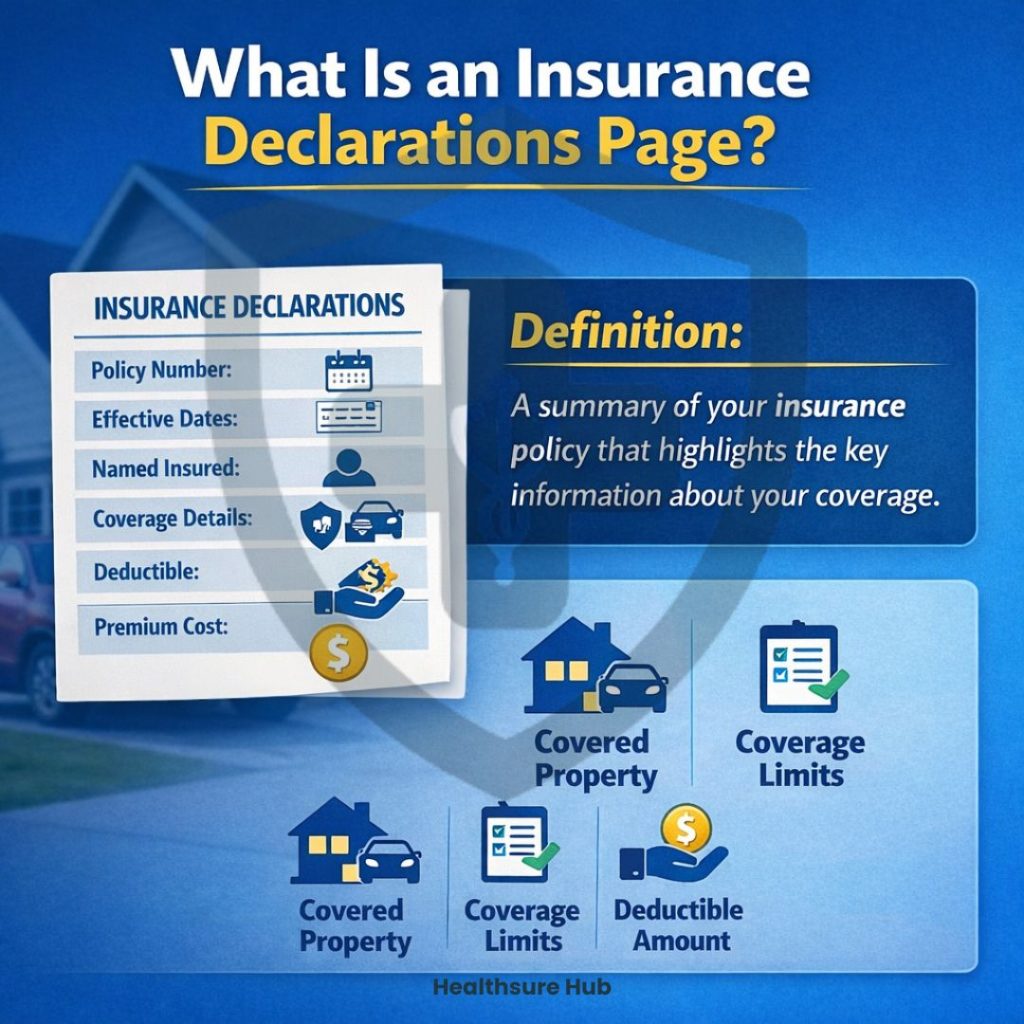
Understanding what is an insurance declarations page also means knowing exactly what information it contains. An insurance declarations page contains structured and essential data about your policy. While the exact layout may vary depending on the insurer, the core components remain consistent across most policies. It typically includes:
- Policy number and effective dates – identifies your policy and specifies the exact start and end dates of your coverage, helping you confirm when protection is active.
- Named insured(s) – lists all individuals or entities covered under the policy, ensuring you know exactly who is protected.
- Covered property or insured risks – describes what is protected, such as a home, vehicle, or individual(s), along with the specific risks included (e.g., liability, collision, medical).
- Coverage types and limits – breaks down each type of coverage and the maximum amount your insurer will pay for a covered claim.
- Deductibles – indicates the amount you are responsible for paying out of pocket before your insurance coverage begins.
- Premium details – outlines the cost of your policy, including payment amounts, billing frequency, and total premiums.
- Endorsements or riders – lists any optional add-ons or policy modifications that expand, restrict, or customize your coverage.
- Mortgagee or lienholder information (if applicable) – identifies any lender with a financial interest in the insured property, typically required for homes or financed vehicles.
- Insurance company and agent contact details – provides essential contact information so you can easily reach your insurer or representative for claims or support.
If applicable, you may also see mortgage lenders or lienholders listed, particularly for homeowners or auto insurance. Lastly, the page provides contact details for your insurance company or agent, ensuring you can quickly reach support when needed. All of these elements help answer what is an insurance declarations page in a practical and comprehensive way.
Insurance Declarations Page Example
To fully grasp what is an insurance declarations page, it helps to look at a real-world scenario. Imagine reviewing a homeowners insurance declarations page. At the top, you’ll see your policy number along with the effective and expiration dates, confirming your coverage period.
Your name and address appear as the named insured, followed by key details like dwelling coverage (the amount to rebuild your home), such as $300,000. Next, you’ll see sections for personal property coverage and liability coverage, each with its own limit that defines the maximum payout. The deductible shows how much you must pay out of pocket before insurance applies, for example, $1,000.
Finally, the premium section outlines the total cost of your policy, giving a clear summary of what you pay for coverage.
How to Get Your Insurance Declarations Page
Insurance companies typically provide your declarations page when you purchase or renew a policy. You can access it through email, your online account, or by contacting your insurance agent.
Many insurers also offer digital access through online portals, allowing you to download your declarations page instantly. This makes it easier to keep your documentation organized and readily available.
Insurance Declarations Page by Type
Auto Insurance Declarations Page
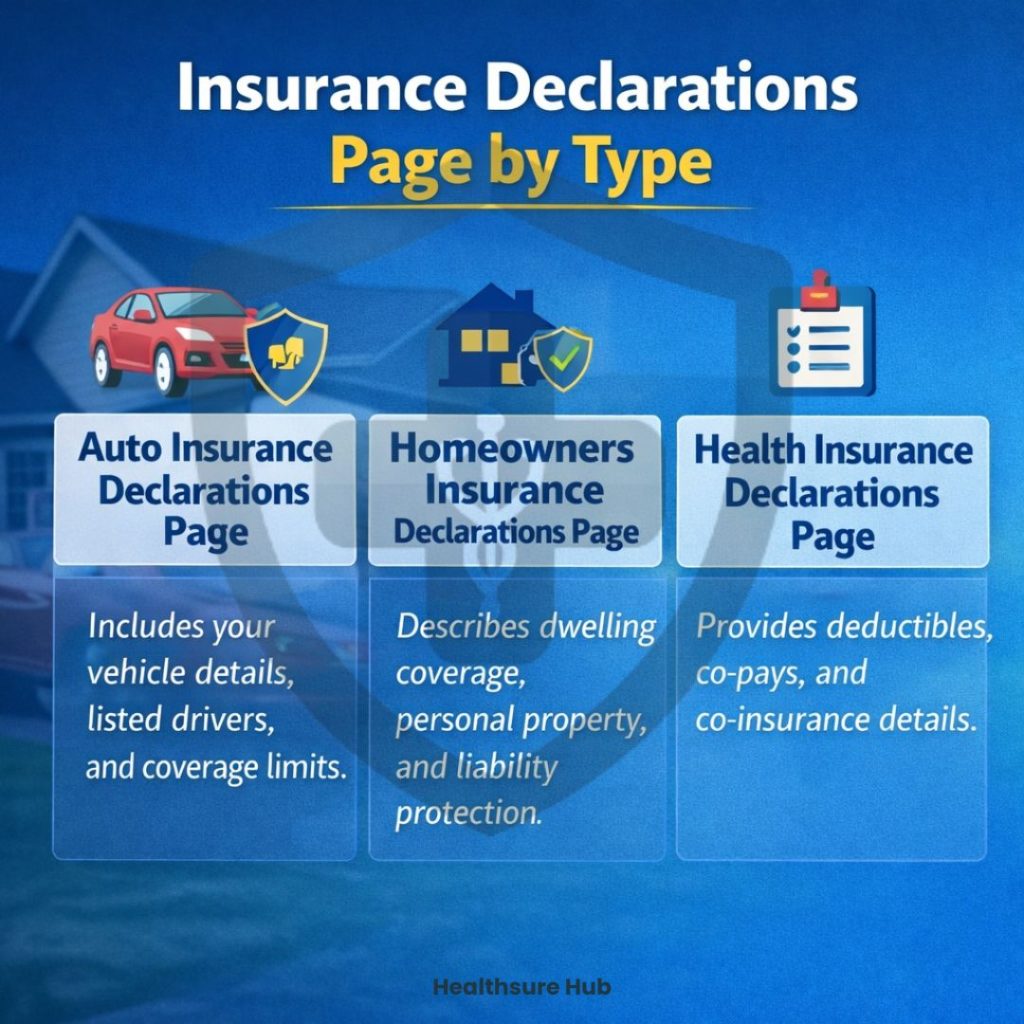
When discussing what is an insurance declarations page, it is helpful to understand how it applies to different types of insurance. An auto insurance declarations page focuses on the details of your vehicle coverage. It includes information such as the listed drivers, vehicle details including the VIN, and the types of coverage selected.
Coverage limits for liability, collision, and comprehensive protection are also clearly outlined, reinforcing the purpose of auto insurance in protecting both your vehicle and financial liability.
Homeowners Insurance Declarations Page
At the homeowners insurance declarations page, you’ll find your homeowners insurance policy number, effective date and expiration date, address of the insured property and the co-applicant covered by your home insurance policy. It includes dwelling coverage or a homeowners insurance coverage, which protects the structure itself, as well as personal property coverage for your belongings.
Liability coverage is also included, offering protection in case someone is injured on your property. If your home is financed, the mortgage lender will often be listed, as they have a financial interest in the property.
This type of declarations page may also clarify whether your policy uses actual cash value or replacement cost, which significantly affects how claims are paid.
Health Insurance Declarations Page
A health insurance declarations page, often referred to as a summary of benefits and coverage (SBC), provides a detailed overview of your medical coverage. It includes deductibles, co-pays, and co-insurance details that determine your out-of-pocket costs.
Unlike auto or home insurance, health insurance declarations pages can be more complex due to the range of services and coverage levels involved. Understanding this format is essential when learning what is an insurance declarations page, especially for managing healthcare expenses effectively.
Why the Insurance Declarations Page Is Important
The insurance declarations page plays a crucial role in confirming your coverage. It helps you verify that your policy includes the protections you expect and ensures that your personal information is accurate.
This document is also essential during the claims process, as it provides quick access to key policy details. In many cases, it helps you identify coverage gaps before they become a financial issue. Because of this, reviewing your declarations page regularly supports better financial planning and risk management.
Common Mistakes to Avoid When Reviewing Your Dec Page
Even after learning what is an insurance declarations page, many policyholders still overlook critical details. Many policyholders overlook important details when reviewing their insurance declarations page. One common mistake is failing to check coverage limits, which can lead to insufficient protection during a claim.
Another issue arises when individuals ignore exclusions that may not be listed on the declarations page but exist within the full policy. Additionally, incorrect personal information or missing endorsements can affect your coverage.
It is also important to confirm your deductible and ensure that all applied discounts are accurately reflected. Overlooking these details can lead to unexpected costs or reduced benefits.
Insurance Declarations Page vs Full Policy
To fully understand what is an insurance declarations page, it is important to compare it with the full policy. The insurance declarations page is a summary, while the full policy is a complete legal document. The declarations page highlights the key components of your coverage, while the full policy outlines the terms, conditions, and exclusions.
Exclusions, in particular, are typically found in the full policy and not on the declarations page. Understanding both documents together gives you a complete picture of your insurance protection and helps you avoid gaps in coverage.
Conclusion
Now that you understand what is an insurance declarations page, it becomes much easier to manage your coverage with clarity and confidence.
Reviewing this page regularly ensures that your coverage remains accurate and aligned with your needs. By understanding how to read and interpret your declarations page, you gain better control over your insurance decisions and overall financial protection.
About the Author