If you’ve spent any time in property and casualty insurance, you’ve probably heard clients (and sometimes even new staff) use insurance binder and policy interchangeably. They’re not the same, and misunderstanding the difference can lead to serious coverage issues, compliance headaches, and unhappy clients.
At a glance, both documents confirm insurance coverage. But the timing, legal weight, and practical use of each are very different. Let’s break it down in a way that actually reflects how these documents show up in day-to-day operations and help you understand the difference between insurance binder vs policy.
What Is an Insurance Binder?
An insurance binder is a temporary proof of coverage issued before the formal policy is finalized. It essentially says: “Coverage is in place, details to follow.” Binders are most commonly used when there’s urgency. Think real estate closings, commercial deals, or situations where a client needs immediate proof of insurance to move forward.
- A typical binder includes:
- Named insured
- Coverage types and limits
- Effective date
- Insurance company
- Basic terms and conditions
But here’s the key point: it’s not the full contract. According to Accenture research, insurers that use intelligent automation and digital workflows can significantly improve underwriting and policy administration speed, enabling faster turnaround times and making it possible to issue binders while the full policy is still being completed.
Why binders exist
In practice, underwriting and policy issuance take time, as insurers must review applications, verify risk details, and finalize terms before issuing the formal contract. During this period, temporary coverage is often provided through a binder until the policy is completed. That gap is exactly where binders come in as they allow business to proceed without waiting for the full policy.

What Is an Insurance Policy?
The insurance policy is the official, legally binding contract between the insurer and the insured. It contains the full terms, conditions, exclusions, endorsements, and obligations.
Unlike a binder, a policy is comprehensive and structured. It typically includes:
- Declarations page
- Insuring agreement
- Conditions
- Exclusions
- Endorsements and riders
This is the document that ultimately governs claims, disputes, and compliance.
Why the distinction matters
From a legal standpoint in the insurance binder vs policy context, the policy is the final authority. If there’s ever a disagreement about coverage, the policy, and not the binder, controls the outcome, unless the binder explicitly states otherwise and is still in force.
Insurance Binder vs Policy: Side-by-Side Comparison
Understanding the difference becomes clearer when you look at how each functions in real workflows.
| Insurance Binder | Insurance Policy |
| Temporary document | Permanent contract |
| Issued quickly (often same day) | Issued after underwriting completion |
| Provides proof of coverage | Full legal documentation |
| Limited detail | Detailed terms and conditions |
| Expires (usually within 30–90 days) | Remains active until cancellation or expiration |
In short: the binder gets things moving, while the policy defines everything.
When Is an Insurance Binder Used?
Binders show up most often in time-sensitive transactions. If you work in commercial lines or real estate-heavy accounts, you’ll see them frequently. Common scenarios include:
1. Real Estate Closings
Mortgage lenders typically require proof of insurance before closing. A binder satisfies that requirement when the full policy isn’t ready yet.
2. Commercial Coverage Placement
Businesses may need immediate coverage to begin operations, sign contracts, or meet regulatory requirements.
3. Policy Renewals with Delays
Sometimes renewals are bound before updated policy documents are issued, especially in complex accounts.
4. High-Risk or Custom Policies
When underwriting takes longer, a binder ensures coverage is active during evaluation.
How Long Does a Binder Last?
In the insurance binder vs policy context, binders are not meant to stick around. Most expire within 30 days, though some can extend to 60 or 90 days depending on the insurer and jurisdiction. Some states even regulate binder duration. This is where operational risk creeps in. If the policy isn’t issued before the binder expires, and no extension is granted, you may be dealing with a coverage gap.
Common Mistakes Agents and Brokers Make
Even experienced professionals run into issues with binders. The mistakes are usually small, but the consequences aren’t.
1. Treating the binder as the final document
It’s easy to assume coverage details won’t change. But once underwriting completes, the issued policy may differ.
2. Not tracking binder expiration dates
This is a big one. Without proper follow-up, binders can lapse unnoticed.
3. Overlooking missing endorsements
Binders often don’t include every endorsement. If a client assumes broader coverage than what’s ultimately issued, disputes can follow.
4. Poor documentation in files
If a claim arises during the binder period, incomplete records can complicate things quickly.
Real-World Example: Where Things Go Wrong
Let’s say a commercial client binds property coverage before opening a new location. The binder reflects general coverage, but doesn’t detail a specific exclusion that later appears in the final policy. A loss occurs during the binder period. Now you’re in a gray area:
- Does the binder imply broader coverage?
- Does the eventual policy wording apply retroactively?
Situations like this can escalate into disputes between insurers, brokers, and clients. That’s why clarity at the binder stage matters more than many people realize.
Compliance and Legal Considerations
From a compliance standpoint in the insurance binder vs policy context, both documents carry weight but in different ways. Binders are recognized as valid proof of insurance, but they must be accurate and not misleading. Misrepresentation at this stage can expose agencies to E&O claims. Policies, on the other hand, must meet all regulatory requirements, including:
- Proper disclosures
- State-specific language
- Approved forms and filings
According to McKinsey & Company, administrative and operational inefficiencies, particularly in underwriting and policy servicing, represent a significant cost burden for insurers, with substantial room for automation and process improvement. This reinforces how important it is to manage the transition from binder to policy correctly.
Best Practices for Handling Binders and Policies
If you’re working in an agency, brokerage, or back-office role, tightening up your process around binders can save time, and prevent problems.
Document Binder Details Clearly
Start with solid documentation. Every binder should capture key details like coverage limits, effective dates, carriers, and any special terms. Relying on assumptions or incomplete notes at this stage often leads to confusion later, especially if a claim happens before the policy is issued.
Track Expiration Dates Proactively
Binders are temporary, so staying on top of expiration dates is critical. Without a system in place, it’s easy for a binder to lapse and create a coverage gap. Using your agency management system or simple reminders helps ensure policies are issued, or extended, on time.
Communicate with Clients Early
Many clients don’t fully understand what a binder represents. They may assume it’s the final policy. Setting expectations early and explaining that coverage is temporary and subject to change can prevent misunderstandings and build trust.
Review the Issued Policy Carefully
Once the policy is issued, take time to compare it with the binder. This step helps catch discrepancies in limits, deductibles, or terms before they become bigger problems.
Confirm Endorsements and Exclusions
Endorsements and exclusions often aren’t fully detailed in the binder, but they can significantly impact coverage. Reviewing these carefully, especially for complex commercial accounts, ensures everything aligns with what was intended.
Insurance Binder vs Policy in Claims Situations
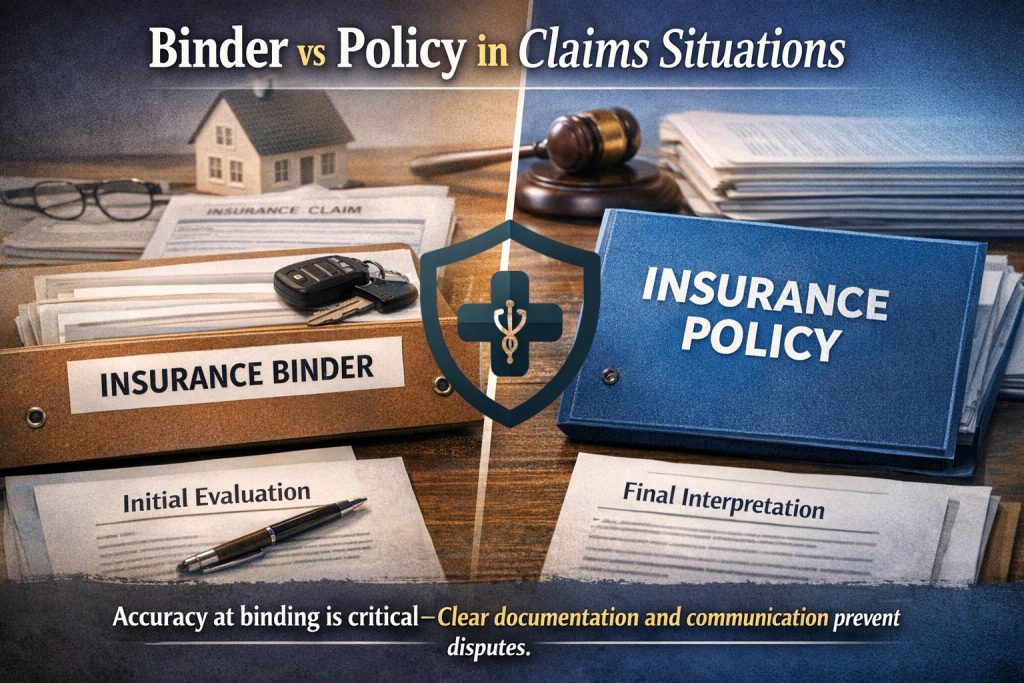
Claims that occur during the binder period can be tricky, but they’re not uncommon. When a valid binder is in place, coverage typically applies, with the binder’s terms guiding the initial evaluation. However, the final policy may still influence how coverage is interpreted, especially if there are differences between what was bound and what was issued.
This is why accuracy at binding is critical, any ambiguity can delay claims handling or lead to disputes. Clear documentation and communication at this stage can prevent most of these issues before they arise.
Why This Distinction Matters More Than Ever
In the insurance binder vs policy context, with faster digital quoting and binding processes, it’s easier than ever to issue coverage quickly. However, that speed also increases the risk of overlooking important details. At the same time, clients expect immediate proof of insurance, especially in commercial settings where timing can directly impact contracts, operations, or closing deals.
This combination puts more pressure on agents and back-office teams to get everything right from the start, from binding coverage correctly and documenting it thoroughly to ensuring a smooth transition into the final policy without discrepancies. Ultimately, the gap between binder and policy may seem small, but it remains one of the most important areas to manage carefully in the insurance workflow.
Final Thoughts
The difference between an insurance binder vs policy isn’t just technical, it’s practical. One keeps business moving; the other defines the rules of the game. If you treat binders as placeholders instead of critical documents, you’re leaving room for errors.
But if you manage them carefully, they become a powerful tool for delivering fast, reliable service without compromising accuracy. For agents, brokers, and operations teams, the goal is simple: Make the transition from binder to policy seamless, documented, and predictable. That’s where professionalism, and trust, really show.
About the Author