Before you sign any contract, there’s one detail that can quietly determine whether you’re protected or exposed: the difference between insurance endorsement vs certificate. Many professionals assume these documents mean the same thing, until a claim proves otherwise.
In reality, they serve very different legal purposes, and confusing them can leave serious gaps in coverage. Knowing how each works doesn’t just sharpen your risk awareness; it gives you the power to confirm real protection, negotiate stronger terms, and avoid costly surprises when it matters most.
The Key Distinction Between Insurance Endorsement vs Certificate
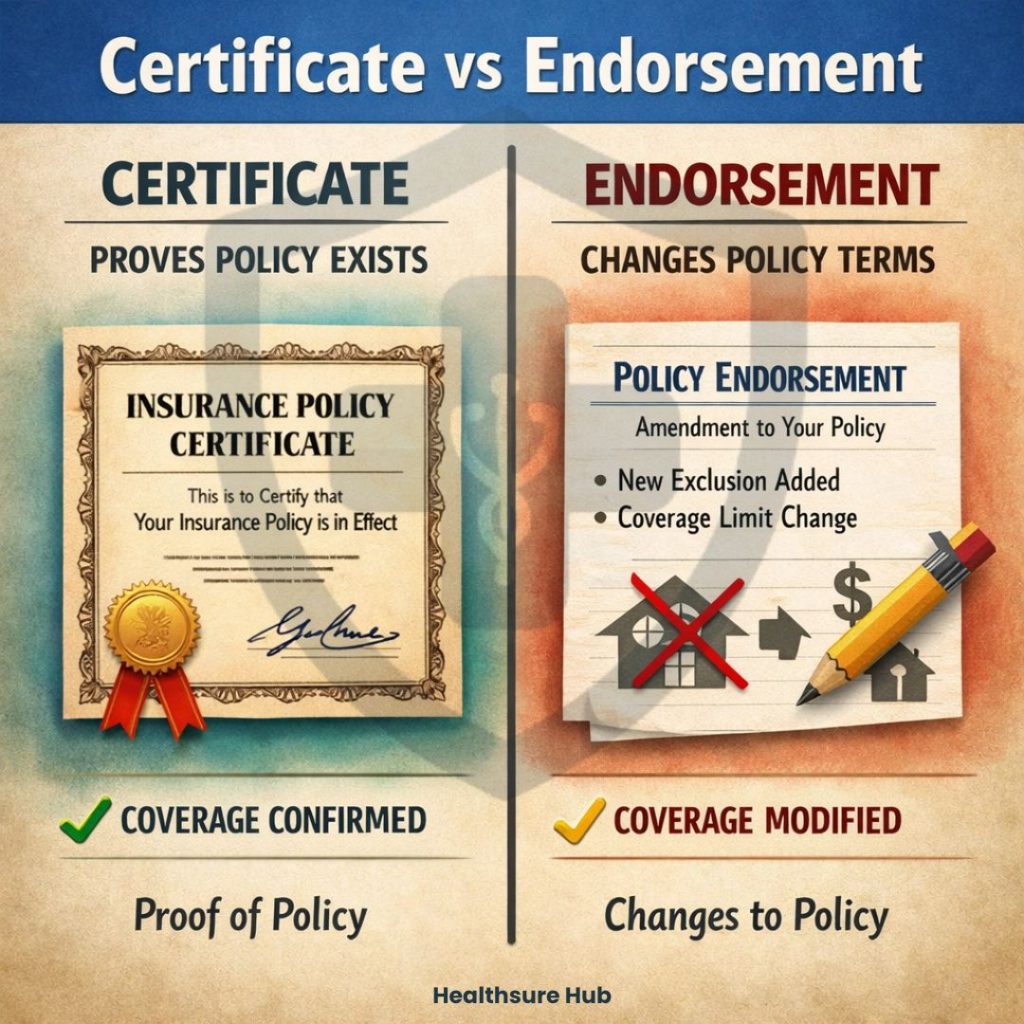
The difference between insurance endorsement vs certificate is straightforward yet powerful: a certificate proves a policy exists, while an endorsement changes what that policy covers. This distinction matters because proof of coverage does not equal legal protection. A certificate confirms information, but an endorsement modifies rights. When you recognize that contrast, you can immediately determine which document actually protects your interests in a contractual relationship.
What a Certificate of Insurance Represents in Insurance Endorsement vs Certificate
A certificate of insurance (COI) functions as written confirmation that a policy was issued and active on a specific date. It is typically produced using standardized forms developed by organizations such as ACORD, which promotes consistency across insurers and industries. Because of this standardized structure, certificates are easy to review and widely accepted as proof of coverage.
Purpose and Function Within Insurance Endorsement vs Certificate
Within the insurance endorsement vs certificate comparison, a certificate serves an administrative role rather than a contractual one. It is issued by an insurer or broker to summarize policy details, and it reflects coverage only at the moment it is generated. This snapshot quality makes certificates useful for verification, vendor onboarding, and compliance tracking. Businesses appreciate certificates because they quickly confirm whether a third party carries required insurance types and limits.
Information Included in a Certificate
Certificates typically list the insured party’s legal name, policy numbers, effective dates, coverage categories, liability limits, and certificate holder. Each element provides meaningful verification. Names confirm the insured entity matches the contracting party. Policy numbers allow validation with carriers. Effective dates show whether coverage applies during the project timeline. Coverage types clarify which risks are insured, while limits indicate the financial scope of protection. The certificate holder field identifies who requested proof, which helps track compliance but does not grant policy rights.
What COI Includes
A Certificate of Insurance (COI) is a document that summarizes key details of an insurance policy and proves that coverage exists. It includes the:
- Policyholder’s name
- The insurance company
- Policy number
- Effective and expiration dates
- Types of coverage (general liability, workers’ compensation, auto)
- Policy limits
Finally, it names the certificate holder, usually the client or contracting party requesting proof of insurance, though being listed does not make them an insured party.
In short, a COI is a snapshot of coverage that helps verify a contractor or vendor has insurance, but it does not change the policy, guarantee claims, or create new legal rights, for that, an endorsement is required.
What a Certificate Does Not Do
A certificate does not alter coverage, grant legal rights, guarantee claim payment, or override policy wording. This limitation defines the entire insurance endorsement vs certificate distinction. Courts consistently interpret certificates as informational documents rather than enforceable contracts. Even when a certificate appears to promise certain protections, the underlying policy always controls. Understanding this principle gives you clarity and prevents reliance on documentation that cannot legally defend you.
What an Insurance Endorsement Means
An endorsement is a formal amendment attached to an insurance policy that changes its terms. In the insurance endorsement vs certificate comparison, endorsements carry legal authority because they become part of the contract itself. Insurers file endorsement forms with regulators, often using templates created by Insurance Services Office, which ensures standardized legal language across policies.
Legal Definition of Insurance Endorsement
Legally, an endorsement modifies the original agreement between insurer and insured. Because it alters contractual obligations, it can add coverage, remove coverage, or redefine responsibilities. This contractual status makes endorsements enforceable during disputes and claims.
Types of Endorsements and Their Practical Impact
Common endorsements illustrate how powerful these documents are. An additional insured endorsement extends coverage to another party, which means that party may receive defense and indemnity under the policy. A waiver of subrogation endorsement prevents insurers from pursuing reimbursement from certain parties after paying a claim, which can protect business partners. A primary and non-contributory endorsement ensures one policy responds before another, shaping claim priority. Limit increase endorsements expand financial protection, while exclusion endorsements remove specific risks. Endorsements can expand liability coverage in ways similar to an umbrella policy, which protects beyond standard limits. Each example demonstrates that endorsements actively shape coverage rather than merely describing it.
Why Insurers Treat Endorsements Differently Than Certificates
Insurers treat endorsements as binding because they affect underwriting risk, pricing, and claim obligations. A certificate does not change exposure, but an endorsement does. Claims adjusters review endorsements carefully because those documents define who is insured, when coverage applies, and how losses are paid. This distinction reinforces why endorsements carry legal weight while certificates remain informational.
Legal Status Comparison of Insurance Endorsement vs Certificate
| Factor | Certificate | Endorsement |
| Binding legal effect | Informational only | Contractually binding |
| Changes policy | No | Yes |
| Accepted as coverage proof in court | Limited | Strong |
| Recognized during claims | Reference only | Governing document |
| Creates coverage rights | No | Yes |
Each row highlights a crucial difference. Binding effect determines whether a document can be enforced. Policy changes define whether coverage is altered. Court recognition influences dispute outcomes. Claims recognition dictates which document adjusters rely on. Coverage rights ultimately decide who receives protection. Together, these factors clearly show that endorsements provide legal power while certificates provide confirmation.
When You Need a Certificate or Endorsement
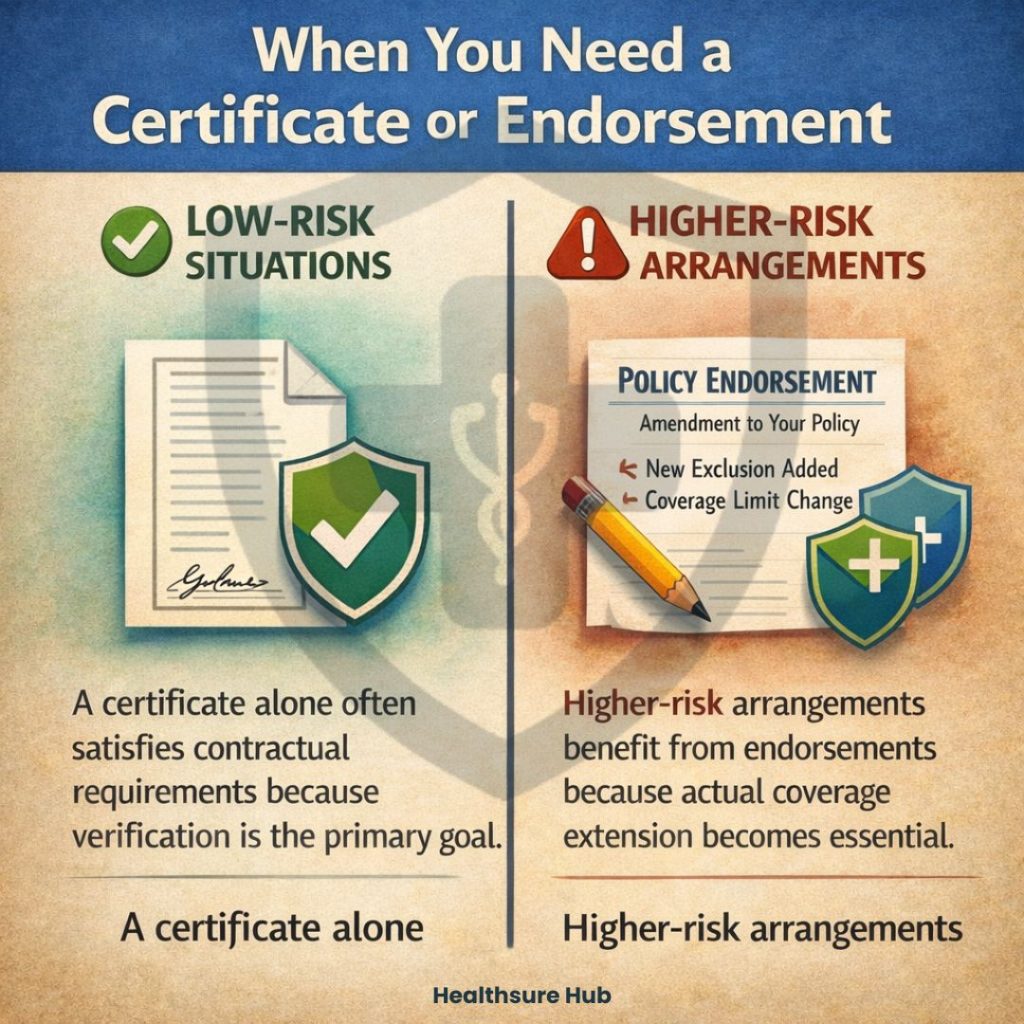
In low-risk situations, a certificate alone often satisfies contractual requirements because verification is the primary goal. Short-term consulting projects, minor vendor services, and low-exposure engagements usually fall into this category. In these contexts, proof of existing insurance is sufficient reassurance.
Higher-risk arrangements benefit from endorsements because actual coverage extension becomes essential. Construction projects, subcontracting relationships, property access agreements, and high-liability operations involve greater exposure, so contractual partners typically require endorsements naming them as insured parties. This requirement ensures that if a claim occurs, coverage applies directly rather than indirectly.
Common Endorsement vs Certificate Errors
Many professionals confidently rely on certificates because they appear official, yet this confidence sometimes rests on misconceptions. A certificate does not guarantee coverage because policies can be canceled or modified after issuance. Being listed as a certificate holder does not provide insured status because that designation only identifies who received proof. Certificates do not transfer liability because liability transfer requires contractual language and often endorsements. Endorsements are not optional paperwork because they define legal obligations. Recognizing these truths strengthens decision-making and prevents avoidable disputes.
How to Review Insurance Documents Confidently
Reviewing a certificate effectively begins with verifying that the insured name matches the contracting entity exactly. Next, confirm policy dates align with the contract term, and ensure limits meet contractual requirements. Contact the insurer if verification is necessary because direct confirmation increases reliability.
Reviewing an endorsement involves deeper analysis. Confirm that all required parties are correctly named, check that the policy number matches the certificate, verify the endorsement form identifier, confirm effective dates, and ensure the document is authorized by the insurer. Each step strengthens certainty that coverage truly exists as intended.
Why Both Documents Matter
Many agreements request both certificates and endorsements because each serves a distinct function. Certificates verify that insurance exists and meets baseline requirements. Endorsements ensure that coverage actually extends to the contracting party. Using both documents together creates layered assurance. Verification confirms the policy is active, while modification guarantees the policy protects the correct parties. This dual-document approach reflects best practices in risk management and contract drafting.
Conclusion
The comparison between insurance endorsement vs certificate ultimately comes down to function and authority. Certificates communicate information, while endorsements create protection. Professionals who understand this rule approach contracts with clarity, confidence, and stronger negotiating power. When you consistently verify certificates and secure necessary endorsements, you build agreements that are not only compliant but also genuinely protective.
About the Author