In medical coding, patient history plays a major role in how providers document risk factors, ongoing monitoring, and follow-up care. Many healthcare visits are influenced not only by current symptoms, but also by a patient’s previous medical conditions that may still affect treatment decisions. Even when a past condition is no longer active, it may still be clinically relevant for future care. That is where history-related ICD-10 codes become important.
At Healthsure Hub, we break down commonly used ICD-10 codes that appear in real-world billing and documentation. Understanding ICD-10 Code Z87.898 helps coders and providers maintain accurate medical records, support claim clarity, and properly document relevant patient history.
What Is ICD-10 Code Z87.898?
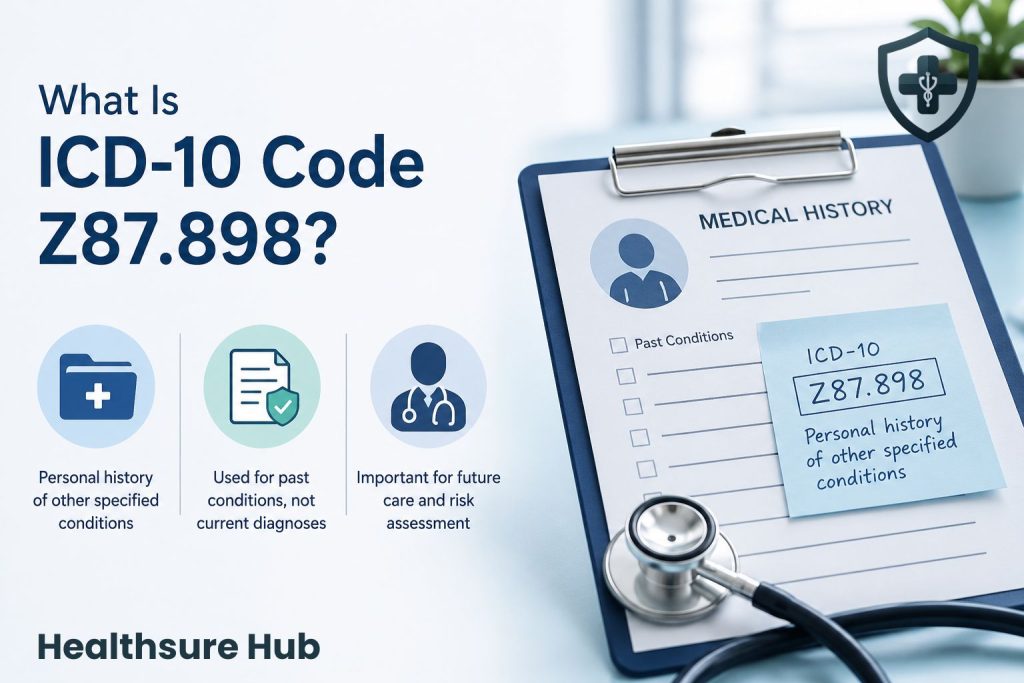
ICD-10 Code Z87.898 is defined as the personal history of other specified conditions. This code is used when a patient has a documented history of a medical condition that is no longer active, but still important enough to be included in the record.
Medical history plays a major role in diagnosis. Research shows that patient history alone contributes to diagnosis in about 80% of clinical cases, meaning that the information gathered from a patient’s past conditions often guides accurate clinical decision-making before tests or exams are even considered.
Z87.898 is used when a past condition doesn’t fit a more specific personal history code. It documents prior conditions that may still affect future care or risk. Unlike active or symptom codes, it is strictly used for medical history, not current diagnoses.
Where Z87.898 Fits in the ICD-10-CM System
Z87.898 is part of the Z87 category, which includes codes for personal history of other diseases and conditions. These codes are used to reflect past health problems that may impact patient care, even if they are not currently present.
Z codes are common in primary care, specialist visits, outpatient settings, and hospital encounters. They support accurate clinical documentation and help paint a complete picture of a patient’s overall health background.
Z87.898 is especially useful when the patient’s past condition affects medical decision-making, monitoring needs, or future screening recommendations.
Breaking Down the Meaning of Z87.898
The code structure provides insight into its purpose:
- Z indicates a factor influencing health status or contact with health services
- 87 refers to personal history of other diseases and conditions
- .898 specifies other personal history conditions not classified elsewhere
This code is essentially used when a patient has a history of a condition that is relevant, but not specifically named under another Z87 code.
Common Situations Where ICD-10 Z87.898 Is Used
ICD-10 code Z87.898 may be used in many real-world clinical scenarios, including:
- History of a resolved condition that still impacts ongoing monitoring
- Past medical issues that influence medication selection or treatment decisions
- Prior infections or medical events that are no longer active but documented as relevant
- Previous conditions that increase risk for future complications
- Follow-up visits where history is a key part of the encounter
For example, a provider may document a personal history of a condition that increases the likelihood of fatigue, chronic symptoms, or recurrent complications. In those cases, Z87.898 may be appropriate if no specific personal history code exists.
This code is also useful when a patient’s past history supports clinical context for current complaints like weakness, shortness of breath, or chest discomfort, which may involve codes such as R07.89 depending on the current presentation.
Z87.898 vs. Active Condition Codes
A common coding mistake is using Z87.898 when the condition is still active. Z87.898 should only be assigned when the condition is resolved or no longer being treated as active, but remains part of the patient’s history.
If the condition is ongoing, recurring, or currently being evaluated, the active diagnosis code should be used instead. The provider’s documentation must clearly support that the condition is historical rather than current.
Z87.898 vs. Other Personal History Z Codes
Z87.898 is often used when a patient has a medical history that does not match a more specific history code. For example, history codes like Z87.891 are reserved for more defined past conditions (such as nicotine dependence history).
However, when documentation indicates a history of a different specified condition that does not have its own dedicated ICD-10 personal history code, Z87.898 may be the best option. The key is ensuring that the medical record clearly identifies the condition as part of the patient’s personal history and confirms that it is not currently active.
Why Accurate Coding Matters for Z87.898
Correct use of ICD-10 code Z87.898 supports better clinical communication and improves long-term medical record accuracy. It ensures that past conditions influencing care decisions are properly documented and not overlooked.
This code can also help providers justify monitoring, follow-up testing, or risk-based decision-making. Accurate history coding improves continuity of care, especially when patients are treated by multiple providers or healthcare systems.
It can also reduce confusion in documentation when symptoms are evaluated in the context of prior conditions. For example, if a patient reports low energy and the provider references a prior medical issue, documentation may overlap with symptom codes such as R53.83 depending on the visit details.
Documentation Elements That Support ICD-10 Code Z87.898
To correctly apply ICD-10 code Z87.898, documentation should clearly show that the condition is historical and relevant.
| Documentation Element | What the Medical Record Should Show | Coding Tip |
| Clear past history statement | Provider documents a previous condition that is no longer active | Must be identified as “history of” |
| Condition is resolved | No active treatment or ongoing diagnosis is documented | Avoid using Z87.898 for current illness |
| Clinical relevance | Past condition affects care decisions, monitoring, or risk | Should support medical necessity |
| No better history code available | Condition does not match a more specific personal history code | Z87.898 is often used as a “catch-all” history code |
| Encounter context supports history use | The history is mentioned as relevant to current care | Helps justify why it is included |
Common Documentation Gaps and Coding Errors
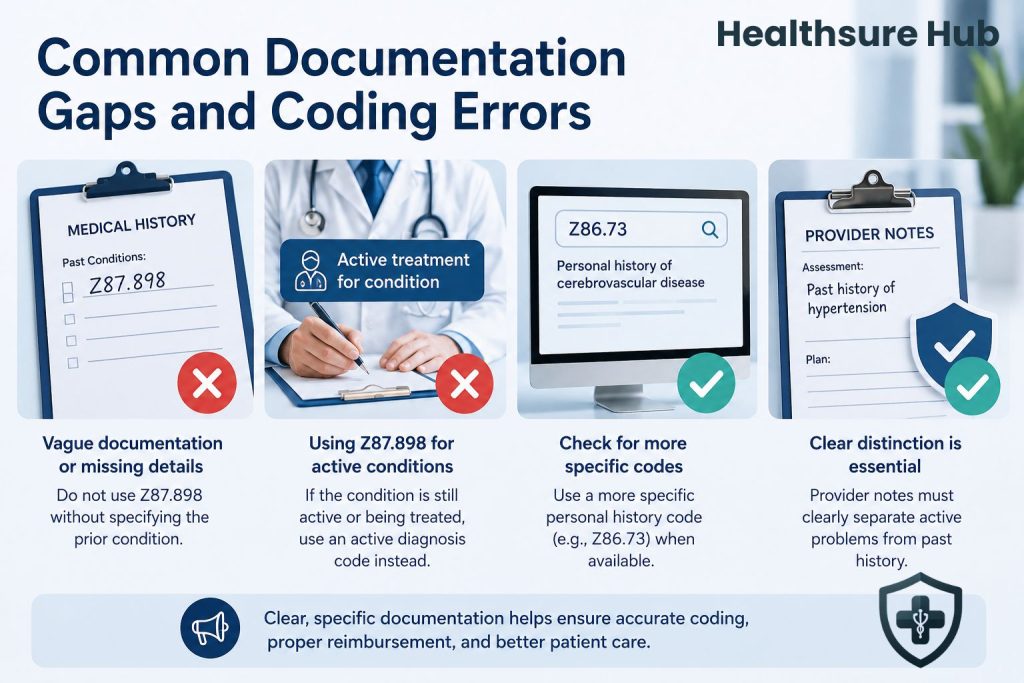
Although ICD-10 code Z87.898 is commonly used, errors can occur when documentation is vague or incomplete. One major issue is assigning ICD-10 code Z87.898 without clearly identifying what the prior condition was. Documentation should specify the condition being referenced, even if it is not currently active.
Another common mistake is using Z87.898 when the patient’s condition is still ongoing or actively being treated. In that case, an active diagnosis code should be reported instead. Coders may also incorrectly use ICD-10 code Z87.898 when a more specific personal history code exists, such as Z86.73, depending on the patient’s documented medical history. Ensuring that provider notes clearly differentiate between active problems and past history is essential for accurate coding.
Conclusion
ICD-10 Code Z87.898 is used to document a patient’s personal history of other specified medical conditions that are no longer active but remain clinically relevant. It plays an important role in helping providers capture key historical details that influence risk assessment, follow-up care, and treatment planning.
For medical coders and healthcare professionals, understanding ICD-10 code Z87.898 supports accurate documentation, strengthens patient record completeness, and improves overall coding consistency across healthcare encounters.
About the Author