Diabetes is one of the most complex conditions to document accurately in medical coding, and the feet are where that complexity concentrates most. Lower extremity complications account for a significant proportion of diabetes-related hospitalization, specialist referrals, and long-term care costs. Yet diabetic foot coding remains one of the areas most prone to errors in clinical settings, ranging from using a nonspecific symptom code when a combination code is available, to failing to link the complication clearly to the underlying diabetic process.
This guide covers the common ICD codes for diabetic foot complications, including ulcers, neuropathy, and Charcot arthropathy, with practical guidance on code selection, sequencing, and the documentation that supports accurate billing.
Why Diabetic Foot Complications Require Precise ICD Coding
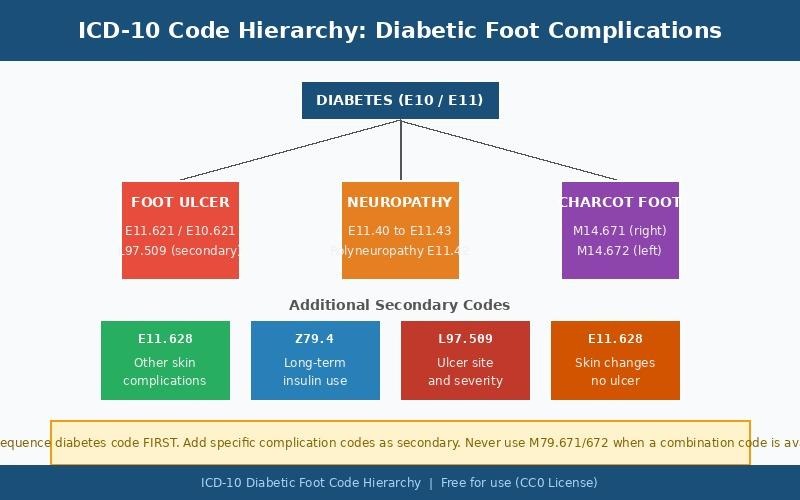
Diabetes does not map to a single ICD-10 code. It generates a hierarchy of combination codes that must accurately reflect the diabetes type, the specific complication, and the anatomical location. The foot is the most frequently coded body region in diabetic complication documentation because of the high prevalence of peripheral neuropathy, vascular compromise, wound ulceration, and Charcot arthropathy in this patient population.
The most common errors in this coding category include selecting a generic foot pain code such as M79.671 or M79.672 when a more specific diabetic complication code is clearly supported by documentation, failing to link the diabetes and its complication through a combination code, and applying incorrect laterality on wound or ulcer codes. Each of these errors can result in claim denials, audit exposure, and a clinical record that does not accurately reflect the patient’s condition or care needs.
Accurate diabetic foot coding affects reimbursement, risk adjustment, quality metrics, and the integrity of the longitudinal care record simultaneously.
Common ICD Codes for Diabetic Foot Ulcers
Foot ulcers represent the most serious and most commonly documented diabetic foot complication. Selecting the correct code requires understanding the combination code structure and when additional codes must accompany it.
E11.621
E11.621 refers to Type 2 diabetes mellitus with foot ulcer. This code is used when a foot ulcer is documented as directly attributable to the patient’s Type 2 diabetes. It must always be sequenced with a secondary code from the L97 category to identify the specific ulcer site and severity.
E10.621
E10.621 is the Type 1 equivalent of the above code. The diabetes type must be clearly supported by the clinical documentation. Coders should not default to Type 2 when the record does not specify.
L97.509
L97.509 refers to a non-pressure chronic ulcer of an unspecified part of the foot with unspecified severity. This code is used alongside E11.621 or E10.621 when the precise ulcer location or depth is not documented with sufficient specificity. More precise L97 codes with laterality and staging should be selected whenever the documentation supports them.
E11.628
E11.628 covers Type 2 diabetes mellitus with other skin complications. This code applies when diabetic skin changes such as callus breakdown or pressure-related skin compromise are documented in the foot but do not meet the criteria for a formal ulcer code.
When coding diabetic foot ulcers, it is worth noting that the symptom code for foot pain coding in diabetic patients such as M79.672 is appropriate only when no confirmed diabetic complication has been established at the time of the encounter. Once a complication is documented, the corresponding combination code must be selected instead.
ICD-10 Codes for Diabetic Peripheral Neuropathy With Foot Involvement
Peripheral neuropathy is the most common diabetic complication affecting the feet and one of the most frequently miscoded categories in outpatient practice. Understanding the distinctions between the E11.40 series codes is essential for accurate documentation.
E11.40
E11.40 covers Type 2 diabetes mellitus with diabetic neuropathy, unspecified. This code is used when neuropathy is documented but the specific type is not further clarified in the clinical record.
E11.41
E11.41 refers to Type 2 diabetes mellitus with diabetic mononeuropathy. This applies when a single peripheral nerve in the lower extremity is documented as affected.
E11.42
E11.42 describes Type 2 diabetes mellitus with diabetic polyneuropathy. This is the most frequently used neuropathy code in diabetic foot patients. It applies when multiple peripheral nerves are involved, producing the classic stocking distribution of numbness, tingling, and burning that most diabetic foot patients describe.
E11.43
E11.43 covers Type 2 diabetes mellitus with diabetic autonomic polyneuropathy. This code is applied when autonomic nerve involvement affects foot sweating, temperature regulation, or peripheral vascular function in the lower extremity.
Coding note: When neuropathy is documented alongside a foot ulcer at the same encounter, both the ulcer combination code and the appropriate neuropathy code should be reported together. The ulcer code takes sequencing priority.
Coding Charcot Foot in Diabetic Patients
Charcot foot is one of the most serious diabetic foot complications and one of the most consistently undercoded conditions in this patient group. It is characterised by progressive bone and joint destruction driven by neuropathy, often occurring without significant pain due to the underlying sensory deficit.
M14.671
M14.671 refers to arthropathy in diseases classified elsewhere affecting the right ankle and foot. This is the code used for Charcot arthropathy of the right foot in the context of diabetes. The underlying diabetes code should always be sequenced first.
M14.672
M14.672 is the laterality-specific code for left-sided Charcot foot and ankle involvement.
Charcot foot is frequently undercoded in practice because providers document the deformity and the radiographic findings but do not always explicitly link the arthropathy to the diabetic process in their clinical notes. Coders who identify Charcot foot findings in imaging or examination documentation without that explicit linkage should query the provider before assigning an M14.671 or M14.672 code.
When to Use Symptom Codes vs Complication Codes
This is one of the most practical and frequently misunderstood distinctions in diabetic foot coding.
Symptom codes such as M79.671 for right foot pain or M79.672 for left foot pain are appropriate only when no confirmed diabetic complication has been identified at the time of the encounter and the provider is still evaluating the underlying cause. Once a complication is documented, the appropriate combination code from the E10 or E11 series must be used in place of the symptom code.
For diabetic patients who present with ankle injuries, accurate documentation becomes particularly important. The guidance for ankle injury coding in diabetic patients is relevant here because diabetic patients presenting with ankle injuries may require additional complication codes alongside the injury code when diabetes is a documented contributing factor to delayed healing or increased severity.
The general sequencing principle is that the condition most responsible for the encounter takes priority, with the diabetes and its complications coded as secondary when they are relevant to the management of the primary presenting problem.
Specialist Referral and Its Impact on ICD Code Selection
When a diabetic patient is referred to a podiatrist for a comprehensive foot evaluation, the resulting documentation should actively support the ICD codes being billed across that encounter and any subsequent visits.
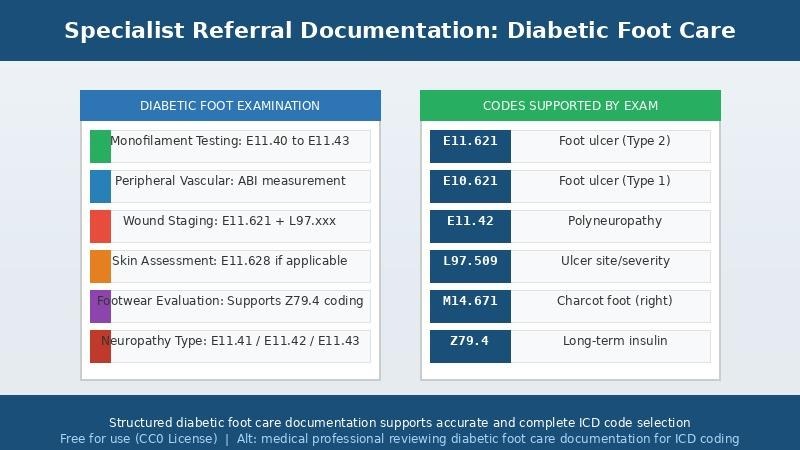
A structured diabetic foot examination typically generates documentation supporting the following:
- E11.40 to E11.43 series for neuropathy type and severity
- E11.621 or E11.628 for skin complications and ulcer staging
- Z79.4 for long-term insulin use where clinically applicable
- Applicable L97 wound staging codes with laterality and depth
Practices offering structured diabetic foot care provide the comprehensive examination documentation covering nerve sensitivity testing, peripheral vascular assessment, wound staging, and footwear evaluation that supports accurate and complete ICD code selection at each encounter. This level of documentation gives coders the specificity they need to move beyond unspecified codes and select the most precise combination codes available.
Quick Coder Checklist: Diabetic Foot Complications
- Diabetes type (Type 1 or Type 2) is clearly documented in the provider note
- The specific foot complication is explicitly linked to the diabetes in the clinical record
- Combination codes are sequenced correctly with the diabetes code taking priority
- Laterality is clearly documented for all wound, ulcer, and neuropathy codes
- L97 secondary codes are added when E11.621 or E10.621 is reported
- Symptom codes such as M79.671 or M79.672 are not used when a specific complication code is supported by documentation
- Charcot foot documentation explicitly links the arthropathy to the underlying diabetic process
- Specialist referral documentation supports the codes selected at each encounter
- Z79.4 is reported when long-term insulin use is documented and clinically relevant
Accurate usage of the common ICD codes for diabetic foot complications depend on understanding the hierarchy of combination codes, the distinction between symptom and complication codes, and the quality of clinical documentation. Coders who understand the progression from diabetic neuropathy and foot ulcers to Charcot arthropathy are better positioned to assign accurate ICD-10 codes, support appropriate reimbursement, and maintain a complete patient care record throughout the diabetic foot care journey.
About the Author