Why do so many claims involving CPT code 99406 get underpaid, denied, or flagged despite being clinically appropriate?
The answer usually isn’t the service itself. It’s how the code is understood, documented, and applied within everyday workflows. At HealthSure Hub, we analyze these patterns closely, helping providers identify where subtle errors or missed details can impact both claim outcomes and financial efficiency.
Overview of CPT Code 99406 in Clinical and Billing Context
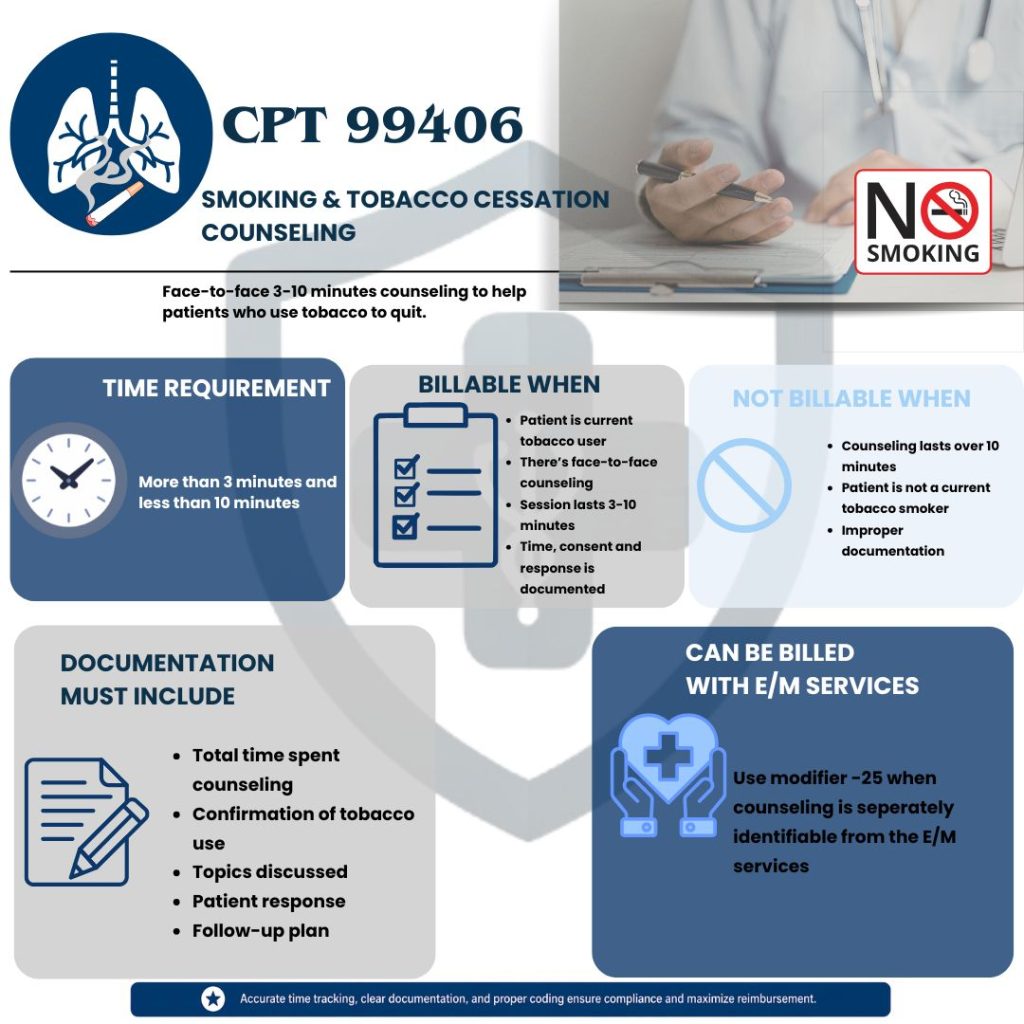
CPT 99406 code represents intermediate smoking and tobacco cessation counseling lasting more than three minutes and up to ten minutes. It applies when a qualified healthcare provider delivers structured, face-to-face counseling to a patient who actively uses tobacco.
Unlike diagnosis systems such as ICD-10-CM, which explain the patient’s condition, 99406 CPT reflects the actual service performed. This distinction is essential because reimbursement depends on clearly demonstrating that a billable service occurred within a defined timeframe.
In real-world settings, CPT 99406 is frequently used during:
- Primary care visits
- Chronic disease management encounters
- Preventive health appointments
This specific CPT code makes it a consistent and valuable addition to outpatient billing strategies.
When CPT 99406 Code Can Be Billed in Routine Encounters
The 99406 CPT code becomes appropriate when a patient is identified as a current tobacco user and receives structured counseling aimed at cessation. Healthcare professionals need to report 99406 if:
- The counseling lasts 3-10 minutes
- The patient is an active tobacco smoker
- The patient underwent a formal counseling session to quit smoking
- The provider documents the time, content, and patient response
If the session lasts more than 10 minutes, a different, more appropriate code should be used in its place such as the CPT code 99407.
Research supported by the American Lung Association shows that even brief interventions significantly increase the likelihood of quit attempts. This impact is reflected in long-term public health trends, with adult smoking rates declining by more than 70% over the past several decades, driven in part by consistent clinical counseling and cessation support efforts.
By incorporating this service into routine encounters, providers create opportunities to deliver meaningful care while capturing appropriate reimbursement.
CPT Code 99406 Compared to CPT code 99407
Understanding the difference between CPT 99406 and CPT 99407 ensures precise coding and optimal reimbursement.
CPT 99406 code applies to counseling sessions lasting between three and ten minutes, while CPT code 99407 is used when counseling exceeds ten minutes. This distinction is critical because time directly determines which code should be reported.
Accurate time tracking allows providers to confidently select the correct code, preventing underbilling or compliance risks while maximizing reimbursement potential.
When CPT Code 99406 Should Not Be Reported in Billing
If counseling lasts less than three minutes, it is considered part of the standard evaluation and management service and cannot be billed separately.
CPT code 99406 also should not be reported if the patient:
- Is not a current tobacco user
- If the documentation does not clearly reflect a structured counseling session.
Simply advising a patient to quit smoking without additional detail does not meet the criteria for this code. Avoiding inappropriate use of CPT code 99406 protects against claim denials and ensures compliance with payer expectations.
Documentation Requirements That Support CPT Code 99406 Claims
Strong documentation is the foundation of successful billing for CPT 99406 code. Every element of the counseling session should be clearly recorded in a way that demonstrates both medical necessity and time-based criteria.
A complete note should include:
- Total time spent counseling
- Confirmation that the patient uses tobacco
- A clear description of what was discussed.
This typically involves outlining the health risks associated with continued tobacco use, assessing readiness to quit, and presenting specific cessation strategies.
Including a follow-up plan strengthens the documentation further by showing continuity of care. This level of detail transforms CPT 99406 code from a simple entry into a defensible and reimbursable service.
Example of Proper Documentation for CPT Code 99406
A strong documentation example helps clarify how CPT 99406 should appear in practice:
“Spent 6 minutes providing smoking cessation counseling. Discussed cardiovascular and pulmonary risks associated with continued tobacco use. Assessed patient readiness to quit and reviewed behavioral strategies along with pharmacologic options. Patient expressed willingness to consider quitting within the next month. Follow-up planned at next visit.”
This type of note clearly supports CPT 99406 code by including time, counseling content, and a forward-looking care plan.
Using CPT Code 99406 With Evaluation and Management Services
CPT code 99406 can be billed alongside an evaluation and management visit when the counseling is separately identifiable from the primary service. In these cases, a modifier such as -25 is typically applied to the E/M code to indicate that the counseling was distinct.
The documentation must clearly separate the counseling from the rest of the visit. This means describing the counseling as an additional, focused service rather than blending it into general clinical discussion.
An important nuance exists when E/M services are billed based on total time. In those situations, the counseling time may already be included, which can limit the ability to report CPT 99406 separately. Understanding this interaction helps maintain compliance and reduces billing errors.
Reimbursement Patterns and Payer Expectations for CPT 99406 Code
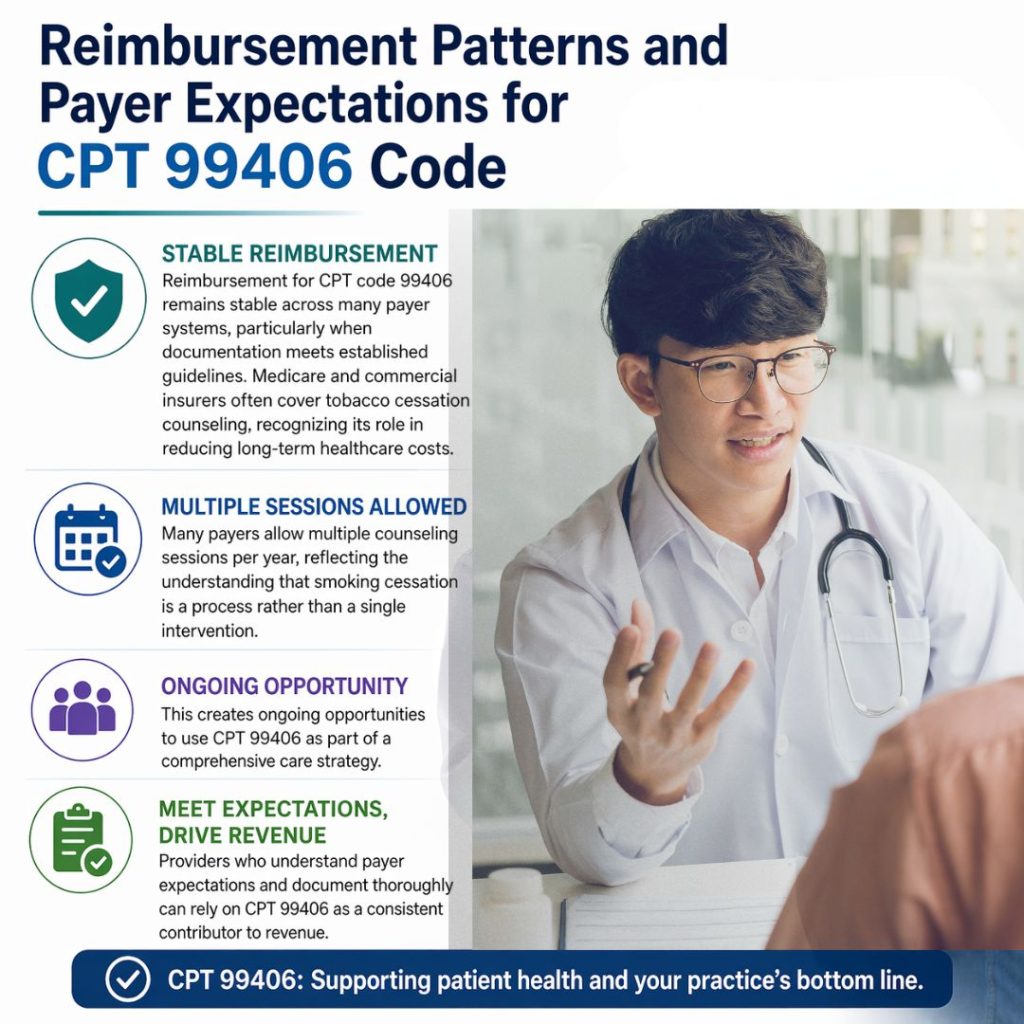
Reimbursement for CPT code 99406 remains stable across many payer systems, particularly when documentation meets established guidelines. Medicare and commercial insurers often cover tobacco cessation counseling, recognizing its role in reducing long-term healthcare costs.
Many payers allow multiple counseling sessions per year, reflecting the understanding that smoking cessation is a process rather than a single intervention. This creates ongoing opportunities to use CPT 99406 as part of a comprehensive care strategy.
Providers who understand payer expectations and document thoroughly can rely on CPT 99406 as a consistent contributor to revenue.
Why CPT 99406 Code Claims Get Denied and How to Prevent It
Claim denials for CPT 99406 often stem from incomplete or unclear documentation. Missing time, insufficient detail about the counseling provided, or unsupported diagnosis codes can all lead to rejection.
In some cases, failing to use the correct modifier when billing with an E/M service can also create issues. Each of these factors highlights the importance of consistency and attention to detail.
Preventing denials starts with structured documentation that clearly supports CPT 99406. Providers who adopt standardized workflows and maintain detailed notes can significantly improve claim approval rates.
Conclusion
CPT code 99406 represents a meaningful intersection between preventive care and accurate billing. When used correctly, it captures the value of structured counseling while supporting broader public health goals.
By focusing on precise documentation, proper coding, and consistent workflows, providers can fully leverage 99406 as a dependable and impactful component of modern healthcare delivery.
About the Author