Imagine experiencing persistent soft tissue pain, swelling, or a noticeable abnormality that doesn’t quite match any clear diagnosis. This situation is more common than many expect, especially in musculoskeletal care where symptoms often overlap and evolve over time. Not every condition fits perfectly into a predefined medical category, and that’s exactly where M79.89 becomes essential. A similar approach is used in other musculoskeletal presentations, such as lower back pain, where symptom-based coding is often applied before a more specific diagnosis is confirmed.
The importance of using M79.89 correctly goes far beyond coding. It directly impacts reimbursement accuracy, strengthens clinical documentation, and supports continuity of care across providers. Here, we provide you with a complete and detailed breakdown of this specific ICD-10 code, including how it’s used, when it applies, and why it plays a key role in both medical and billing workflows.
What Is ICD-10 Code M79.89?
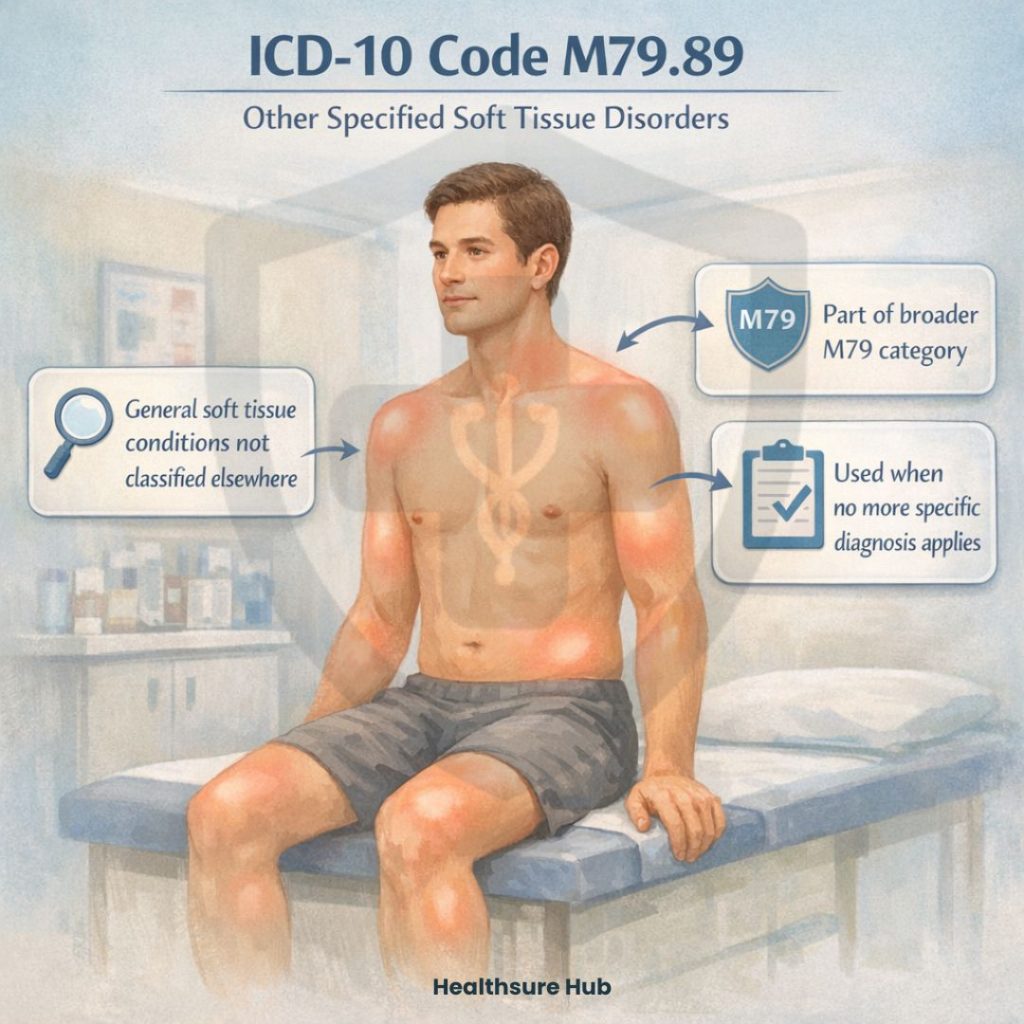
ICD-10 code M79.89 is a billable code to classify other specified soft tissue disorders that do not fall under more specific ICD-10 categories. It belongs to the broader M79 category, which focuses on soft tissue disorders not classified elsewhere.
Clinically, this ICD-10 code applies to conditions affecting muscles, fascia, and connective tissue when those conditions are documented but lack a more precise diagnostic label. This makes the code highly valuable in real-world practice, where not every case presents with textbook clarity.
From a billing perspective, M79.89 serves as a “specified but not otherwise classified” code. Providers use it when they can clearly describe a condition but cannot match it to a more specific ICD-10 code. This distinction is important because it separates the code from vague or unspecified codes, allowing for more accurate claims submission.
Understanding Soft Tissue Disorders in Clinical Practice and Where M79.89 Fits
Soft tissue includes a wide range of structures such as muscles, tendons, ligaments, fascia, and fat. These tissues support movement, stability, and overall physical function, making them highly susceptible to stress, injury, and inflammation.
Soft tissue disorders often develop due to repetitive strain, acute injury, inflammatory processes, or gradual degeneration. In many cases, symptoms appear before a clear diagnosis can be established, which creates a natural gap in classification systems.
Globally, musculoskeletal conditions affect an estimated 1.7 billion people, making them one of the leading contributors to disability. Soft tissue-related complaints represent a large portion of outpatient visits, especially in primary care, orthopedics, and physical medicine.
Within this landscape, this ICD-10 code plays a bridging role. It captures clinically meaningful conditions that fall outside defined categories, ensuring that important patient data is not lost simply because it doesn’t meet strict diagnostic criteria.
M79.89 Used in Real Clinical Scenarios
The use of the code becomes especially relevant when a condition is clearly documented but not fully classifiable. This often happens in early-stage conditions, atypical presentations, or cases where diagnostic testing does not point to a specific disorder.
For example, a patient may present with localized soft tissue swelling that imaging confirms as abnormal, yet no definitive diagnosis such as a tumor or cyst is identified. In another case, a provider may document non-specific connective tissue changes that do not align with known inflammatory or degenerative diseases.
A practical scenario highlights its value. A patient reports persistent thigh discomfort and mild swelling. An MRI reveals soft tissue irregularities without evidence of myositis or a defined lesion. The physician documents a soft tissue disorder with specific characteristics but cannot assign a narrower code. In this case, the ICD-10 code for other specified soft tissue disorders accurately reflects the clinical reality, supporting both documentation and billing integrity.
This reinforces a key requirement: documentation must clearly describe the condition, even if the diagnosis remains broad. This ICD-10 code is not a shortcut but a precise solution for complex cases.
Key Symptoms Associated With Soft Tissue Disorders
Soft tissue disorders often present with symptoms that are noticeable, persistent, and sometimes difficult to pinpoint. These symptoms include localized pain, tenderness, swelling, restricted movement, and muscle stiffness.
The intensity and combination of symptoms can vary significantly depending on the underlying condition. Some patients experience mild discomfort with occasional flare-ups, while others report chronic pain that affects daily function.
Soft tissue pain is a major contributor to global chronic pain statistics, with a substantial percentage of cases linked to musculoskeletal conditions. This makes accurate classification through codes like this specific ICD-10 code even more important, as it helps track patterns and improve long-term care strategies.
Using terms like “soft tissue disorder symptoms” in documentation also supports better clinical communication and enhances the clarity of coding decisions.
ICD-10 Coding Guidelines for M79.89 and How to Use It Correctly
Using this specific ICD-10 code effectively requires a strong understanding of ICD-10 coding principles. The code should only be applied when no more specific alternative exists and when the provider has clearly documented the condition.
Accurate physician notes are essential. They should describe the nature of the soft tissue disorder, its location, and any relevant findings from imaging or examination. This level of detail supports claim approval and reduces the risk of audits.
From a billing standpoint, improper use of the said code can lead to claim denials or delays, especially if payers determine that a more specific code was available.
A practical coder tip improves accuracy: always review related categories before assigning the code to any condition. This step ensures that the code is used appropriately and reinforces compliance with coding standards.
M79.89 vs Similar ICD-10 Codes and Why the Difference Matters
| Code | Description | Key Difference |
| M79.89 | Other specified soft tissue disorders | Condition is specified but not classified elsewhere |
| M79.9 | Soft tissue disorder, unspecified | Lacks detailed documentation |
| M60–M63 | Myositis and muscle disorders | Includes clearly defined inflammatory muscle conditions |
The distinction between “specified” and “unspecified” is critical. This ICD-10 code reflects a higher level of clinical detail, which improves both data quality and reimbursement outcomes.
What Conditions Fall Under M79.89
This ICD-10 code includes a range of soft tissue conditions that are specified but not categorized elsewhere. Polymyalgia is a condition included as part of this specific ICD-10 code. These may involve soft tissue masses without a defined pathology, non-specific inflammation, or atypical fibrous tissue changes.
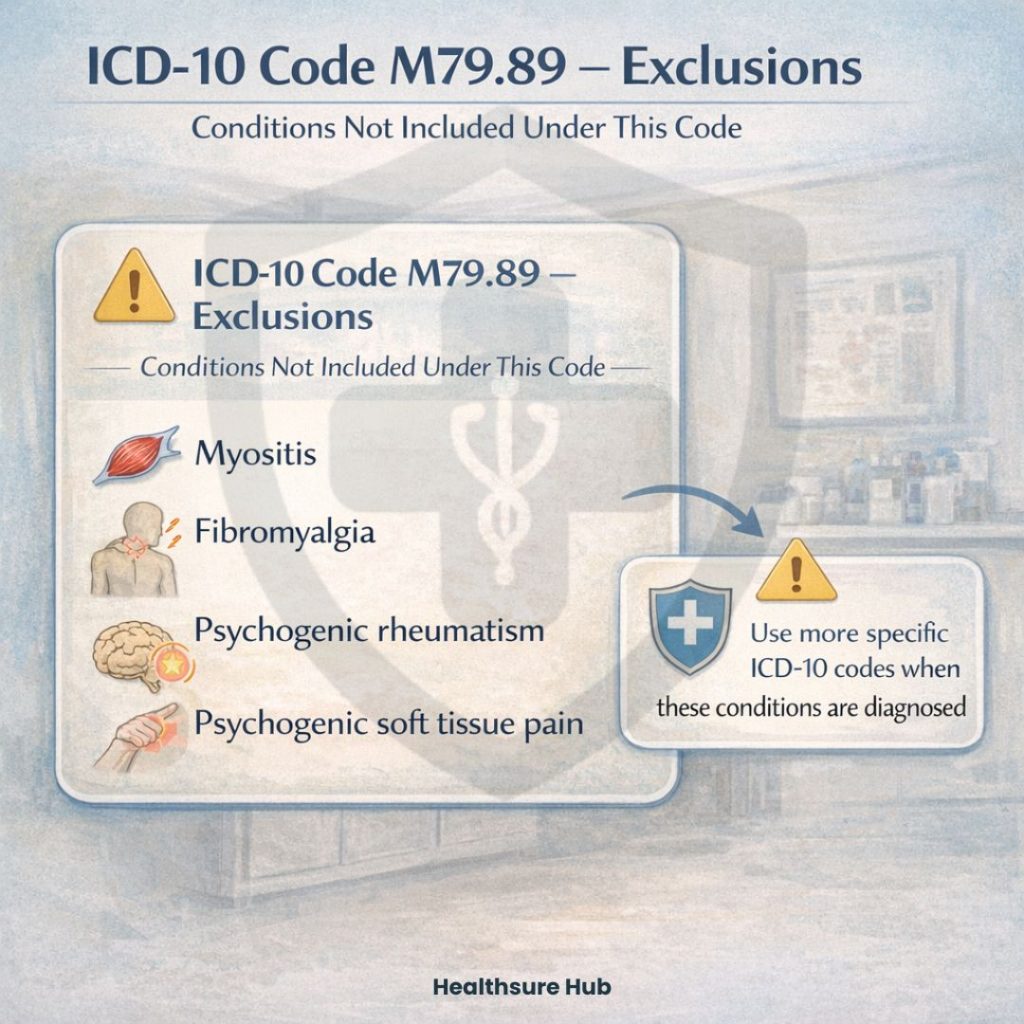
At the same time, it is equally important to understand what the code does not include. This specific code doesn’t include conditions such as:
- Myositis
- Fibromyalgia
- Psychogenic rheumatism
- Psychogenic soft tissue pain
All these have their own dedicated ICD-10 codes and should not be grouped under M79.89 when a clear diagnosis exists.
This distinction highlights a core principle of ICD-10 coding: specificity drives accuracy. Using M79.89 correctly ensures that the condition is neither overgeneralized nor incorrectly categorized, which ultimately improves data quality across healthcare systems.
Accurate Coding With M79.89
Accurate use of this code directly influences both financial performance and patient care. In billing, correct coding ensures that claims are processed efficiently and reimbursed appropriately. In clinical practice, it contributes to reliable health data that supports research and population health insights.
Medical billing errors remain a major challenge in healthcare, contributing to billions of dollars in annual losses globally. Using the said code correctly helps reduce these errors by aligning documentation with billing standards.
Beyond finances, accurate coding enhances communication between providers, ensuring that patient records reflect true clinical findings.
Conclusion
ICD-10 code M79.89 plays a vital role in capturing soft tissue disorders that fall outside traditional classifications. It ensures that clinically valid conditions are documented, coded, and reimbursed accurately, even when they do not fit neatly into predefined categories.
Its value lies in precision without limitation. By bridging the gap between specificity and flexibility, this ICD-10 code supports better documentation, stronger data integrity, and more reliable healthcare outcomes.
When used correctly, this code is not just a fallback option but a strategic tool that reflects the complexity of real-world medicine while maintaining the highest standards of coding accuracy.
About the Author