Accurate clinical documentation and medical coding are essential for patient care, reimbursement accuracy, and healthcare compliance. ICD-10-CM code Z91.14 plays an important role in explaining factors that directly affect treatment outcomes and healthcare decision-making.
At Healthsure Hub, we break down what this ICD-10 code means, when providers should use it, why proper documentation matters, and how accurate coding supports both clinical care and revenue cycle management..
Overview of ICD-10-CM Code Z91.14
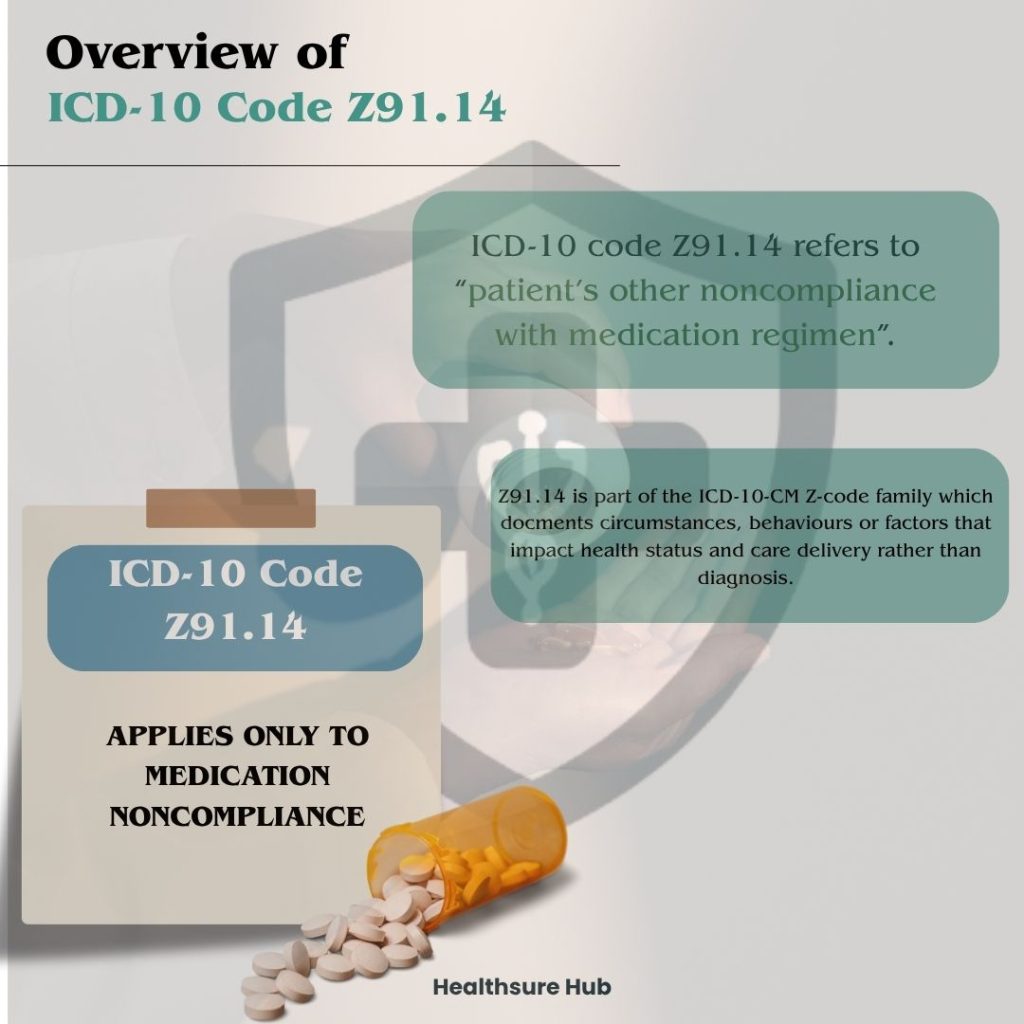
ICD-10 code Z91.14 refers to “patient’s other noncompliance with medication regimen”. It is part of the ICD-10-CM Z-code family, which documents circumstances, behaviors, or factors that impact health status and care delivery rather than diagnoses.
Unlike diagnosis codes that identify medical conditions, this classification documents a behavioral or adherence-related issue that may affect treatment effectiveness. It can help explain why a patient’s condition remains uncontrolled, worsens unexpectedly, or fails to improve despite receiving a prescribed treatment plan.
Importantly, this code applies only to medication noncompliance. It should not be used for missed therapy sessions, dietary noncompliance, or failure to follow other treatment plans unrelated to medications.
Why Medication Noncompliance Matters
Medication adherence remains one of the biggest challenges in healthcare. According to the World Health Organization, adherence rates among patients with chronic illnesses average roughly 50% in developed countries.
When medications are not taken consistently, the consequences can be significant. Research shows that nonadherence contributes to avoidable hospital admissions, emergency visits, and disease progression, leading to substantial and preventable healthcare costs each year.
Because of this, accurate documentation of medication noncompliance is important in everyday clinical practice. It helps providers make better-informed treatment decisions, coordinate care more effectively, and manage chronic conditions in a way that reflects real patient behavior. It also supports population health tracking, quality reporting, and data-driven improvements in care delivery.
Most importantly, documenting these patterns allows healthcare teams to better understand the underlying barriers patients face and respond with more practical, supportive strategies that improve long-term outcomes. identify barriers to treatment adherence and improve long-term patient outcomes.
When Should This Code Be Used?
This ICD-10-CM code is appropriate when a healthcare provider clearly documents that a patient is not following a prescribed medication regimen and no more specific noncompliance code applies.
Common examples include:
- Skipping prescribed medication doses
- Taking medications inconsistently
- Discontinuing medication without provider approval
- Altering dosage frequency against instructions
- Frequently forgetting medications
- Refusing medication despite counseling
Providers must clearly state that medication noncompliance exists. Coders should never infer noncompliance based only on uncontrolled symptoms or poor clinical outcomes.
Incomplete or unclear documentation may increase the likelihood of claim issues, making effective denial management in healthcare essential for maintaining reimbursement accuracy
Related ICD-10-CM Noncompliance Codes
Accurate code selection is critical for compliance and reimbursement accuracy. This medication noncompliance code should be distinguished from similar ICD-10-CM classifications that describe more specific circumstances.
Related codes include:
- Z91.120 – Patient’s intentional underdosing due to financial hardship
- Z91.128 – Other noncompliance with medical treatment and regimen
- Z91.13 – Patient’s noncompliance with dietary regimen
Healthcare providers and coders should always select the most specific code supported by documentation.
Documentation Requirements
Clear documentation is critical when reporting the ICD-10 code. Providers should ensure the medical record Accurate documentation is essential when reporting Z91.14 to ensure the clinical situation is clearly understood and appropriately coded. The record should confirm that a medication was prescribed and clearly document any evidence of noncompliance, along with its relevance to the current visit.
It should also explain how this affects treatment decisions, such as changes to the care plan, follow-up, or need for additional support. All documentation should remain objective, focusing on facts rather than judgmental language.
Clear documentation improves coding accuracy, supports audit readiness, strengthens communication between providers, and ensures continuity of care and appropriate reimbursement. Poor or vague notes (e.g., simply stating “noncompliant” without context) reduce clinical value and can weaken care coordination.
Clinical Importance
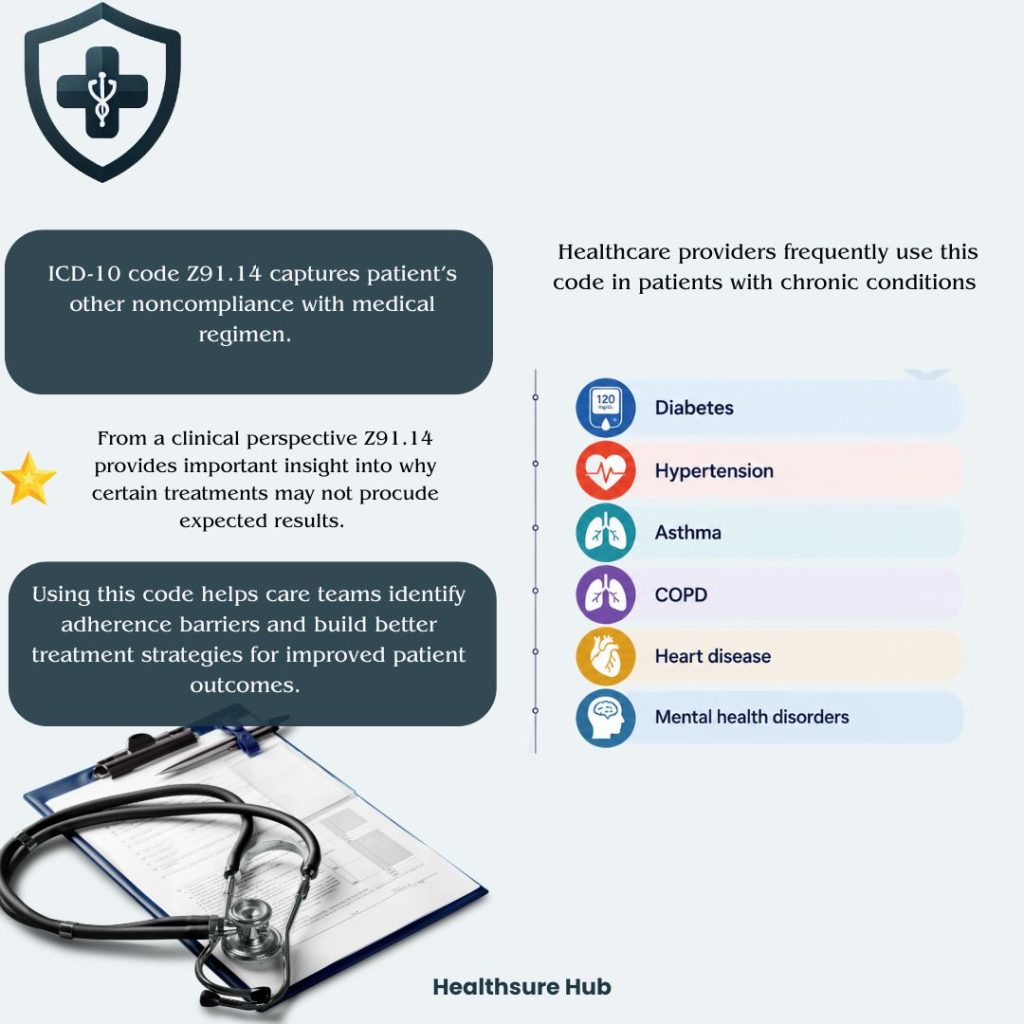
From a clinical standpoint, Z91.14 helps healthcare providers understand one of the most common, and often overlooked, reasons why a treatment plan may not be working as expected: difficulties with taking medication consistently. It shifts the focus from “why isn’t this working?” to “what might be getting in the way for the patient?”
This code is particularly relevant in patients living with long-term conditions such as:
When properly documented, Z91.14 helps care teams identify adherence barriers and develop better treatment strategies.
The use of Z91.14 becomes especially important during high-risk transitions of care where medication adherence significantly affects patient outcomes and overall patient responsibility in medical billing discussions.
Common Clinical Scenarios
Z91.14 is frequently applied in:
- Chronic disease follow-up visits – during regular check-ups for long-term conditions, clinicians may notice that a patient hasn’t been taking their medication as prescribed, which can help explain why symptoms aren’t improving as expected
- Primary care and specialty encounters – in everyday appointments with a family doctor or specialist, this code may be used when it becomes clear that a patient is skipping doses, stopping medication early, or struggling to stay consistent with treatment.
- Transitional care and hospital discharge planning – when patients leave the hospital, providers often consider whether they’ll realistically be able to manage their medication at home, especially if there have been past challenges with following instructions.
- Medication reconciliation and care coordination services – during medication reviews across different providers, gaps or confusion in how a patient is taking their medicines may come to light, highlighting the need for clearer guidance or support.
In each case, the code provides essential insight into factors influencing treatment effectiveness.
Conclusion
ICD-10-CM code Z91.14 is a vital documentation and coding tool that captures medication noncompliance as a factor influencing patient care. While it does not represent a diagnosis, its correct use strengthens clinical records, supports compliance, and enhances data accuracy. By applying this specific ICD-10 code appropriately, healthcare providers and coders help ensure patient care is understood in its full clinical context, leading to better decisions, safer care, and stronger healthcare systems.
About the Author